
Uric acid Quantitative (24-Hours Urine), Uricosuria
Uric acid Quantitative (24-hours urine)
What sample is needed for Uric acid Quantitative (24-hour urine)
- This test is done in the urine.
- Collect urine for 24 hours.
- Discard the first sample (empty the urinary bladder), and then collect all urine samples until 24 hours have passed.
- Also, add the last sample (empty the urinary bladder) to the container.
- Do not refrigerate the urine; add NaOH (10 mL) to keep the urine alkaline.
- If there is no bacterial growth, the urine will be stable at 22 °C to 24 °C for three days.
What are the indications for Uric acid Quantitative (24-hour urine)
- To find if kidney stones are due to high uric acid levels in the body.
- Evaluates uric acid metabolism in gout.
It helps to evaluate the effect of uricosuric drugs.
What are the Precautions for Uric acid Quantitative (24-hour urine)?
- Some drugs increase the uric acid level like:
- Salicylates.
- Diuretics.
- Vitamin C.
- Cytotoxic drugs are used to treat cancers (leukemias and lymphomas).
- Strenuous exercise.
- A diet high in purines.
- Allopurinol decreases the uric acid level.
How would you discuss the pathophysiology of Uric Acid?
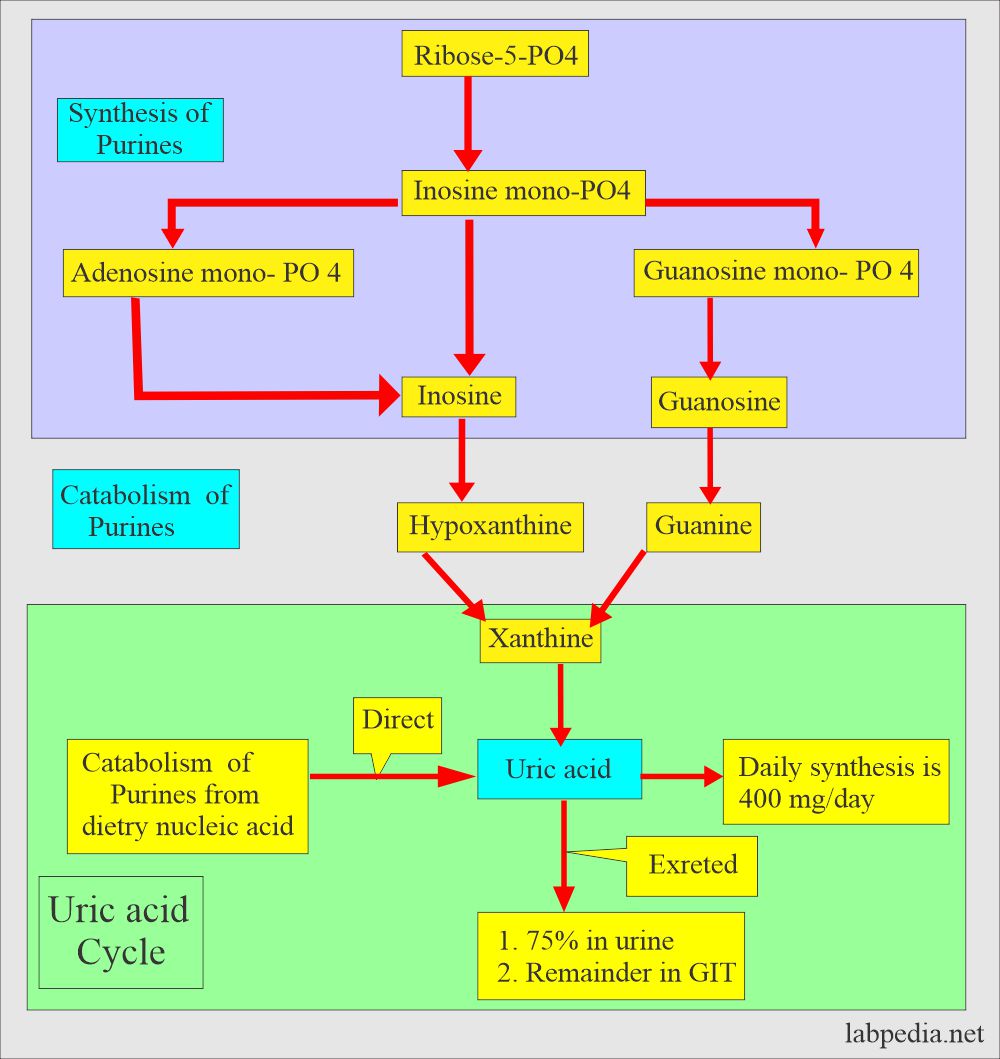
- Uric acid is the major product of catabolism of:
- Purine Nucleosides.
- Adenosine.
- Guanosine.
- Nucleic acid precursors are purines, adenosine, and guanosine.
- Dietary nucleic acid forms purines, directly converted to uric acid.
Uric acid Quantitative (24-Hours Urine): Uric acid metabolism
- Endogenous nucleic acid forms purines; these are excreted as uric acid into the urine.
- Uric acid is readily filtered through the glomerulus.
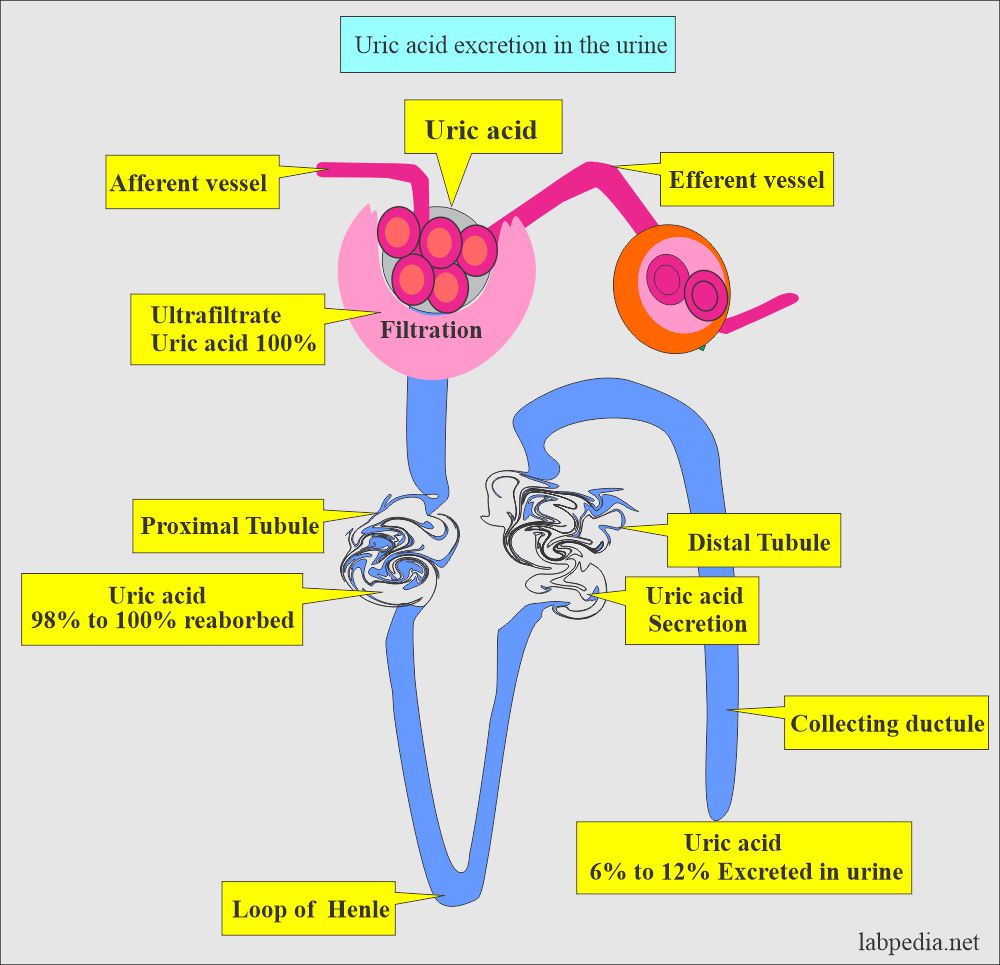
Uric acid excretion from the kidney into the urine
- Uric acid is absorbed + excreted by the kidney; only 6% to 12% of filtrate is uric acid in urine.
- Most of the uric acid is excreted by the kidney and a small amount by the intestinal tract.
- Normally, bacteria degrade 1/3 of the uric acid formed in the intestine.
- Excess of uric acid is related to dietary intake of purines or endogenous uric acid production.
- Uric acid is more soluble at a pH of >5.75.
- Uric acid is undissociated at a pH of <5.75.
- Most uric acid is excreted in the urine, and the rest passes out in the stool.
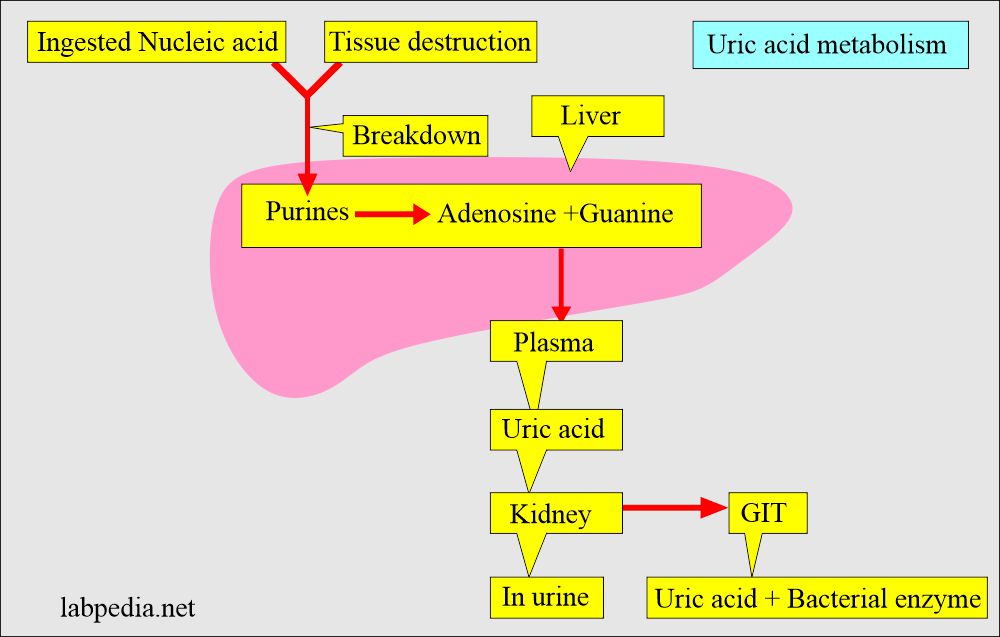
Uric acid metabolism
Does clinically, hyperuricemia may lead to gout?
- This is also called gouty arthritis.
- It appears in common sites in large toes, feet, ankles, knees, and elbows.
- There is severe pain in the joints.
- There is stiffness in the joints.
- There are limited movements of the joints.
- Joints are deformed.
- There are redness and swelling of the joints.
- There may be uric acid deposits called gouty tophi.
- There is a higher chance of the formation of uric renal stones.
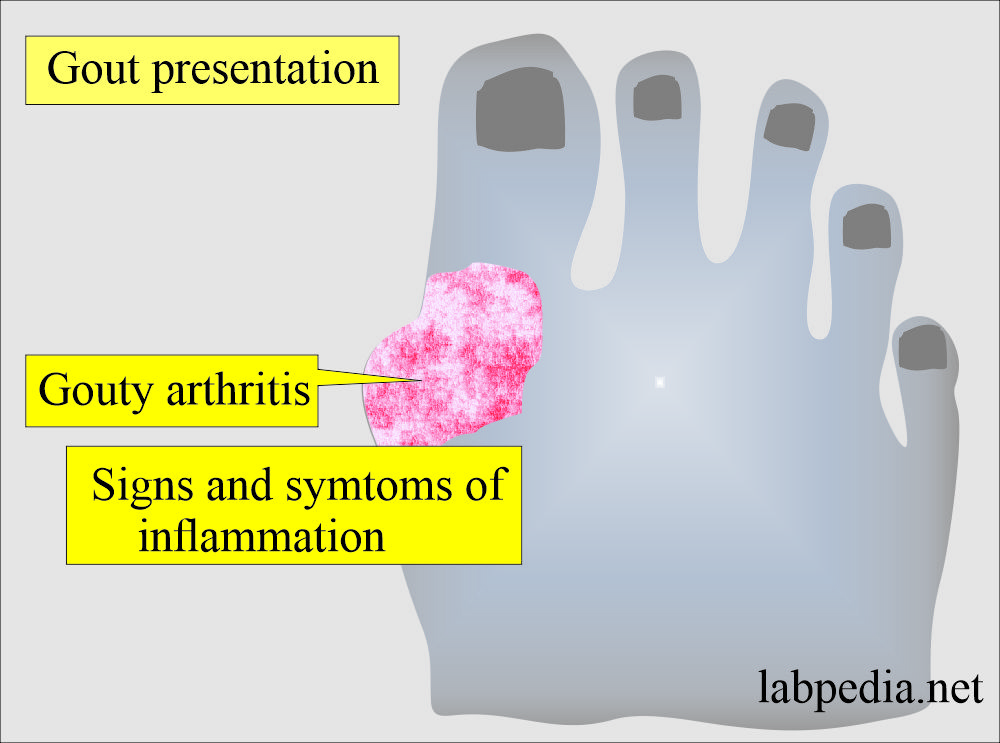
Gout presentation
What is the normal Uric acid in urine for 24 hours?
Source 1
| Diet | mg/day Uric acid (24 hours) |
The average on a
|
|
| Purine free diet | |
|
|
|
|
| Low purine | |
|
|
|
|
| High purine diet | |
|
|
Source 2
- Urine = 250 to 750 mg/24 hours or
- 1.48 to 4.43 mmol/24 hours
Another source
- Men = 250 to 800 mg /24 hours
- Women = 250 to 750 mg /24 hours
- With a purine-free diet = <400 mg / 24 hours.
- With a high purine diet = <1000 mg / 24 hours.
What are the causes of raised urine uric acid levels (Uricosuria)?
- Gout.
- Renal calculi.
- Cancers (widespread disease).
- Chronic myelogenous leukemia.
- Multiple myelomas.
- Viral hepatitis.
- High–purine diet.
- Wilson’s disease.
- Sickle cell anemia.
- Polycythemia vera.
What are the causes of decreased urine uric acid levels?
- Long-term alcohol abuse.
- Chronic glomerulonephritis (chronic kidney disease).
- Lead poisoning.
- Xanthinuria.
- Folic acid deficiency.
- Cytotoxic drugs.
- Eclampsia.
Acidosis (ketotic or lactic).
Normal urine picture:
| Physical features | Chemical features | Microscopic findings |
|
|
|
Questions and answers:
Question 1: At what pH of urine is uric acid soluble?
Uric acid is soluble at pH of >5.75.
Question 2: What is the uric acid major product of catabolism?
Uric acid is the major product of catabolism of purine, adenosine, and guanosine.
there is no way how the calculation done or no guidance for that
There is a slight increase in the SGPT. Please check your viral profile. If negative, take more fruits and check SGPT/SGOT after one month. Oral contraceptives may be the cause.
I have not written the methodology because it varies from different kits.
I have upgraded the topic; now, please see it.
https://labpedia.net/urine-uric-acid-quantitative-24-hrs-urine-sample-uricosuria/