
Mycobacterium Tuberculosis:- Part 3 – Mycobacterium Tuberculosis (AFB) Culture
Mycobacterium Tuberculosis (AFB) Culture
What sample is needed for the AFB culture?
- AFB cultures can be done on sputum.
- Material from other tissues, like the endometrium and chronic ulcers.
- A lung biopsy may be taken when Mycobacterium Tuberculosis is suspected.
- Pleural fluid should be at least 2 mL and refrigerated until culture.
- Bronchial washing should be at least 2 mL and also refrigerated until processed for culture.
What are the Indications for Mycobacterium Tuberculosis Culture (AFB)?
- For the diagnosis of Mycobacterium tuberculosis in the sputum.
- For the diagnosis of TB meningitis.
- For the diagnosis of tuberculosis in other sites like lymph nodes, chronic ulcers, and pleurisy.
- Any patient with a persistent cough, fever, night sweats, anorexia, weight loss, and hemoptysis.
What are the precautions for Mycobacterium Tuberculosis Culture (AFB)?
- Pulmonary tuberculosis can be diagnosed from sputum. Always try to get deep sputum and avoid saliva.
- When tissue is taken from the patient, smear it on slides and stain it while it is fresh.
- Smear sensitivity is low, so culture follows.
What is the microbiology of Mycobacterium Tuberculosis (AFB)?
- Mycobacteria are called acid-fast because, after mordanting with the stain, they resist decolorization by strong acids.
- This staining property is due to the cell wall composition, which has high lipid content.

Mycobacterium Tuberculosis (AFB) Culture: Mycobacterium tuberculosis, AFB stain
- These stain poorly with Gram stain.
- One of the cell lipids forms a complex with acid and mycolic acid.
- Mycobacteria are divided into:
- Fast-growing, which forms colonies in 2 to 3 days.
- Slow-growing, which forms colonies in 1 to 3 weeks.
- The most common AFB is Mycobacterium tuberculosis (TB).
- These pleomorphic, rod-shaped bacteria contain a large amount of mycolic acid in the wall, making them difficult to stain.
- When heat or other agents force carbol fuchsin into the cytoplasm, the bacteria resist decolorization with a dilute acid-alcohol solution. Therefore, they are called acid-fast bacilli.
- Mycobacterium is a Gram-positive and non-motile bacterium.
- These are intracellular pathogens.
- Tuberculosis, M. bovis, M. africanum, and M. microti are all commonly known as Tuberculosis (T B).

Mycobacteria causing various diseases
- Tuberculosis is pathogenic for humans, while M. bovis is usually pathogenic for animals.
- Mycobacteria are:
- Obligate anaerobes that easily grow in the lungs with high oxygen content.
- These are facultative intracellular pathogens, usually involving mononuclear phagocytes.
- These are slow-growing bacteria and may take a few days to weeks.
- These are Hydrophobic with a high lipid content in the cell wall.
- Because the cells are hydrophobic and tend to clump together, they are impermeable to the usual stains, e.g., Gram stain.
- They are known as “acid-fast bacilli” because of their lipid-rich cell walls.
- Once stained, the cells resist decolorization with acidified organic solvents and are therefore called “acid-fast.”
- Morphology:
- These are slender, beaded bacilli and nonsporing.
- Colonies are rough, dry, and yellow in color on the Lowenstein-Jensen medium.
- These are slow-growing bacteria in this medium.
- At least 5000 Acid-fast bacilli must be present in each mL of the specimen to be seen on the microscopic smear.
What are the media for the culture of Mycobacterium tuberculosis?
Solid medium:
- Culture is done using a special culture medium called L. J. (Lowenstein-Jensen) medium.
- LJ medium contains a whole egg, asparagine, glycerol, and material that inhibits the growth of infectious material, such as malachite green.
- Bacilli take 4 to 6 weeks to grow at 37 °C.
- These are obligate aerobes and do not grow on ordinary media.
- This is eugonic growth on the LJ medium.
- Keep the culture for 6 to 8 weeks before discarding the medium.
- Smears from the culture show these AFB as red rods, single or in clusters. Morphologically, these are pleomorphic.
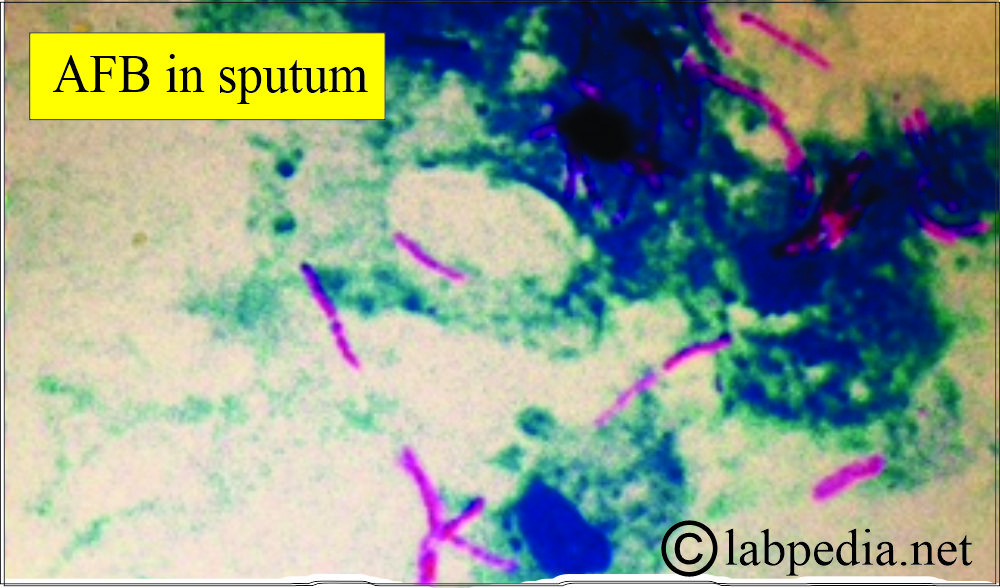
AFB in sputum
Liquid medium:
- These are better than solid media.
- The growth is rapid, and it takes 12 to 16 days instead of 4 to 6 weeks.
- These are more easily contaminated, so they need antimicrobial agents.
- Incubation with additional CO2 is not required.
Automated system:
- Requires continuous monitoring to observe growth for 6 weeks.
Important facts:
- Acid-fast bacilli may be found in tuberculosis caseous material, but tubercle bacilli recover more quickly in sputum.
Questions and answers:
Question 1: What is the principle of AFB stain?
Because of the high lipid content of the cell wall, once Fuchsin enters the cell wall, it will not be affected by acid-alcohol.
Please visit labpedia.net for more topics.