
Mean Corpuscular Hemoglobin (MCH), Mean Cell Hemoglobin
Mean Corpuscular Hemoglobin (MCH)
What sample is needed for Mean Corpuscular Hemoglobin (MCH)?
- This test is done on blood in EDTA (anticoagulant).
What are the indications for Mean Corpuscular Hemoglobin (MCH)?
- It is done as part of blood indices.
- It is done to diagnose anemia. It has limited value in diagnosing anemia.
What are the precautions for Mean Corpuscular Hemoglobin (MCH)?
- Remember that an abnormal RBC size may affect the value.
- The presence of cold agglutinins can cause a falsely elevated value.
- A raised WBC count also affects the value.
How will you define Mean corpuscular hemoglobin (MCH)?
- It is the average amount of hemoglobin inside one RBC.
- Mean corpuscular hemoglobin (MCH) is obtained by dividing hemoglobin by RBC count.
- It represents the average hemoglobin content per RBC.

Mean corpuscular hemoglobin (MCH) calculation
What is the significance of the Mean Corpuscular Hemoglobin (MCH)?
- This is the mean weight of hemoglobin in one RBC.
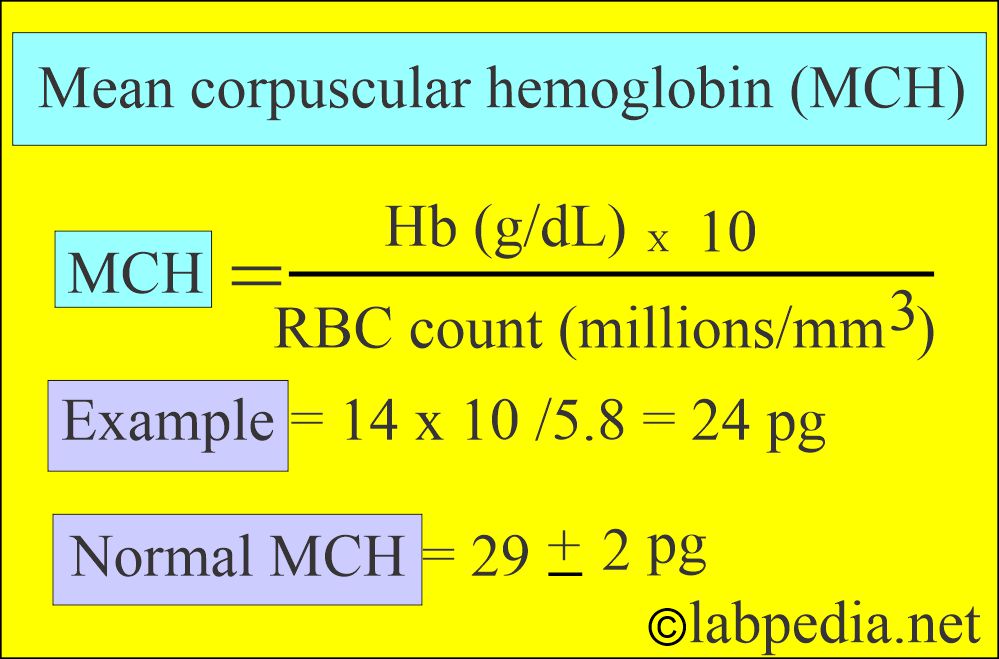
Mean corpuscular hemoglobin (MCH) formula
- MCH and MCHC values determine the hemoglobin content in the RBCs.
- MCH adds very little value to other blood indices.
- The RBC size influences MCH.
- A large RBC with normal hemoglobin will contain a greater weight of hemoglobin than a small RBC with normal hemoglobin.
- MCH also depends upon the amount of hemoglobin in relation to the size of the RBC; for example, hypochromic RBCs have less hemoglobin than normochromic RBCs.
- In short, macrocytosis leads to increased MCH, and microcytosis and hypochromia decrease MCH.
What is the normal value of MCH?
Source 1
| Age | pg/cell | |
| Fetal blood | ||
|
43.14 ± 2.7 | |
|
41.39 ± 3.32 | |
|
40.48 ± 2.88 | |
|
37.04 ± 3.67 | |
| Infants and Child | ||
|
31 to 37 | |
|
30 to 37 | |
|
29 to 36 | |
|
27 to 34 | |
|
25 to 32 | |
|
24 to 30 | |
|
25 to 30 | |
|
24 to 30 | |
|
22 to 30 | |
|
25 to 31 | |
|
25 to 31 | |
|
26 to 32 | |
| Adult/Children | Male | Female |
|
26 to 32 | 26 to 32 |
|
27 to 32 | 26 to 34 |
|
27 to 37 | 27 to 34 |
|
27 to 35 | 27 to 34 |
|
27to 34 | 27 to 35 |
Source 2
- Adult = 27 to 31 pg (picograms).
- Newborn = 32 to 34 pg (picogram)
Another source
- 26 to 34 pg
How will you interpret MCH values?
| MCH | MCH value |
|
|
|
|
|
|
What conditions will interfere with estimating Mean Corpuscular Hemoglobin (MCH)?
- Lipemia.
- Cold agglutinins.
- Increased white blood cells (Leucocytosis = >50,000/cmm).
- In vivo hemolysis.
- In case of high heparin concentration.
- Monoclonal proteins in the blood.
What are the causes of increased Mean corpuscular hemoglobin (MCH)?
- Macrocytic anemia and in newborns.
- Vitamin B12 deficiency.
- Infants and newborns.
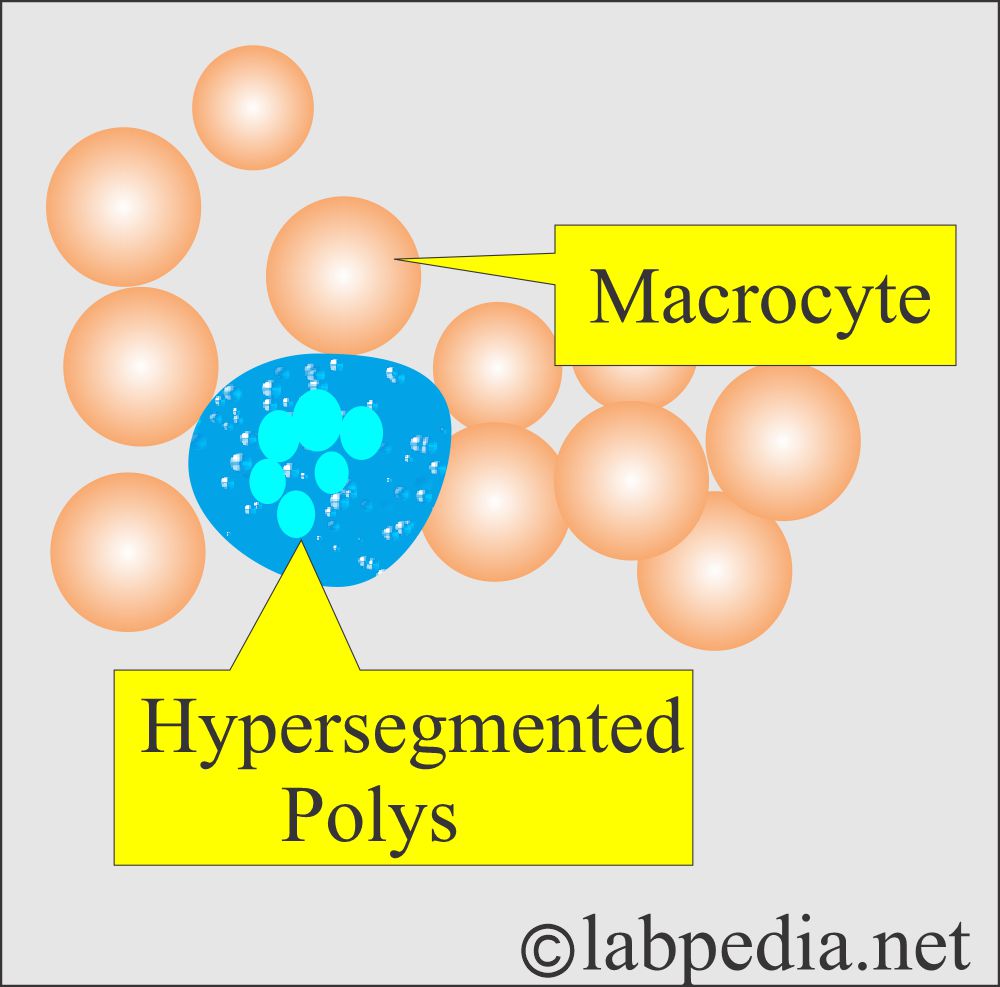
Macrocytosis seen in megaloblastic anemia
What are the causes of decreased Mean Corpuscular Hemoglobin (MCH)?
- Microcytic anemia (iron deficiency anemia).
- Hypochromic anemia.
- Thalassemia.
- Some chronic diseases.
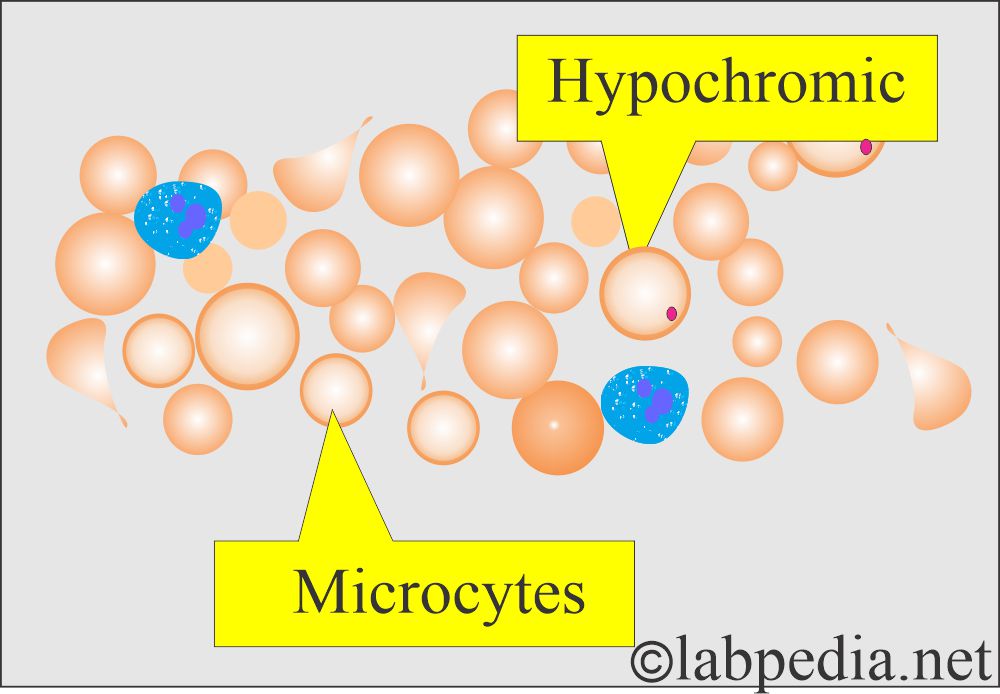
Microcytic hypochromic RBC indicating low MCH
Questions and answers:
Question 1: What is the value of MCH for the diagnosis of anemia?
MCH has little value for the diagnosis of anemia.
Question 2: What is an effect of hemolysis on MCH?
Hemolysis interferes with the estimation of MCH.
Please visit labpedia.net for more topics.
Very well explained Sir.