
Malarial parasite:- Part 2: – Plasmodium Falciparum, Blackwater Fever
Plasmodium Falciparum
What sample is needed for the diagnosis of Plasmodium Falciparum?
- Malarial parasites (MP) may be detected in a patient’s blood smear.
- The best time to make a smear is during shivering.
- Make thick and thin blood smears.
- Serum is needed for serological methods and PCR.
How will you define Plasmodium falciparum?
- This is the most common type in the tropics.
- It causes a fever every 48 hours. This is the deadliest type of malaria and causes blackwater fever.
- It can infect all stages of RBC maturation.
What are the important facts about Plasmodium Falciparum?
- Plasmodium falciparum is most common (≈45%) in the tropics and the United States.
- Epidemiology of Plasmodium falciparum:
- 90% of cases occur in Africa,
- 40% to 50% of cases in the Western Pacific and SE Asia,
- 4% to 30% in S. Asia, S. America, and the rest of the tropics.
- P. Falciparum is responsible for the majority of malaria deaths globally.
- This is the most prevalent species in sub-Saharan Africa.
- This can infect RBCs of any age.
- Young RBCs are more vulnerable.
- RBCs are not usually enlarged or distorted, as seen in P. vivax and P. ovale.
- As all RBC ages are involved, there is a large amount of toxic cellular material and capillary plugging.
- Only ring form and gametocytes are seen in the smears.
- Only the ring form and the gametocytes are seen in the peripheral blood.
What is the exoerythrocytic cycle of Plasmodium Falciparum?
- P. falciparum schizont grows in the liver cells.
- It is more irregular in shape than P. vivax, with projections extending in all directions by the fifth day.
- After rupture, it releases about 30,000 merozoites.
- There may be remission of up to one year.
- These merozoites can infect RBCs of any age, including reticulocytes, leading to very high parasitemia.
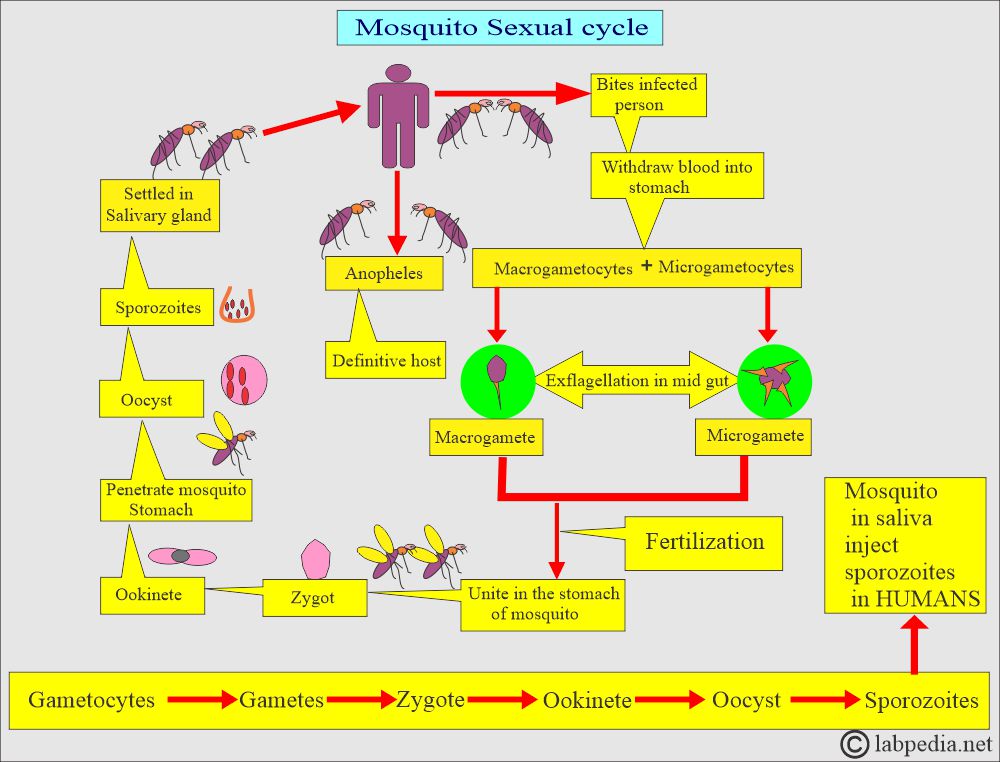
Plasmodium Falciparum: MP sexual cycle
What is the erythrocytic cycle of Plasmodium Falciparum?
- Merozoites infect all RBC ages and reticulocytes.
- There is sequestration of the RBCs in the capillaries of the brain, spleen, and bone marrow.
- The early ring form trophozoite is the smallest of any Plasmodium type.
- Schizonts are less symmetrical than any of the other forms.
- It forms 8 to 32 merozoites and is usually 16 in number.
- The erythrocytic cycle takes 48 hours.
- There is a high level of parasitemia, with more than 65% of the RBCs containing parasites.
- The 25% involvement of RBCs is fatal.
- Only young trophozoites, such as ring form and gametocytes, are seen in the peripheral blood.
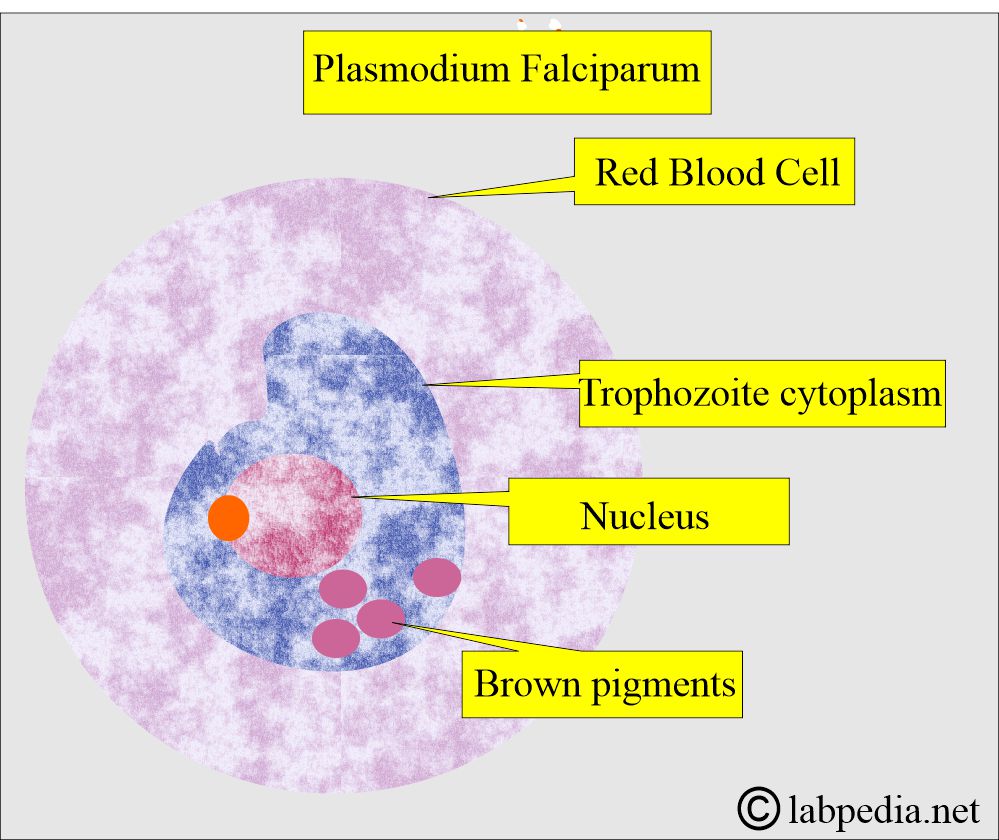
Plasmodium Falciparum trophozoite
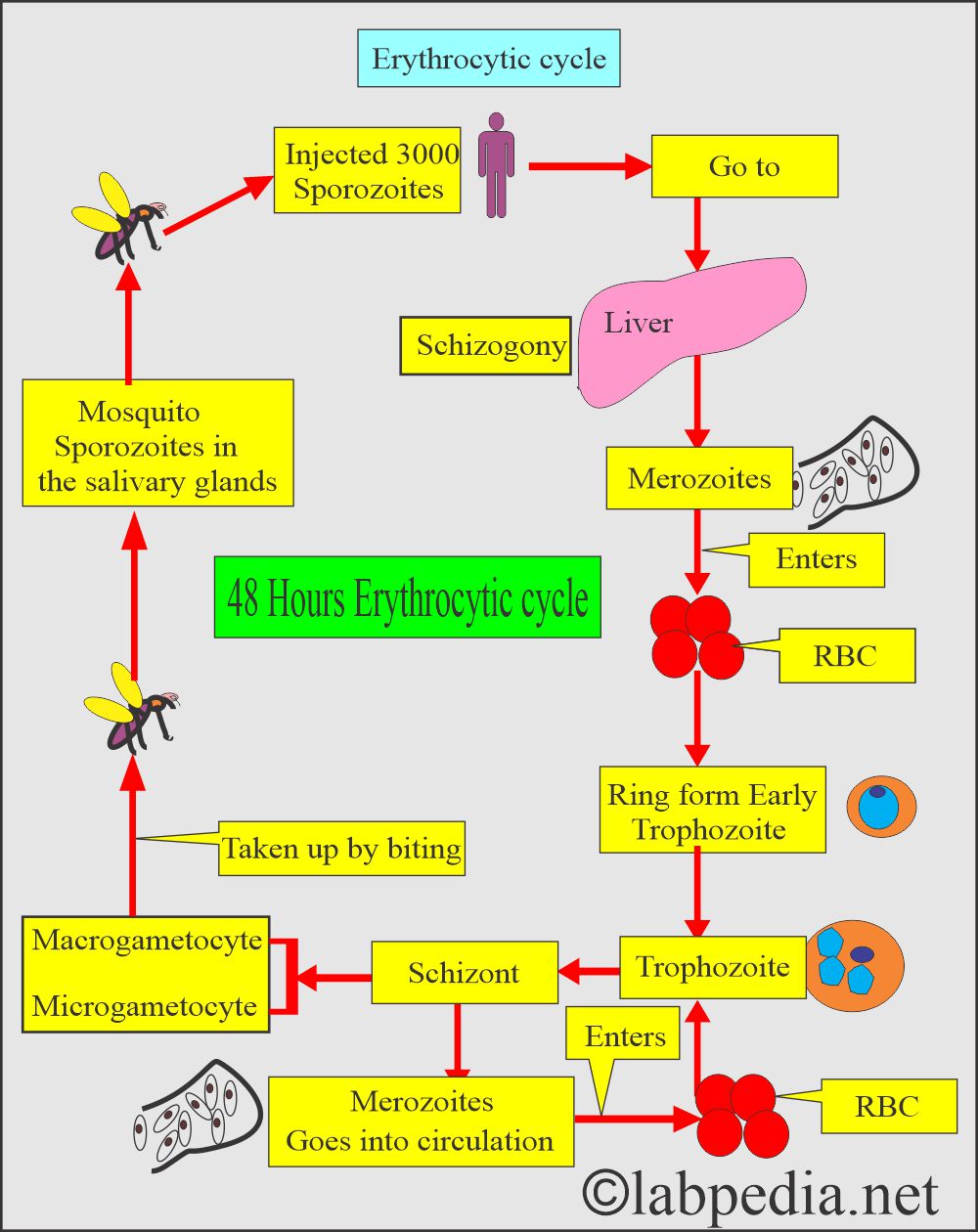
Plasmodium Falciparum (MP) erythrocytic cycle
How will you discuss the clinical presentation of Plasmodium Falciparum?
- There may be early flu-like symptoms.
- This is the most fatal and threatening of the other types.
- The incubation period is short, 7 to 10 days.
- There are episodes of chills and fever.
- There will be nausea and vomiting.
- There will be diarrhea.
- There are muscle aches and pain.
- These symptoms are cyclical for 36 to 48 hours.
Blackwater fever:
What is Blackwater fever or malignant tertian malaria?
What is the mechanism of injury to the RBCs?
- Acute intravascular hemolysis causes hemoglobinuria (Blackwater fever).
- When this parasite enters the kidney, brain, and liver.
- Infected RBCs develop a sticky-knobby appearance leading to the sludging of the RBCs and causing infarction of the brain, kidneys, and other organs.
What are the signs and symptoms of Blackwater fever?
- Cerebral malaria is only caused by Plasmodium falciparum. These patients will have cerebral signs and symptoms and may go into a coma.
- There is marked hemoglobinuria.
- Plasmodium Falciparum, when severe, gives rise to:
- Coma.
- Breathing difficulties.
- Low blood sugar.
- Low hemoglobin leads to anemia.
- Children are more prone to develop cerebral malaria.
- Untreated, severe malaria can lead to death.
How will you diagnose Blackwater fever?:
- For the diagnosis, a smear will show banana-shaped parasites.
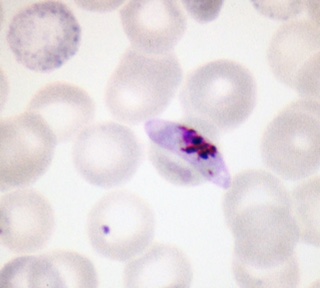
Mature Gametocyte
How will you protect from Plasmodium falciparum (Blackwater fever)?
- Sickle cell anemia and thalassemia confer protection against Plasmodium falciparum.
- These RBCs rupture before the merozoites mature inside these RBCs.
What are the complications of Plasmodium Falciparum?
- There may be acute renal failure.
- Other possibilities are tubular necrosis and nephrotic syndrome.
- The brain is involved with plug formation in the capillaries and causes cerebral malaria.
- The patient goes into a coma, followed by death.
- There may be pulmonary edema.
- There is severe anemia.
How will you diagnose Plasmodium Falciparum?
- Make thick and thin blood smears.
- Gametocytes are readily identified.
- Take a smear every 6 to 12 hours for another 48 hours.
- Advise serological tests.
- PCR.
How will you control mosquitoes?
- Try to eliminate breeding places:
- Fill the vacant land and pump out the water.
- Remove the junk and water-retaining debris.
- Destroy the larvae:
- Clean the drains.
- Try to remove algae from the ponds.
- Add larva-eating fish to the ponds.
- Use of insecticide:
- The best example is DDT.
- Use of mosquito repellent:
- Pyrethroid repellent.
- N, N- diethyl meta tolbutamide.
- Use of mosquito nets.
- Use of clothes to prevent mosquito bites.
- Train people on malaria prevalence.
- Train people in malaria detection, treatment, and follow-up.
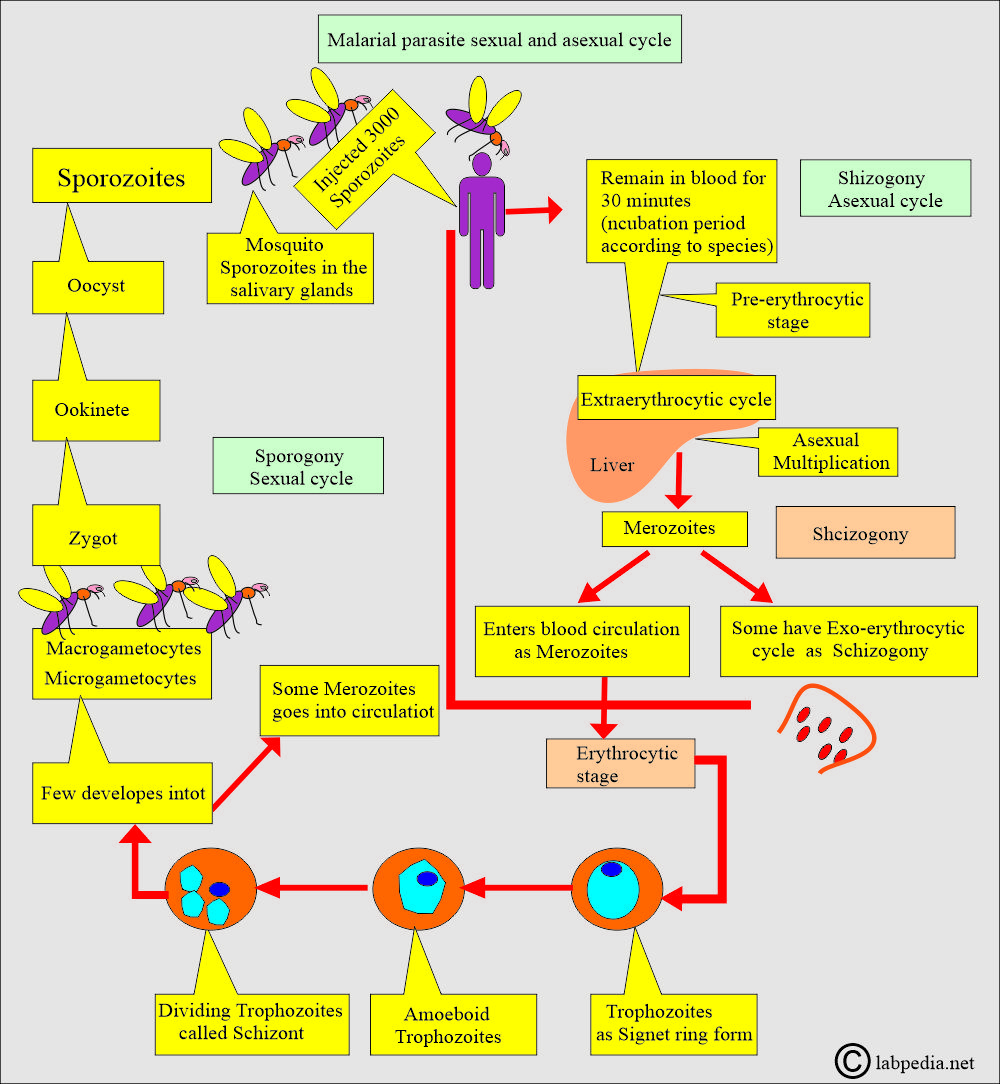
Malarial Parasite (MP) sexual and asexual cycle
How will you treat Plasmodium Falciparum?
- For uncomplicated cases, one can use:
- Artemether + Lumifantrin = Commonly used first line of action.
- Artesunate + Amdiquine.
- Artesunate + Mefloquine.
- Dihydroartemisinin + Piperaquine.
- In severe Plasmodium falciparum, give I/V Artesunate.
- Antimalarial drugs are quinidine, chloroquine, primaquine, pyrimethamine, sulfadoxine, mefloquine, tetracyclines, and proguanil.
- Chloroquine is the drug of choice and is best for P. falciparum.
- This is effective for the erythrocytic stage and not for the liver stage.
- Must use primaquine to eradicate P. ovale and P. vivax.
- There are chloroquine-resistant cases of P. falciparum.
- Amodiaquine, piperaquine, and pyronaridine are close to chloroquine.
- In some areas, Amodiaquine is less toxic, cheaper, and more effective than chloroquine against chloroquine-resistant P. falciparum.
- Mefloquine is effective against chloroquine-resistant P. falciparum.
- Quinine and quinidine are still the first lines of therapy against P. falciparum.
- Primaquine is a synthetic drug and is the drug of choice for eradicating the liver stage from P. vivax and P. ovale.
- Antibiotics and Inhibitors of folate synthesis are slow-acting antimalarial drugs.
- Halofantrine and lumefantrine are related to quinine and are effective against the erythrocytic stage.
- Malaria drug-resistant strains are emerging.
Duration of the various cycles in malarial parasites:
| Type of malarial parasite | Sexual cycle in the mosquito | Length of asexual cycle | Length of the sexual cycle |
|
9 to 10 days | 5 to 7 days | 36 to 48 hours |
|
8 to 9 days | 8 days | 48 hours |
|
14 days | 9 days | 48 hours |
|
15 to 20 days | 15 to 16 days | 72 hours |
Questions and answers:
Question 1: What is blackwater fever?
When plasmodium falciparum involves the brain, kidneys, and liver.
Question 2: What is the typical shape of a gametocyte of Plasmodium falciparum?
The typical picture of a gametocyte is banana-shaped.
Please see more details on labpedia.net.