
Magnesium level (Mg++)
Magnesium level (Mg++)
What sample is needed for Magnesium level (Mg)?
- This test is done on the patient’s serum (3 to 5 mL of clotted blood).
- A fasting sample is preferred.
- Collect blood in the metal-free container.
- Separate the red cells immediately.
- Hemolysis interferes with the test. This may give a falsely high value.
- Magnesium is Stable in blood for 3 hours and in serum at 2 to 8 °C for 8 hours.
- Separate the serum as soon as possible (within 45 minutes).
- Collect the sample in the prone position, as an upright position may increase magnesium by 4%.
What are the precautions for Magnesium level (Mg)?
- Avoid hemolysis, as it can give a falsely high value.
- Some drugs that can cause low values include diuretics, insulin, and antibiotics.
- A few drugs that can cause high values include antacids, calcium-containing medicines, laxatives, and thyroid medicines.
- A fasting sample is preferred.
- Avoid venous stasis.
What are the Indications for Magnesium level (Mg)?
- To evaluate renal function.
- To evaluate the electrolytes.
- To evaluate magnesium metabolism to find deficiency or overload.
How will you describe the pathophysiology of Magnesium level (Mg)?
- Magnesium is the fourth most abundant cation in the body, after sodium, potassium, and calcium.
- Mg++ concentration in the cell is second to Potassium.
- Extracellular concentration is much lower.
- 30% of Mg++ in plasma is bound to albumin.
- 70% Mg++ exists as the ion Mg++.
- The majority of magnesium is intracellular.
- Magnesium is stored in:
- Bone 40% to 60%.
- Within the cells, 30%.
- Muscles 20%.
- Serum 1% (RBC).
- The distribution of magnesium in the body is as follows:
- Skeleton =55%
- Soft tissue = 45%
- Extracellular fluid = 1%
- Total weight in grams = 25 G
- Magnesium in the serum:
- 55% is free.
- 33% Associated with the protein (mainly albumin).
- 15% Complexed with PO4, citrate, and other anions.
- Magnesium intracellular and extracellular are shown in the following diagram.
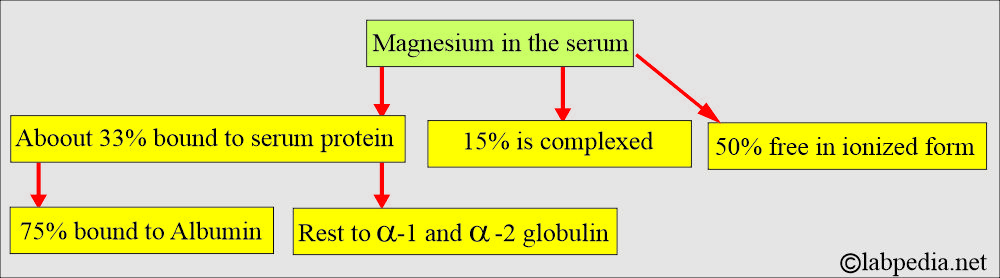
Magnesium level (Mg++): Magnesium in the serum
- Another source:
- 50% is present in the soft tissues, 50% in the bone, and about 1% to 5% is extracellular.
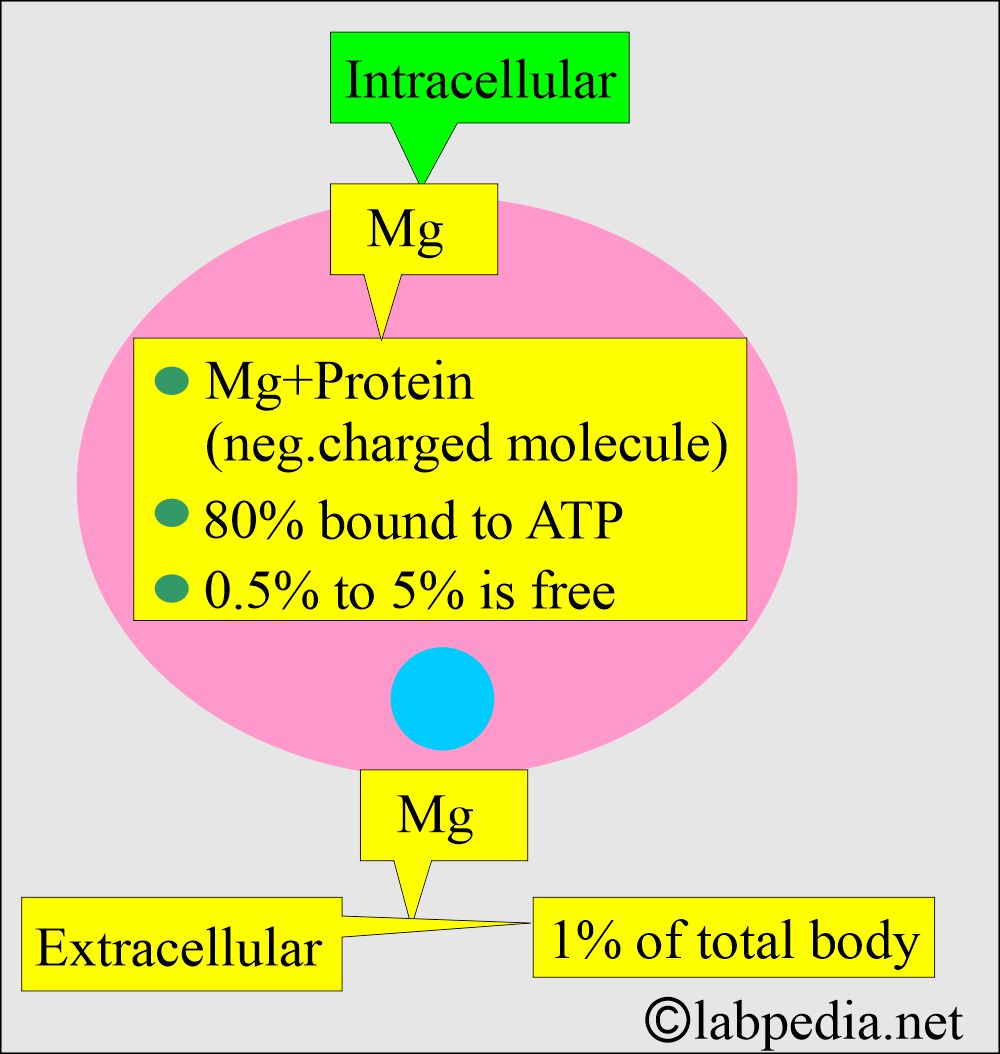
Magnesium level (Mg++): Magnesium in cells and extracellular
How is magnesium absorbed, and what are the sources?
- Meat.
- Green vegetables.
- It is absorbed in the upper intestine (small intestine).
- About 1/3 is absorbed in the small intestine.
- 50% is absorbed by active transport or passive diffusion in the jejunum and ileum.
- Vitamin D is not needed for absorption.
- The majority of the Mg is not absorbed because of the formation of insoluble phosphates and soaps in the gut.
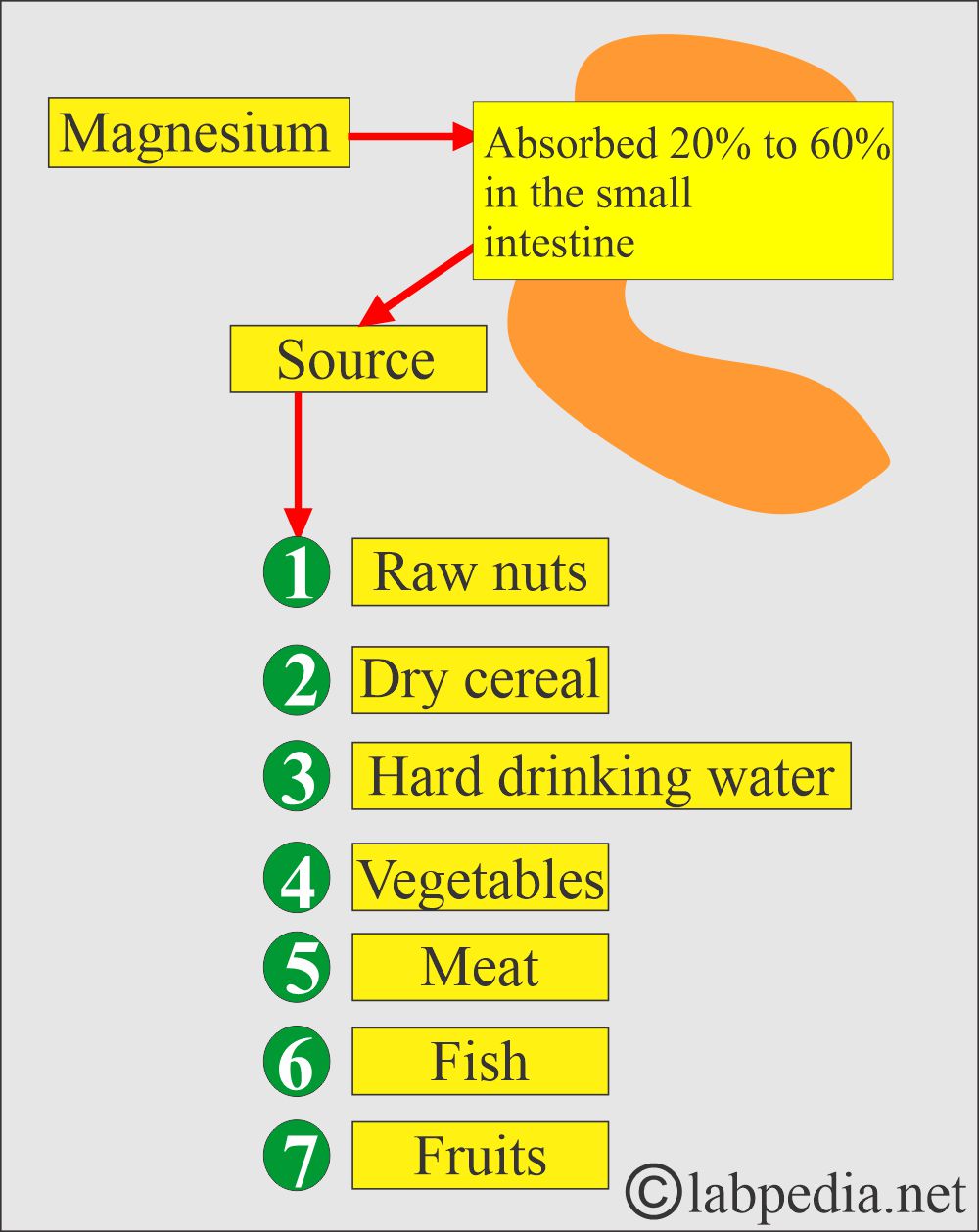
Magnesium source
- The average human being weighing 70 Kg will have 24 grams of magnesium.
How will the excretion of magnesium be?
- Magnesium is excreted by the kidneys, primarily by glomerular filtration.
- Some tubular reabsorption also takes place.
- Parathyroid hormone (PTH) is an important regulator of blood magnesium levels. It occurs via reabsorption of magnesium in the renal tubules.
- When the serum magnesium is low, it leads to increased neuromuscular excitability because magnesium competes and inhibits calcium entry into neurons.
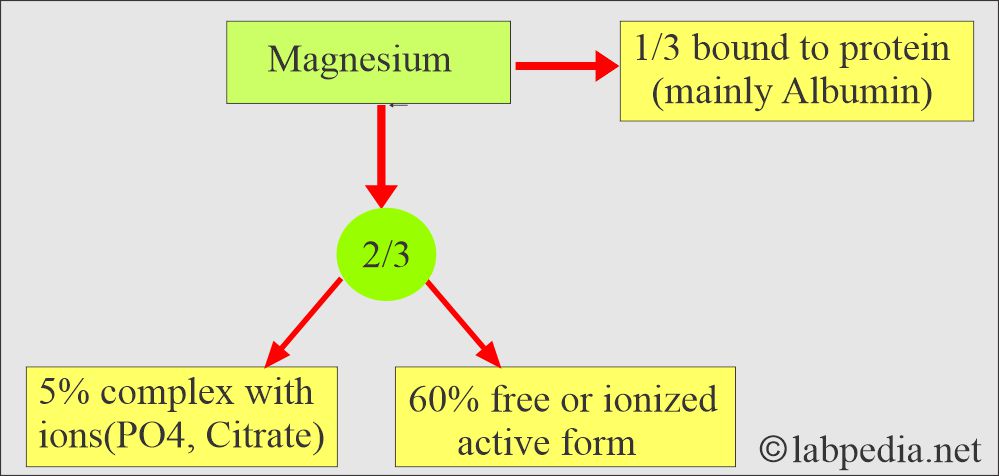
Magnesium distribution in the body
What are the functions of Magnesium?
- Magnesium’s role in biosynthesis of:
- Magnesium cofactor for >300 enzymes in the body.
- Magnesium is important for protein synthesis and enzyme activation.
- Magnesium is also important for oxidative phosphorylation.
- Magnesium’s Role in Neurons:
- Mg++ is important for neuromuscular excitability.
- It has an important role in smooth muscle contraction and relaxation.
- In cardiac patients, low magnesium levels increase cardiac muscle irritability and may lead to arrhythmias.
- Mg++ has a synergistic effect with sodium, calcium, and potassium ions.
- It is important for the clotting mechanism.
- It has an important role in:
- Oxidative phosphorylation.
- Glycolysis.
- Cell replication.
- Protein Biosynthesis.
- Nucleotide metabolism (nucleic acid synthesis).
- Contraction of the muscular tissue.
- It is important for the action of ATP (adenosine triphosphate). It is bound to the ATP molecule.
- It takes part in phosphorylation, which is the main source of energy.
How is the Magnesium absorption/Excretion?
- The kidney is the organ that balances Mg++.
- The kidney will conserve when intake is low and excrete excess when intake is high.
- In a damaged kidney with decreased renal function, magnesium may be retained in the body and increase the serum magnesium level.
- Aldosterone promotes the excretion of Mg++ together with K+ and the retention of Na+.
- Magnesium helps with the absorption of calcium from the intestine.
- Magnesium deficiency mobilizes calcium from the bones.
- Magnesium deficiency may lead to abnormal calcification in the aorta and kidneys.
What are the normal values of Magnesium level (Mg++)?
Source 1
| Age | mg/dL |
|
|
|
|
|
|
|
|
|
|
|
|
|
|
|
|
- To convert into SI unit = 0.4114 = mmol/L
Source 2
- Adults = 1.3 to 2.1 meq/L (1.8 to 2.6 mg/dL).
- Child = 1.4 to 1.7 meq/L (1.7 to 2.1 mg/dL).
- Newborn = 1.4 to 2.0 meq/L (1.5 to 2.2 mg/dL).
What are the causes of increased magnesium (Hypermagnesemia)?
- Antacids.
- Enemas.
- Parenteral therapy in patients with renal failure.
- Administration of Mg++ in a patient with renal failure.
- This raised serum magnesium leads to the following:
- Decreased neuromuscular transmission (depression of neuromuscular system).
- Decreased cardiac conduction.
- Slow, deep tendon reflexes.
- Respiratory depression.
- Magnesium-containing antacids may increase the magnesium level.
- Hemolyzed sample.
What are the signs and symptoms of increased magnesium (Hypermagnesemia)?
- Lethargy.
- Slurred speech.
- Nausea and vomiting.
- Muscle weakness.
- Deep tendon reflexes disappear at a level between 5 and 9 mg/dL.
- Depressed respiration is seen at 10-12 mg/dL.
- Hypotension.
- Bradycardia.
- Cardiac arrest at a higher level.
- ECG shows typical changes as follows:
- Tall T wave.
- Widened QRS.
- Flattened P wave.
- Increased PR interval.
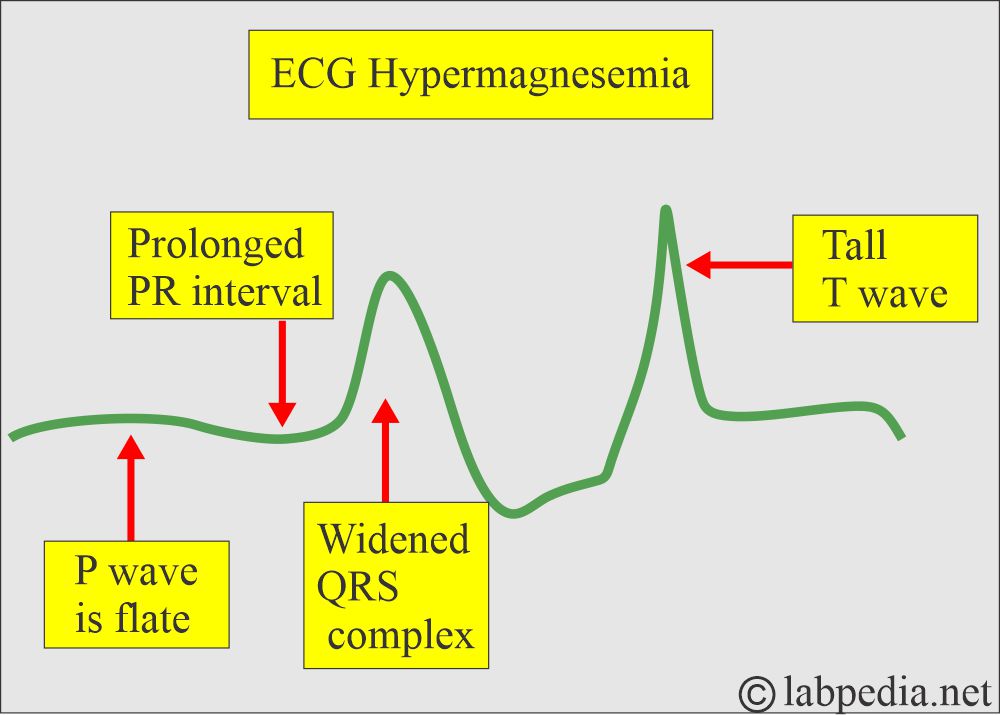
ECG in Hypermagnesemia
What are the causes of low magnesium (Hypomagnesemia) and magnesium deficiency?
- Low magnesium is seen in:
- Hospitals.
- Intensive care units.
- Alcohol abuse increases the loss of magnesium in the urine.
- Malabsorption.
- I/V fluid therapy without magnesium.
- Hemodialysis.
- Diabetic ketoacidosis.
- Severe diarrhea.
- Hypercalcemia.
- Congestive heart failure.
- Some of the medicines, like thiazide diuretics, Cyclosporin, Cisplatin, and gentamicin.
What causes increased magnesium (Mg++, hypermagnesemia) >2.5 meq/L?
- Oral intake of Mg++ in the presence of chronic renal failure.
- Renal failure and oliguria.
- Dehydration.
- Addison’s disease.
- Diabetes mellitus uncontrolled (rare).
- Antacids containing magnesium.
- Hypothyroidism.
- Multiple myelomas.
- The enema contains Mg++.
- Treatment of Mg++ deficiency.
What is the complication of Hypermagnesemia?
- It may cause respiratory paralysis and cardiac arrest.
What are the signs and symptoms of low magnesium (Mg++)?
- Low magnesium levels may lead to:
- Neuromuscular irritability with tetany and seizures.
- This is because Mg++ inhibits the entry of calcium into neurons.
- Cardiac arrhythmias may be seen. This may be related to hypokalemia and intracellular potassium depletion, secondary to magnesium deficiency.
- Tachycardia and hypotension.
- Increased reflexes.
- Muscle cramps.
- Nystagmus.
- ECG changes are difficult to document in low Mg++, which is associated with other electrolyte imbalances, such as hypokalemia and hypocalcemia.
What causes decreased Magnesium (Mg deficiency) <1.0 meq/L?
- Malabsorption (Kwashiorkor).
- Malnutrition (a diet low in protein intake).
- Prolonged nasogastric suction.
- Extensive bowel resection.
- Acute and chronic diarrhea.
- Intestinal and biliary fistula.
- Neonatal primary hypomagnesemia.
- Cirrhosis.
- Hypoparathyroidism.
- Hyperaldosteronism.
- Alcoholism, chronic.
- Chronic renal tubular disease.
- Chronic pyelonephritis.
- Interstitial nephritis.
- Glomerulonephritis.
- Renal tubular acidosis.
- Postrenal transplantation.
- Phosphate depletion.
- Hypercalcemia of any cause (Hyperparathyroidism).
- Hemodialysis.
- Chronic pancreatitis.
- Long Term I/V therapy,
- Diabetic acidosis.
- Idiopathic cause.
- Drugs:
- Diuretic therapy (furosemide).
- Cisplatin.
- Cyclosporin.
- Amphotericin B.
- Cardiac glycosides.
- Increased Excretion by the kidney:
- Tubular disorder.
- Pyelonephritis.
- Glomerulonephritis.
- Excess lactation.
- Pregnancy.
What are the complications of Hypomagnesemia (Mg++)?
- There are tetany, delirium, agitation, muscle weakness, and, ultimately, cardiac arrhythmias.
- There may be decreased levels of Calcium, Phosphate, and Potassium.
What are the critical values of Magnesium?
- Hypomagnesemia = <1.2 mg/dL (< 0.5 meq/L); there may be tetany.
- Hypermagnesemia = > 5.0 mg/dL (> 3 meq/L).
Questions and answers:
Question 1: What is the level of hypomagnesemia?
Patients will show S/S when the magnesium level is <1.2 mg/dL.
Question 2: What is the raised critical level of magnesium?
The patient will show S/S when the magnesium level is >5.0 mg/dL.
Please visit labpedia.net for more topics.