
Liver:- Part 1 – Bilirubin Metabolism, and Jaundice
Bilirubin Metabolism
What sample is needed for serum bilirubin?
- It is done on the patient’s serum.
- Heparinized plasma can be used.
- A random sample can be taken.
- The serum is stable for 3 days at 1 to 6 °C.
What are the precautions for serum Bilirubin?
- Avoid hemolysis.
- A fasting sample is preferred for bilirubin.
- Protect serum or plasma from the light.
- Lipemia also falsely increases the value.
What are the Indications for serum bilirubin?
- LFT diagnoses any liver disease.
- LFT has been done to follow up with the patient on treatment.
- LFT is done routinely in patients on chemotherapy.
- LFT may be advised in a patient on antituberculous treatment.
What tests are included in routine LFT?
- Bilirubin.
- Bilirubin total
- Bilirubin is direct and indirect.
- SGPT.
- SGOT.
- Alkaline phosphatase
- Total protein.
- Albumin.
What are the additional liver function tests?
- γ – GT (gamma – GT)
- Viral hepatitis profiles like HBV, HCV, HAV, HDV, HEV, etc.
What are the steps in the diagnosis of Jaundice?
- Clinical history and examination of the patient.
- Stool examination for ova and parasites.
- Occult blood in the stool is positive for cancers.
- Urine examination:
- The persistent absence of urobilinogen indicates obstructive jaundice.
- Bilirubinuria is an early sign of viral hepatitis.
- Negative urobilinogen and bilirubin indicate hemolytic anemia.
- Dark urine and clay-colored stool indicate hepatocellular or cholestatic jaundice.
- Advise biochemical tests like LFT, serum albumin, alkaline phosphatase, γ-GT, PT, total proteins, and immunoglobulin quantitation.
- Hematological work-ups like CBC, reticulocytes, and Coombs’ test.
- Serological tests include ANA, Mitochondrial antibody, IgG, IgA, IgM, hepatitis viral profile, and AFP.
- Radiology includes X-rays, plain X-ray of the abdomen, USG, and CT scans.
- Special tests like α1-antitrypsin, amylase, ceruloplasmin, iron, and IBC.
- Needle biopsy or FNA.
How will you discuss the functions of the liver?
- The liver is a multifunctional organ involved in various functions, such as excretory, synthesis, detoxification, storage, and metabolism.
- It can store (storage function):
- Amino Acids.
- Carbohydrates.
- Lipids.
- Vitamins.
- Minerals.
- It can synthesize (metabolic function):
- Proteins, like albumin, alpha globulins, and beta globulins.
- Coagulation factors.
- Transport proteins.
- Bile acids from cholesterol.
- The liver is the site for detoxification of:
- Drugs.
- Toxins.
- Its major function is Conjugation:
- Bilirubin combines with glucuronic acid as:
- Bilirubin Monoglucuronide.
- Bilirubin diglucuronide.
- Bilirubin combines with glucuronic acid as:
- The liver has an excretory function:
- Excrete bilirubin into bile.
- Bile acids are excreted into the bile.
- The liver is also the site of catabolism of:
- Thyroid hormone.
- Steroid hormones.
- A few other hormones as well.
How will you discuss Bilirubin metabolism?
What are the changes in the mononuclear phagocytic system?
- The breakdown of the RBCs is a major source for forming Globin and heme.
- Heme changes into Biliverdin and releases iron, recycled to form RBCs in the bone marrow.
- Biliverdin forms the unconjugated bilirubin, which is fat-soluble.
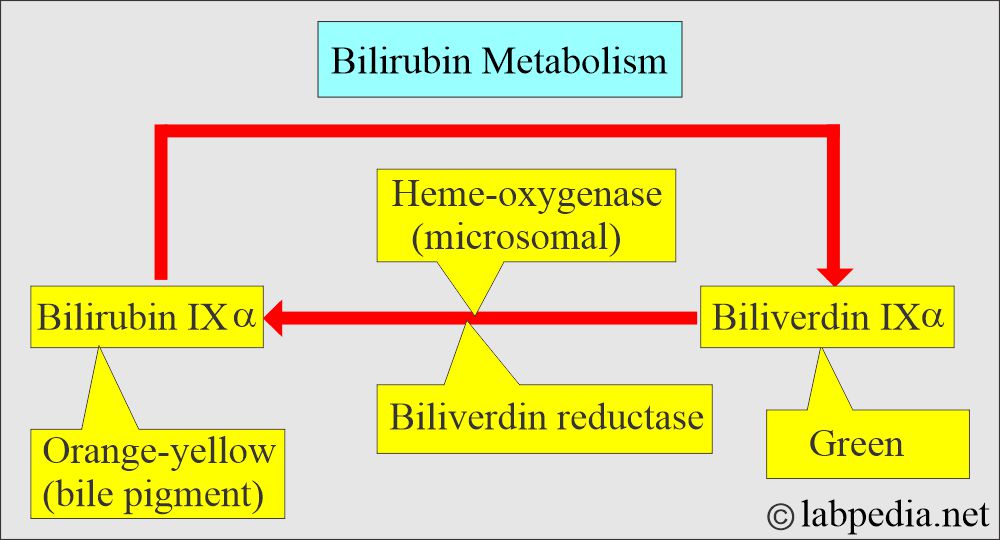
Formation of unconjugated bilirubin
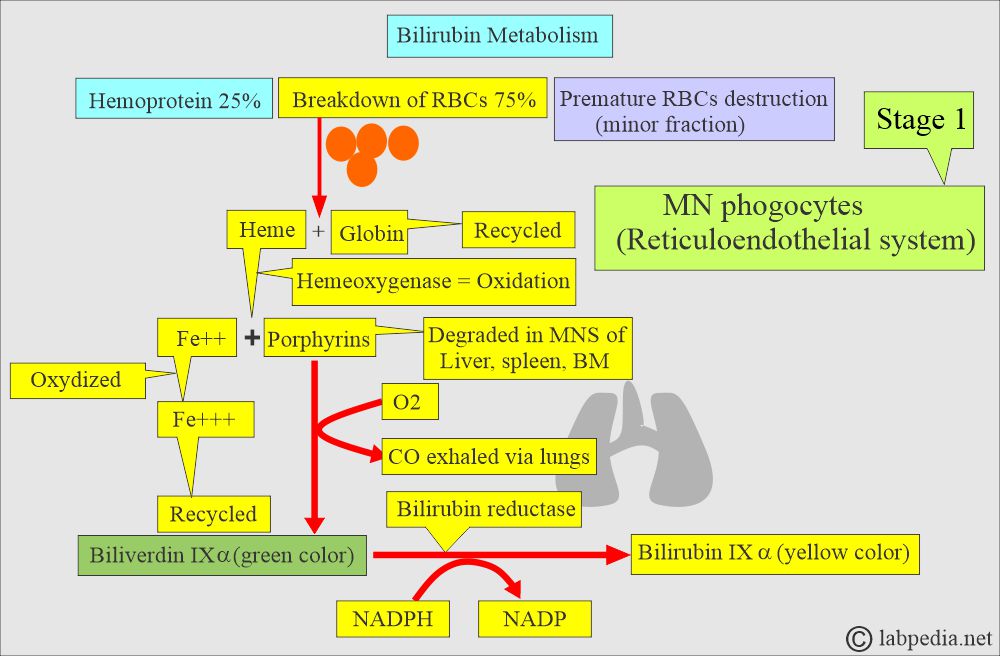
Bilirubin first stage in MNS
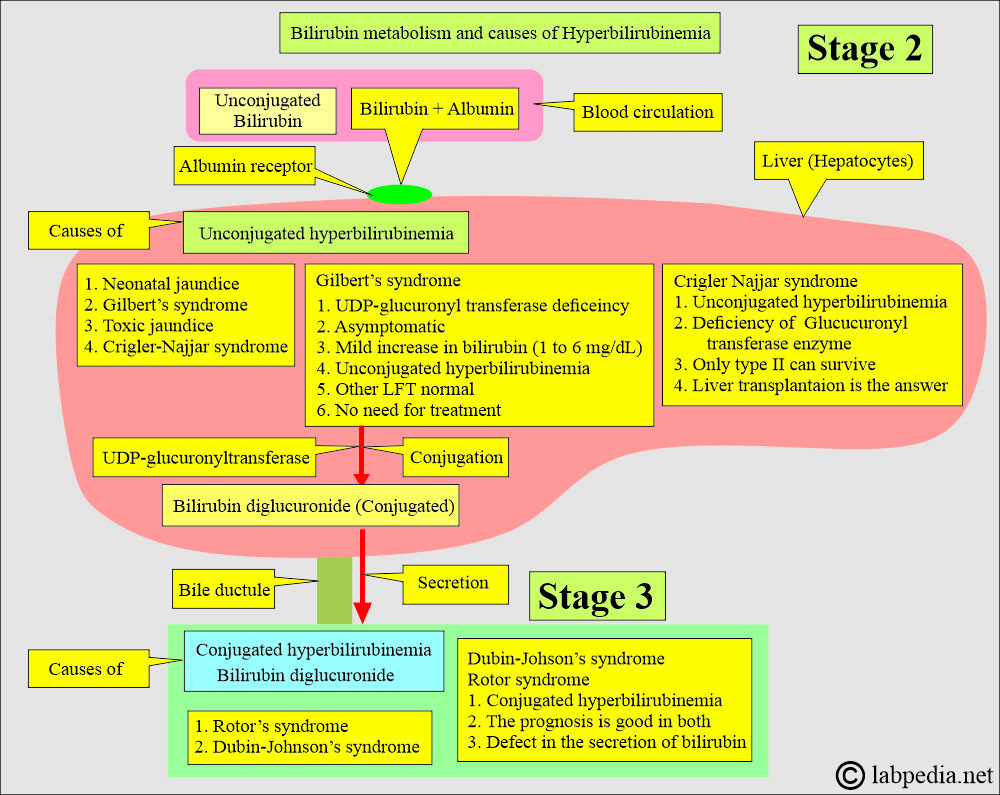
Bilirubin transportation from blood to Gallbladder
What are the changes in the liver cells?
- Unconjugated bilirubin is in the presence of glucoronyl transferase enzyme conjugated with glucuronic acid.
- Monoglucuronide and diglucuronide (conjugated bilirubin) are formed.
- Conjugated bilirubin enters the enterohepatic circulation.
- Bilirubin 95% is excreted into bile in the form of:
- Glucuronide.
- ∼90% is diglucuronide.
- ∼10% is monoglucuronide.
- Glucosides.
- Xylosides.
- Glucuronide.
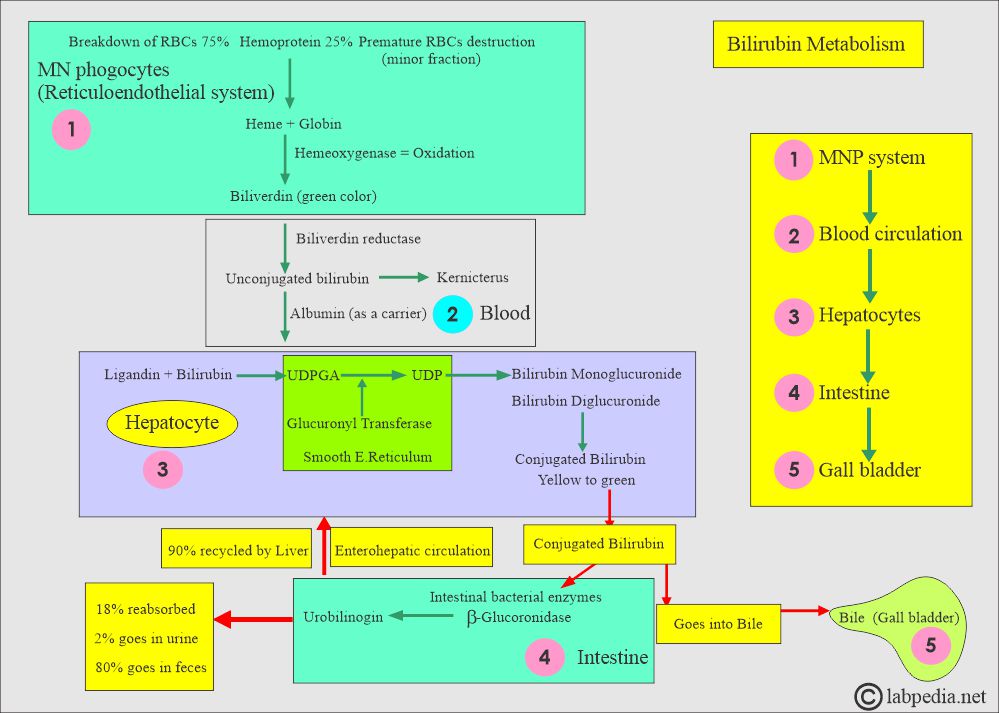
Summary of the Bilirubin metabolism
What are the changes of bilirubin in the intestine?
- Bilirubin is hydrolyzed by the catalytic action of β-glucuronidase from the liver, intestinal epithelial cells, and bacteria.
- The anaerobic intestinal bacterial flora reduces the unconjugated bilirubin to form a group of three colorless tetrapyrroles called urobilinogen:
- Stercobilinogen.
- Mesobilinogen.
- Urobilinogen (20%) is reabsorbed from the intestine and enters the enterohepatic circulation.
How is Bilirubin excreted in the urine?
- When bile reaches the duodenum, it is acted on by intestinal bacteria, which convert most bilirubin into urobilinogen.
- Most urobilinogen is lost in the stool, but part is absorbed into blood circulation.
- Urobilinogen in the blood travels to the liver (Enterohepatic circulation) and is excreted by the hepatic cells.
- The kidneys excrete some of this urobilinogen, which appears in the urine.
- Conjugated bilirubin, like urobilinogen, is partially excreted by the kidneys if the serum level is raised.
- Unconjugated bilirubin can not pass through the glomeruli, so it does not appear in the urine.
- In case of an increased level of unconjugated bilirubin, there is an increase in conjugated bilirubin, which will enter the bile duct and the intestine, and more urobilinogen is produced.
- This additional urobilinogen is absorbed into the blood circulation and appears in the urine.
- Urobilinogen is found in the urine when there is increased production of unconjugated bilirubin.
What is the extrahepatic fate of bilirubin?
- Water-soluble bilirubin is stored in the gallbladder and released into the intestine.
- Through enterohepatic circulation, it is excreted in the feces and the urine.
- In the urine, it is excreted as urobilinogen.
- In the stool as stercobilinogen.
- The three urobilinogens in the lower intestinal tract produce bile pigments:
- Stercobilin.
- Mesobilin
- Urobilin.
- These are orange-brown and are major pigments of the stool.
How will you define Jaundice?
- This is defined as the yellow discoloration of the skin and sclera because of the deposition of bile pigments.
- It appears when the serum bilirubin level is above 2 mg/dL.
- Bilirubin is a yellow pigment that is biotransformed in the liver and then excreted in the bile, urine, and stool.
How would you classify Jaundice?
Based on etiology:
- Pre-hepatic.
- Hepatic.
- Posthepatic.
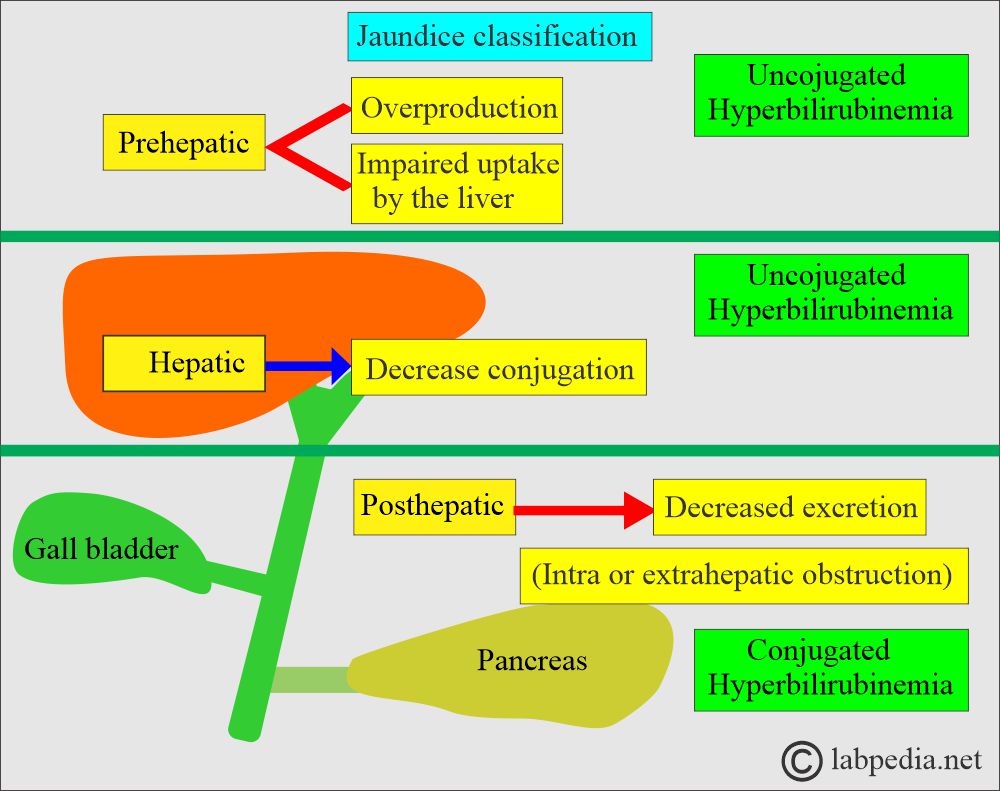
Jaundice classification
How will you classify Physiologically Jaundice?
- Unconjugated hyperbilirubinemia (indirect bilirubin).
- Conjugated hyperbilirubinemia (indirect bilirubin).
How will you discuss Unconjugated hyperbilirubinemia?
What are the causes of unconjugated hyperbilirubinemia?
- Increased production of unconjugated bilirubin:
- Hemolysis (hemolytic disease of the newborn).
- Hereditary.
- Acquired.
- Ineffective erythropoiesis.
- Increased turnover, like in neonates.
- Physiologic jaundice of the newborn.
- Decreased delivery:
- Congestive heart failure.
- Portacaval shunt.
- Decreased uptake by the hepatocytes:
- Drugs.
- Gilbert’s syndrome.
- Sepsis.
- Fasting.
- Decreased storage of unconjugated bilirubin:
- Fever.
- Competitive inhibition.
- Decreased conjugation:
- Physiologic jaundice, e.g., Neonatal jaundice.
- Drugs.
- Hereditary, like Crigler-Najjar syndrome.
- Complete enzyme deficiency, Type 1
- Partial enzyme deficiency, Type 2
- Gilbert’s syndrome.
- Hepatocellular dysfunction.
How will you discuss Conjugated Hyperbilirubinemia?
What are the causes of conjugated hyperbilirubinemia?
- Decreased secretion into bile canaliculi:
- Hepatitis.
- Cholestasis (Intrahepatic).
- Dubin–Johnson syndrome.
- Rotor syndrome.
- Decreased drainage or excretion.
- Extrahepatic obstruction:
- Stones.
- Carcinoma.
- Stricture.
- Atresia.
- Sclerosing cholangitis.
- Intrahepatic obstruction:
- Drugs.
- Primary biliary cirrhosis.
- Tumors.
- Granulomas.
- Idiopathic neonatal hepatitis (cholestatic jaundice).
- Extrahepatic obstruction:
How will you discuss the characteristics of the various types of jaundice?
| Tests | Pre-Hepatic | Hepatic | Post-hepatic |
|---|---|---|---|
|
Raised | Raised | Raised |
|
Raised | Raised | raised |
|
Normal | Raised markedly ++++ | Normal or slightly raised |
|
Normal | Raised markedly ++++ | Normal or slightly raised |
|
Normal | Slightly raised + | Markedly raised ++++ |
What are the causes of Jaundice?
| Type of Jaundice | Causes |
|---|---|
|
|
|
|
|
|
How will you define Hepatorenal failure?
- There is progressive renal failure in patients with severe end-stage liver disease (acute liver failure).
- There is no obvious cause of renal disease.
- The renal biopsy is essentially normal.
Questions and answers:
Question 1: What is the value of GGT?
GGT indicates minimal liver cell injury.
Question 2: What is the role of bacteria on bilirubin in the intestine?
Bacteria in the intestine convert bilirubin into urobilinogen.
Please join our group for updated topics: https://www.facebook.com/share/g/19JU1ng6J5/