HealthFlex
×
  • Home
  • Immunology Book
  • Lab Tests
    • Hematology
    • Fluid analysis
    • CSF
    • Urine Analysis
    • Chemical pathology
    • Blood banking
    • Fungi
    • Immune system
    • Microbiology
    • Parasitology
    • Pathology
    • Tumor marker
    • Virology
    • Cytology
  • Lectures
    • Bacteriology
    • Liver
    • Lymph node
    • Mycology
    • Virology
  • Blog
    • Economics and technical
    • Fitness health
    • Mental health
    • Nutrition
    • Travel
    • Preventive health
    • Nature and photos
    • General topic
  • Medical Dictionary
  • About Us
  • Contact

Liver:- Part 2 – Liver function tests and Jaundice Classification

August 11, 2026Chemical pathologyLab Tests

Table of Contents

Toggle
  • Liver Function Tests
        • What sample is needed for Liver Function Tests?
        • What tests are recommended to evaluate liver function?
        • What are the normal values of liver function tests?
        • What are the phases of jaundice?
      • How will you classify jaundice?
      • Questions and answers:

Liver Function Tests

What sample is needed for Liver Function Tests?

  • Venous blood is needed to prepare the serum.

What tests are recommended to evaluate liver function?

  1. Total Bilirubin.
    1. Direct bilirubin.
    2. Indirect bilirubin.
  2. SGPT.
  3. SGOT.
  4. Alkaline phosphatase.
  5. Gamma-glutamyltransferase (γ-GT).
  6. Total protein.
  7. Albumin
  8. A / G ratio.
  9. Prothrombin time (PT).
  10. Ultrasound of the abdomen to evaluate the liver or any other mass in the abdomen.
  11. Viral markers.

What are the normal values of liver function tests?

Test Normal value
  • Total bilirubin
  • o.3 to 1.0 mg/dL
  • Conjugated bilirubin
  • 0.1 to 0.3 mg/dL
  • Unconjugated bilirubin
  • 0.1 to 0.8 mg/dL
  • Newborn total bilirubin
  • 1.0 to 12.0 mg/dL.
  • Alkaline phosphatase
  • Adult = 30 to 120 units/L
  • Child <2 years = 85 to 235 units/L
  • 2 to 8 years = 65 to 210 units/L
  • 9 to 15 years = 60 to 300 units/L
  • 16 to 21 years = 30 to 200 units/L
  • SGOT  (AST)
  • Adult = 0 to 35 units
  • Elderly = values slightly higher than adults
  • Newborn and infants = 15 to 60 units/L
  • SGPT (ALT)
  • Adult and child = 4 to 40 units/L
  • Infants may be twice as high as the adult value
  •  Albumin
  • Adult = 3.5 to 5 g/dL
  • Premature infants = 3 to 4.2 g/dL
  • Newborn = 3.5 to 5.5 g/dL
  • Infant = 4.4 to 5.4 g/dL
  • Child = 4 to 5.9 g/dL
  • Total protein
  • 6.4 to 8.3 g/dL
  •  A/G ratio
  •  0.8 to 2.0
  • Gamma-glutamyltransferase (γ-GT).
  • >45 years = 8 to 38 units/L
  • Female <45 years = 5 to 27 units/L
  • Childlike adult level
    • Newborn = 5 times higher than the adult level
  • Prothrombin time (PT)
  • 11 to 12.5 seconds
  • Anticoagulant therapy = 1.5 to 2 times control
  • Ultrasound
  • No organomegaly
  • Viral markers
  • Negative


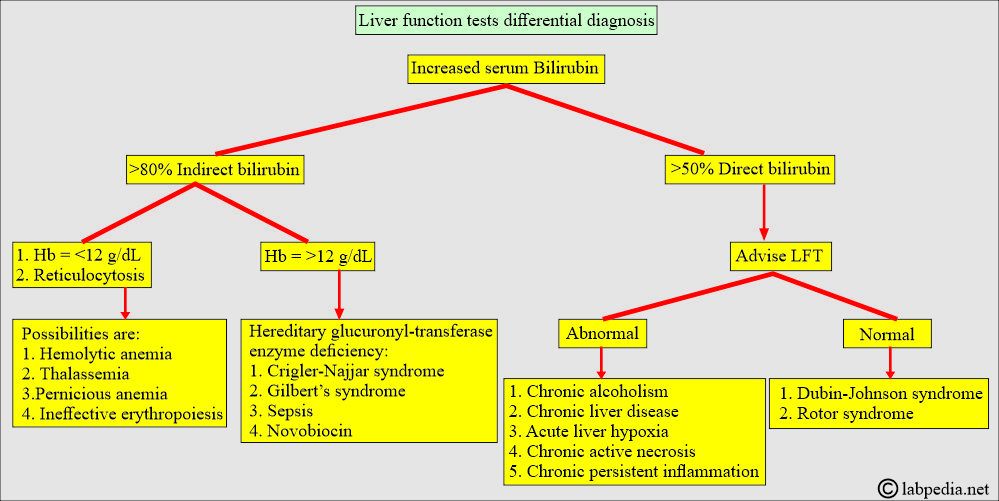
Liver function tests and differential diagnosis

Liver function tests and differential diagnosis

What are the phases of jaundice?

  1. Preicteric phase.
  2. Icteric phase.
  3. Nonicteric phase.

Preicteric phase:

  1. In this phase, urine and bilirubin are usually positive 1 to 6 days before the onset of clinical jaundice.
  2. Urinary urobilinogen is usually increased.
  3. The BSP test is usually the first test to become positive in this phase.
  4. Thymol flocculation, turbidity tests, and cephalin flocculation tests are positive in the late phase of jaundice.

Icteric phase:

  1. Direct bilirubin is increased.
  2. Urinary urobilinogen is increased, and bile is present in the urine.
  3. Alkaline phosphatase may or may not be elevated.
  4. The thymol turbidity and flocculation tests and the cephalin flocculation test were positive.
  5. The Bromsulphalein test is not helpful.

Non-icteric phase:

  1. Urinary urobilinogen is increased.
  2. Thymol-flocculation and turbidity and cephalin flocculation tests are usually positive.
  3. The Albumin-globulin ratio shows high globulin and low serum albumin.
  4. Alkaline phosphatase and cholesterol ester may or may not be helpful.
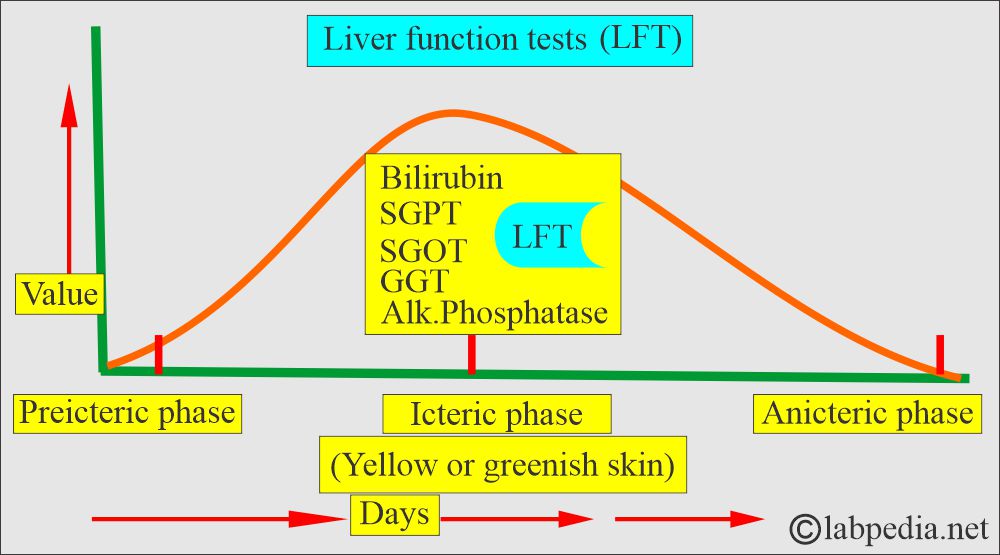
Jaundice phases

Jaundice phases

How will you classify jaundice?

  • The major causes of jaundice are:
  1. Pre-hepatic jaundice where there is hemolysis.
  2. Hepatic jaundice is where intrahepatic biliary tract obstruction occurs.
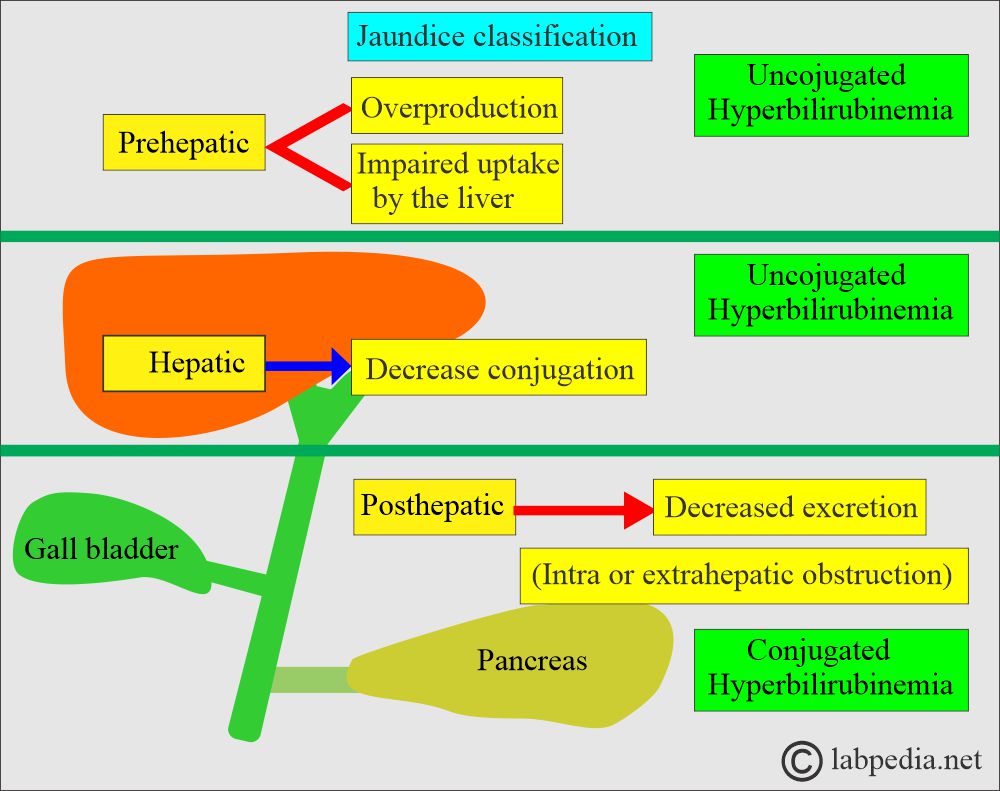
  3. Post-hepatic jaundice is when extrahepatic biliary tract obstruction occurs.
jaundice classification

jaundice classification

  • Please see more details in the LFT part.

Questions and answers:

Question 1: What is the value of GGT?
GGT is raised only in liver cell injury. It helps to differentiate from raised alkaline phosphatase from bone or liver.
Question 2: Which bilirubin will be raised in obstructive jaundice?
There is conjugated hyperbilirubinemia.

Please join our group to see updated topics: https://www.facebook.com/share/g/187TEYA4b2/


Possible References Used
Go Back to Chemical pathology

Comments

MUMTAZ AHMED Reply
October 6, 2022

I am very thankful to you for sharing this type of informatic site for us thank you so much sir

Dr. Riaz Reply
October 6, 2022

Thanks.

Dr SK Khilar Reply
June 25, 2024

An asymptomatic 24 yr male, no comorbidities on LFT has mildly raised serum bilorubin as well as mildly raised direct bilirubin, with rest all enzymes normal. HOW DO I INTERPRET THIS OR WHAT FURTHER INVESTIGATIONS DO I ASK HIM TO DO?

Dr. Riaz Reply
June 25, 2024

This is one of the congenital jaundices. Please see this topic and this may solve your problem.
https://labpedia.net/gilberts-syndrome-signs-symptoms-and-diagnosis/

Add Comment Cancel


The reCAPTCHA verification period has expired. Please reload the page.

  • Lab Tests
    • Blood banking
    • Chemical pathology
    • CSF
    • Cytology
    • Fluid analysis
    • Fungi
    • Hematology
    • Immune system
    • Microbiology
    • Parasitology
    • Pathology
    • Tumor marker
    • Urine Analysis
    • Virology

About Us

Labpedia.net is non-profit health information resource. All informations are useful for doctors, lab technicians, nurses, and paramedical staff. All the tests include details about the sampling, normal values, precautions, pathophysiology, and interpretation.

[email protected]

Quick Links

  • Blog
  • About Us
  • Contact
  • Disclaimer

Our Team

Professor Dr. Riaz Ahmad Bhutta

Dr. Naheed Afroz Syed

Dr. Asad Ahmad, M.D.

Dr. Shehpar Khan, M.D.

Copyright © 2014 - 2026. All Rights Reserved.
Web development by Farhan Ahmad.