
Lipoprotein:- Part 3 – Very Low-Density Lipoprotein (VLDL)
Very Low-Density Lipoprotein (VLDL)
What sample is needed for Very Low-Density Lipoprotein (VLDL)?
- The best sample is serum after 10 to 12 hours of fasting.
- Plasma can also be used.
- The sample with the preservative is stable for one week at 4 °C.
What are the Indications for Very Low-Density Lipoprotein (VLDL)?
- These are estimated to predict heart disease.
- Lipoproteins may be part of the lipid profile.
- These are done regularly to monitor the disease.
What are the precautions for Very Low-Density Lipoprotein (VLDL)?
- Keep in mind that smoking and alcohol decrease HDL values.
- After myocardial infarction, the cholesterol level may be decreased.
- Avoid high-fat meals before the test.
- HDL values are age- and sex depending.
- Drugs that may affect (increase) the lipoproteins are Aspirin, Phenothiazines, Sulfonamides, oral contraceptives, and steroids.
- HDL is normal or slightly raised in hypothyroidism, and VLDL is mildly to moderately increased.
What are lipoproteins?
- Lipoproteins consist of the following:
- High-density lipoprotein (HDL).
- Low-density lipoprotein (LDL).
- Very low-density lipoprotein (VLDL).
- Chylomicrons
- The outer covering lipoproteins are called Apoproteins, and these are classified into:
- Apo-1.
- Apo-II.
- Apo- B.
- Apo-D.
- Apo-E.
- Apolipoproteins are a hydrophilic component of lipoproteins.
- Lipids like cholesterol and triglycerides are hydrophobic and need to be placed in water-soluble micellar structures (Apolipoproteins) to be transported in the plasma.
- Apo-C, B-100, and E become the main components.
Very low-density lipoprotein (VLDL)
What are the important facts about VLDL (Very Low-density lipoprotein)?
- It originates from the liver and carries triglycerides from the liver to other tissues.
- VLDL carries a minimal amount of cholesterol.
- It is the product of endogenous lipoprotein synthesis in the liver and is delivered to the tissue.
- VLDL proteins are the primary carrier of triglycerides synthesized in the liver.
- Triglycerides are derived from dietary precursors, such as free fatty acids, glycerol, and carbohydrates.
- Triglycerides are a predominant component.
- VLDL contains about 10% cholesterol and functionally important apolipoproteins.
- VLDL may be expressed as the percentage of cholesterol.
- Apo-C activates the release of lipoprotein lipase enzyme, which hydrolyzes triglycerides into glycerol, monoglycerol, and free fatty acids.
- This reaction may give rise to intermediate lipoproteins (IDL).
What are the contents of VLDL?
- VLDL consists of the following:
- Triglycerides = 40% to 60%
- Cholesterol = 5% to 8%
- Cholesterol ester = 11% to 14%
- Phospholipids = 20% to 23%
- Protein = 4% to 11%
- Another source:
- Triglycerides = 60%
- Cholesterol = 15%
- Phospholipids = 15%
- Protein 10%
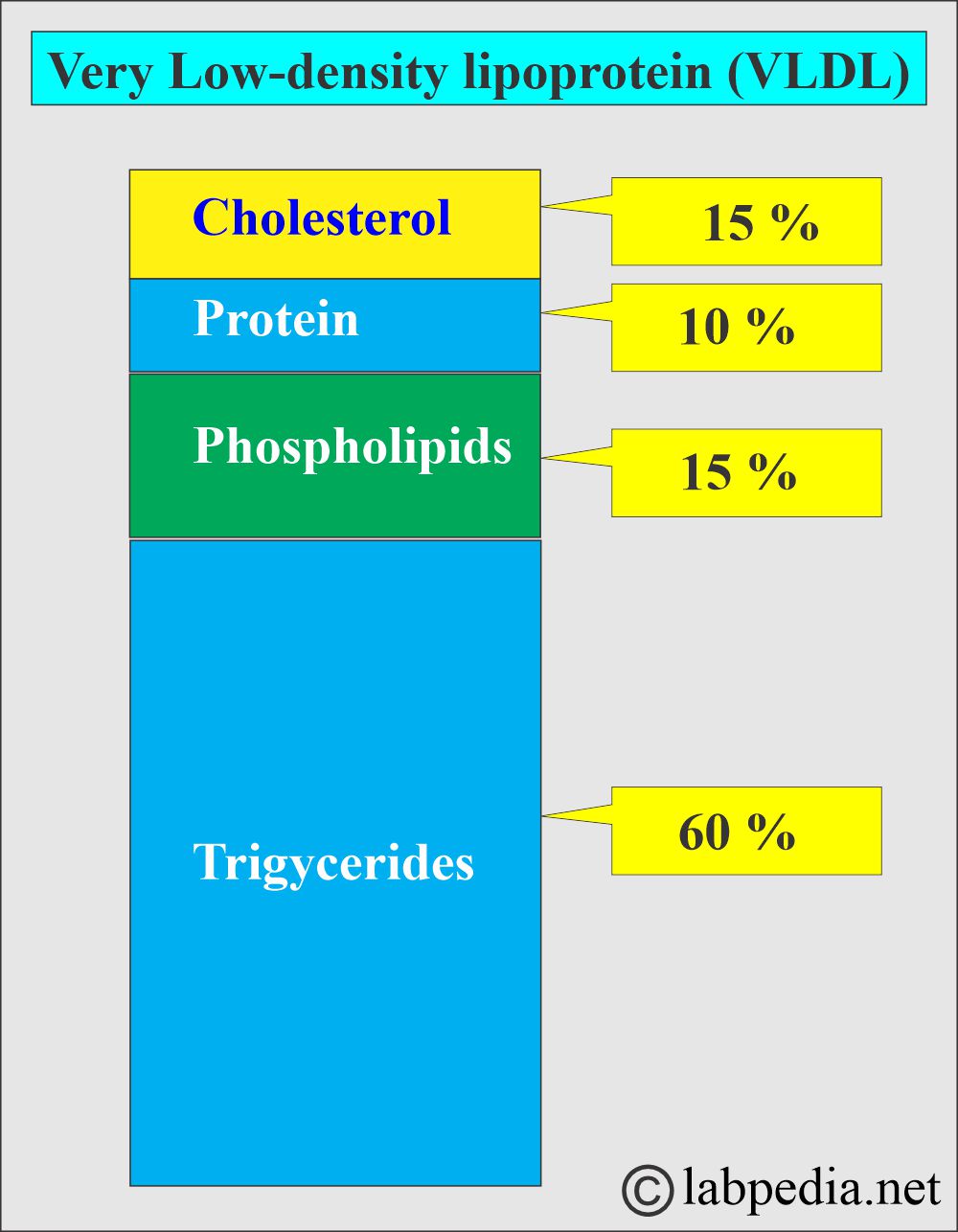
VLDL (Very low-density lipoprotein)
What are the characteristic features of Very Low-Density Lipoprotein (VLDL)?
- It is a pre-β-lipoprotein derived from the liver.
| Type of lipid | Source | Diameter (nm) | Ultracentrifuge | % Protein | % Total lipids | Free cholesterol |
| Very low-density lipoprotein (VLDL) |
|
|
|
|
|
|
What is the difference between VLDL and LDL?
- LDL has lower triglyceride and higher cholesterol content.
- LDL carries 70% of the total cholesterol and very little triglyceride.
- LDL has no apoproteins C or E.
- Inside the cells, the LDL molecule is metabolized into its parts.
- This shows that LDL plays a major role in providing cholesterol to body cells and can lead to atherosclerosis.
- VLDL has the majority of triglycerides and less cholesterol content.
| Clinical Parameters | LDL (Low-density lipoprotein) | VLDL (Very low-density lipoprotein) |
|
Formed in plasma from LDL | Liver |
|
Cholesterol | Triglyceride |
|
Low (5% to 15%) | High (50% to 70%) |
|
High (45% to 50%) | Moderate (10% to 20%) |
|
Removed by hepatic LDL receptor | Converted to IDL and then to LDL |
|
2 to 3 days | 2 to 6 hours |
|
ApoB-100 only |
|
|
Deliver cholesterol to peripheral tissues | Transport endogenous triglycerides from liver to peripheral tissues |
|
Smaller (18 to 25 nm) | Largest of the atherogenic lipoproteins (30 to 80 nm) |
|
Marked increase | Mild to moderate increase |
|
Mostly normal or mild increase | Markedly increased |
|
Primary therapy lowering drugs | Marker of hypertriglyceridemia |
|
Optimum <100 mg/dL | Normal 5 to 50 mg/dL |
|
|
|
|
Lower LDL-cholesterol | Lower triglyceridemia |
What are the drawbacks of Very Low-Density Lipoprotein (VLDL)?
- VLDL is associated with an increased risk of coronary heart disease.
- VLDL can convert to LDL.
- More than 25% to 50% of Very Low-Density Lipoprotein (VLDL) is associated with an increased risk of coronary heart disease.
What are the functions of Very Low-Density Lipoprotein (VLDL)?
- Very Low-Density Lipoprotein (VLDL) has the main role of transporting endogenously synthesized triglycerides by the liver to:
- Adipose tissue.
- Muscles.
- Very Low-Density Lipoprotein (VLDL) carries triglycerides from the intestinal mucosa to the periphery.
- Very Low-Density Lipoprotein (VLDL) is mainly synthesized in the liver and, to a lesser extent, the intestinal tissues.
- Very Low-Density Lipoprotein (VLDL) passes through a transient intermediate lipoprotein form called intermediate-density lipoprotein (IDL).
- Intermediate-density lipoprotein (IDL) changes to Low-density lipoprotein (LDL).
What is the normal value of Very Low-Density Lipoprotein (VLDL)?
Source 2
- 7 to 32 mg/dL.
Another source
- 25% to 50%
Source 4
| Age | mg/dL |
| Adult | |
|
|
|
|
|
|
| Children and adolescents | |
|
|
|
|
|
|
What are the causes of increased Very Low-Density Lipoprotein (VLDL)?
- Nephrotic syndrome.
- Glycogen storage diseases.
- Familial LDL lipoproteinemia.
- Hypothyroidism.
- Chronic liver disease.
- Liver cell carcinoma.
- Gammopathies.
- Cushing syndrome.
- Familial hypercholesterolemia.
What are the causes of decreased Very Low-Density Lipoprotein (VLDL)?
- Hypoproteinemia.
- Hyperthyroidism.
- Familial hypolipoproteinemia.
How will you summarize the characteristics of the lipoproteins?
| Characteristics | Chylomicron | HDL | LDL | VLDL |
|
|
Clear | Clear or yellow-orange tint | Turbid to opaque |
|
>70.0 nm | 4 to 10 nm | 19.6 to 22.7 nm | 25 to 70 nm |
|
Origin | α – region | β – region | Pre – β region |
|
0.4 to 30 x 109 | 3.6 x 10⁹ | 2.75 x 10⁹ | 5 to 10 x 109 |
|
Intestine | Intestine and liver | Intravascular | Liver and intestine |
|
||||
| Cholesterol esterified | 5 | 38 | 49 | 11 to 14 |
| Cholesterol unesterified | 2 | 10 | 13 | 5 to 8 |
| Triglycerides | 84 | 9 | 11 | 44 to 60 |
| Phospholipids | 7 | 22 | 27 | 20 to 23 |
| Proteins | 2 | 21 | 23 | 4 to 11 |
|
Markedly raised | Normal | Normal/ Raised | Moderately to markedly raised |
|
|
Decreased risk of CAD | Increased risk of CAD | Increased risk of CAD |
|
Transport dietary lipids to tissue | Carry cholesterol from tissue to liver | Carries cholesterol to tissue | Transport endogenous TG from the liver to adipose tissue |
Note: Lipoproteins are described in detail in LDL and HDL.
Questions and answers:
Question 1: What is the complication of Very Low-Density Lipoprotein (VLDL)?
The main drawback is that it is atherogenic.
Question 2: Is Very Low-Density Lipoprotein (VLDL) increased in renal diseases?
Yes, Very Low-Density Lipoprotein (VLDL) is increased in renal diseases (Nephrotic syndrome).