
Lactate Dehydrogenase (LDH), Isoenzymes of LDH
Lactate Dehydrogenase (LDH)
What sample is needed for the Lactate Dehydrogenase (LDH) enzyme?
- LDH can be done on serum or plasma.
- The sample can be stored at room temperature.
- Perform the test immediately.
- The hemolyzed sample is unacceptable because RBCs contain LDH.
- LDH can be done on urine and CSF.
- LDH can also be done on ascites.
What precautions are needed for Lactate Dehydrogenase (LDH)?
- The serum is preferred to plasma.
- The plasma may not be used due to platelets with high LDH.
- Separate the serum as soon as possible, immediately after the clot formation.
- Do not refrigerate or freeze, and perform the test immediately.
- The hemolyzed serum has 150 times more LDH due to the RBCs, particularly LDH-1 and LDH-2, than the clear serum.
- Oxalate and Borate both inhibit the LDH enzyme activity.
- EDTA also inhibits this enzyme activity.
What are the Indications for Lactate Dehydrogenase (LDH)?
- LDH is used to diagnose diseases or injuries to:
- Heart muscles.
- RBCs.
- Kidney.
- Skeletal muscles.
- Lung.
- Brain.
- Liver.
- It is a late marker of AMI.
- It is a good marker for activity in cryptogenic fibrosing alveolitis and extrinsic allergic alveolitis.
- It is a marker for hemolytic anemia.
- It is a Nonspecific tumor marker.
- Helpful in the diagnosis of exudative fluid in malignant tumors.
- LDH-2 is high in 35% of the cases.
What are the reasons for raised Lactate Dehydrogenase (LDH)?
- Hemolysis raises the LDH level, as seen in myocardial infarction.
- There is a raised level of LDH1 and 2 in megaloblastic anemia.
- Avoid poor venipuncture.
- Separate the clot from the serum as soon as possible.
- Avoid heating the sample.
How will you discuss the pathophysiology of Lactate Dehydrogenase (LDH)?
- LDH values reflect the total LDH activity in serum.
- LDH is an enzyme in all body cells and only in the cytoplasm of cells.
- The highest concentrations are in the heart, liver, skeletal muscles, kidneys, and RBCs.
- A lesser amount is found in the lungs, smooth muscles, and brain.
- LDH sites of origin released into the blood after injury are:
- Heart.
- Liver.
- Skeletal muscles.
- RBCs.
- Kidneys.
- Malignant tumors.
- Lungs.
- Lymphocytes.
- Its molecular weight is 134,000 daltons (128,000).
- Its isoenzyme’s molecular structure consists of 4 polypeptide chains, each with a molecular weight of 32,000 daltons.
- Two different polypeptide chains, H (heart) and M (muscle), combine into five different arrangements and give rise to five different isoenzymes.
- It consists of four peptide chains of two types, M (or A) and H (or B).
- This M is for muscles, and H is for the heart.
- These are controlled by the loci on human chromosomes 11 and 12, respectively.
- Five isoenzymes make the total LDH. These are separated by electrophoresis (A thin layer of agarose gel).
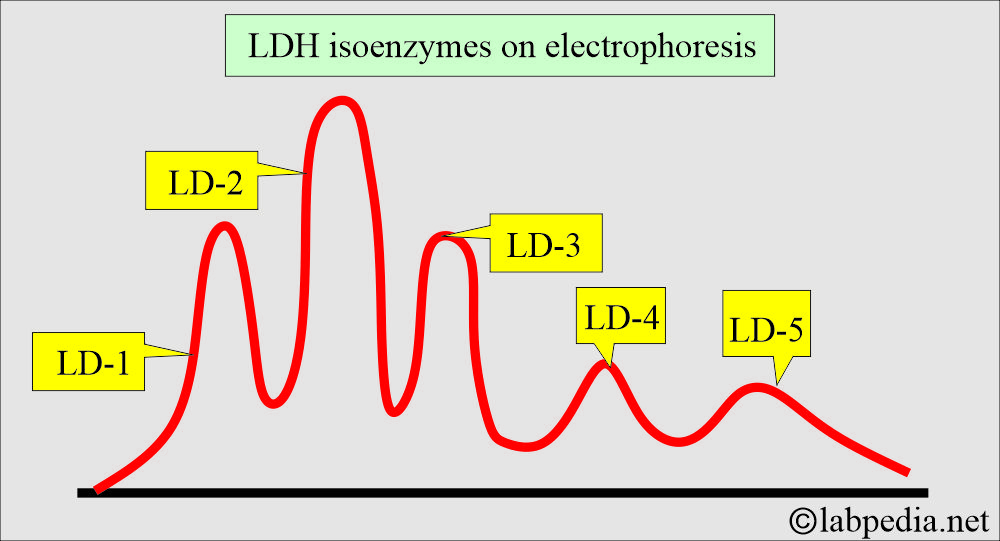
Lactate Dehydrogenase (LDH): LDH electrophoresis
Distribution of the isoenzymes of LDH:
| Type of isoenzyme | Structure | Distribution % | Distribution in various organs | Diseases Association |
|
|
|
|
|
|
|
|
|
|
|
|
|
|
|
|
|
|
|
|
|
|
6% to 16% |
|
|
LDH enzyme level in U/g in various tissues is high as compared to the serum, e.g.:
| LDH in various tissues | Amount of LDH U/g in various tissues |
|
|
|
|
|
|
|
|
|
|
|
|
- The tissue level of LDH is roughly 500 times higher than the serum. So contamination with damaged tissue will give very high values.
What is the role of the lactate dehydrogenase enzyme in a chemical reaction?
- LDH is an enzyme of the oxidoreductase class that catalyzes the interconversion of Lactic and Pyruvic acid.
- The LDH enzyme catalyzes the oxidation of L-lactate to Pyruvate, with NAD acting as an H+ acceptor.
- This reaction depends upon the following:
- pH.
- Temperature.
- Substrate.
- Buffers concentration.
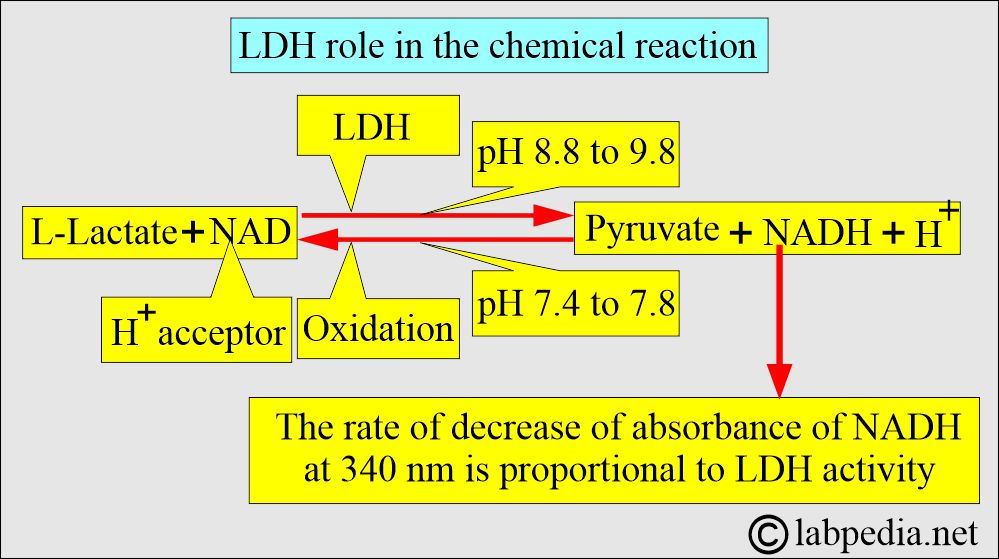
LDH reaction principle
- When cells are injured, LDH spills into the bloodstream.
- LDH is the total measure of LDH isoenzymes.
- LDH 1 indicates myocardial injury.
- LDH 2 indicates a pulmonary injury.
- LDH 3 indicates a pulmonary injury.
- Total LDH indicates multi-organ injuries like:
- Myocardial infarction.
- Congestive heart failure causes pulmonary and hepatic congestion.
- Advanced malignancies.
- Autoimmune diseases.
How will you summarize LDH isoenzymes in various tissues?
| Various organs | LDH isoenzymes | LD-1 | LD-2 | LD-3 | LD-4 | LD-5 |
|---|---|---|---|---|---|---|
|
4 and 5 | 0.2% | 0.8% | 1% | 4% | 94% |
|
3 and 2 | 10% | 18% | 28% | 23% | 21% |
|
4 (another ref: 1 and 2) | 28% | 34% | 21% | 11% | 6% |
|
1 and 2 | 60% | 30% | 5% | 3% | 2% |
|
4 and 5 | 3% | 4% | 8% | 9% | 76% |
|
28% | 32% | 19% | 16% | 5% | |
|
1 and 2 | 40% | 30% | 15% | 10% | 5% |
|
3 | 5% | 15% | 31% | 31% | 18% |
|
0 | 0 | 4% | 17% | 79% | |
|
3 | |||||
|
4 (another ref: 3) | |||||
|
4 | |||||
|
2 | |||||
|
Major LD-2 followed by LD1>LD3>LD4>LD5 | |||||
What is the normal Lactate Dehydrogenase (LDH) level in blood?
Source 1
- Neonates = 415 to 690 U/L
- Adult = 140 to 280 U/L
Source 2
- Adult = 100 to 190 U/L at 37 °C.
- Newborn = 160 to 450 U/L (30° C)
- Infants = 100 to 250 U/L.
- Child = 60 to 170 U/L
- Isoenzymes: Adult / elderly
- LDH 1 = 17 to 27 %.
- LDH 2 = 27 to 37 %.
- LDH 3 = 18 to 25 %.
- LDH 4 = 3 to 8 %
- LDH 5 = 0 to 5 %.
- The reference ranges are highly method-dependent.
What is Normal LDH in CSF?
- It is ∼10% of the serum level
Where will you see the raised level of Lactate dehydrogenase (LDH)?
Liver disease:
- Ten times raised in toxic hepatitis with jaundice.
- LDH-5 is raised in primary liver disease.
- LDH-5 is raised in the case of liver anoxia.
- LDH-5 is raised in primary liver disease.
- In early hepatitis, there is an increase in LD-5. It may become normal even when ALT remains elevated.
- There is a moderate increase in cirrhosis, obstructive jaundice, and acute viral hepatitis.
- A marked increase in the LDH-5 occurs in the prodromal stage and is greatest at the onset of jaundice. Total LDH may be increased in 50% of the cases.
- ALT/LD or AST/LD ratio within 24 hours of S/S >1.5 favors acute hepatitis compared to acetaminophen or ischemic injury.
- There is a marked increase in the metastatic infiltrate of the carcinoma.
- LD-4/LD-5 ratio <1.05 favors the diagnosis of liver cell carcinoma.
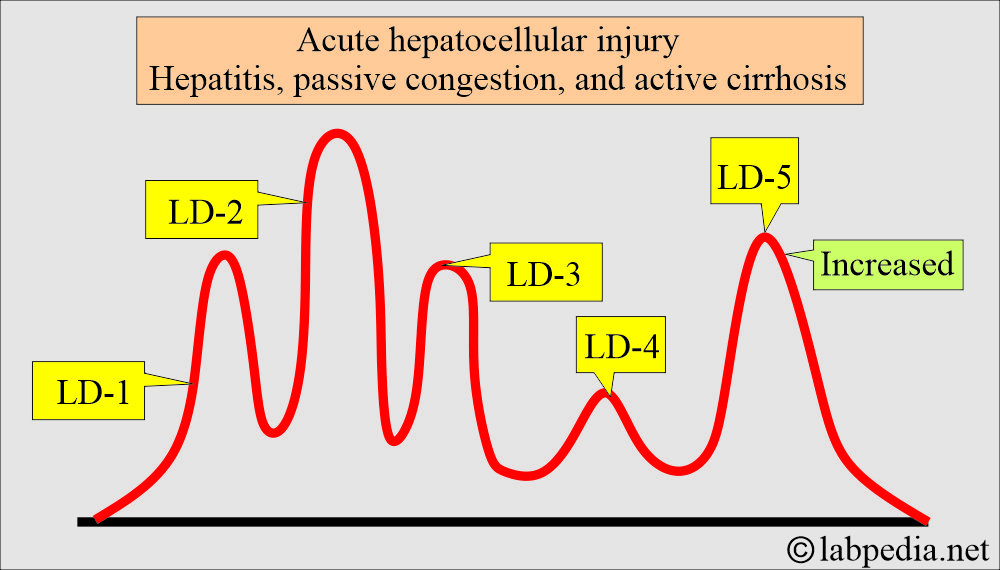
LDH in liver diseases
Lung diseases:
- In pulmonary infarction, there is an increase in LD-2, LD-3, and LD-4.
- In pulmonary embolism, there is an increase in LD-2, LD-3, and LD-4.
- Increased in sarcoidosis.
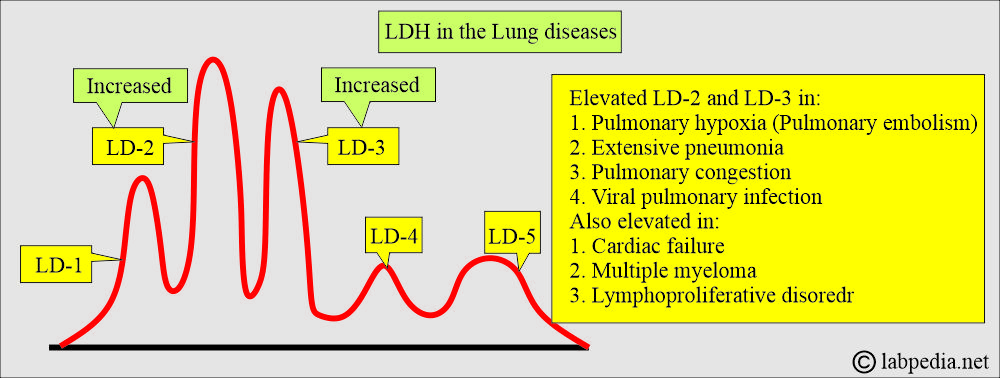
LDH in lung diseases
Hematological disease:
- The case of pernicious anemia and folic acid deficiency shows an increase in LDH, mainly in LD-1, which is >LDH-2, and when the Hb is <8 g/dL.
- LDH is increased in all hemolytic anemias and can be ruled out if LD-1 and LD-2 are not raised in anemic patients.
- LDH is normal in aplastic and iron-deficiency anemia, even with severe anemia.
- During sickle cell crises, there is an increase in LD-1 and LD-2 levels.
- Mothers carrying erythroblastic babies show an increase in LD-5.
Medication:
- It is seen in, e.g., Warfarin and antiepileptics.
Alcohol:
- It is increased with repeated drinking of alcohol.
Acute Myocardial Infarction:
- LDH rises within 24 to 48 hours.
- The peak is 2 to 3 days (48 to 72 hours).
- Return to normal is a slow process that may take 5 to 10 days.
- It was used for the late diagnosis of AMI.
- That is why the LDH level helps diagnose MI in the late stage, after 4 days of chest pain history.
- LDH >2000 IU suggests a poor prognosis.
- In congestive heart failure, there is an increase in LD-2, LD-3, and LD-4.
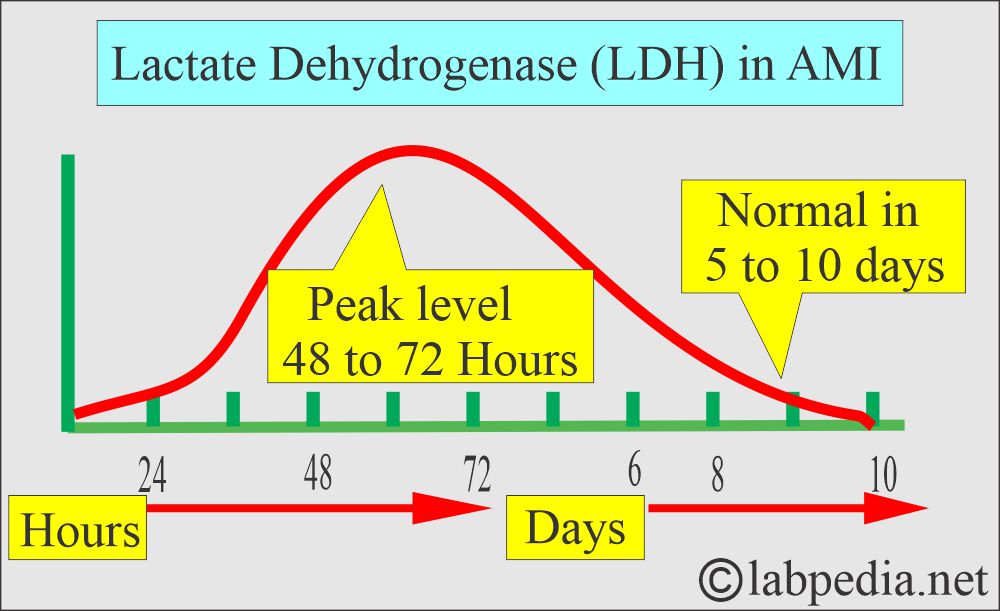
LDH levels in AMI
Kidney diseases:
- It is raised in 1/3 of cases of kidney diseases.
- Mostly in tubular necrosis.
- And in pyelonephritis.
- In the case of renal infarction, the picture is like myocardial infarction.
- LD-1/LD-2 ratio >1 may occur in acute renal infarction, hemolysis, pregnancy, muscle disorders, and cancers.
Malignant diseases:
- LDH is elevated in 50% of solid carcinomas and in advanced stages.
- LDH levels are raised in lymphomas and liver cell necrosis.
- 70% of the cases with metastasis to the liver have increased LDH.
- It is found in 20% to 60% of cases without liver metastasis.
- High levels are seen in the case of Hodgkin’s disease, abdominal cancer, and lung cancer.
- Leukemias have a moderate increase.
- Raised levels of LDH in cancers show poor prognosis.
- Prostate carcinoma shows increased LD-5, and the ratio of LD-5:1 is >1.0.
- Malignant lymphoma shows increased LD-3 and LD-4. There may also be an increase in LD-2.
Muscular dystrophy:
- There is a moderate increase in progressive muscular dystrophy, particularly in the disease’s early and mid stages.
- LDH-5 is mainly increased in the anoxic injury of the striated muscle.
- After damage or loss of the large muscle mass, the LDH level declines.
- There is an increase in total LDH in electrical and thermal burns and trauma of the muscles.
Cerebrospinal fluid:
- Normally, it is lower than the serum.
- LDH-4 and LDH-5 are not found in the CSF.
- In bacterial meningitis, WBCs raise the level of LDH-4 and LDH-5.
- In viral meningitis, lymphocytes increase the levels of LDH-1 and LDH-3.
Cerebrovascular accidents:
- LDH increases in most cases, and peak levels are 1 to 3 days.
- It does not relate to xanthochromia, RBCs, WBCs, protein, sugar, or chloride.
- The subarachnoid and subdural hemorrhage increases all subclasses of LDH, especially LD 3, 4, and 5.
CNS neoplasia:
- There is an increased LD5 >9% and a decreased LD-1: LD-5 ratio <2.5 in the absence of infection or hemorrhage, suggesting neoplasia in the meninges.
- LD-5 >10% suggests high-grade neoplasm.
- LD-3 and LD-4 increase; occasionally, LD-5 is seen in the leukemic and lymphomatous infiltration.
Meningitis:
- There is a mild increase in viral meningitis.
- There is an increase in LD-1 and LD-2 in viral meningitis.
- There is a marked increase in bacterial meningitis.
- There is an increase in LD-4 and LD-5 in bacterial meningitis.
- TB meningitis shows increased levels of LD-1, LD-2, and LD-3, with LD-3 being the most elevated.
- HIV infection does not make much difference.
Urine:
- A total LDH level raised in the urine indicates urologic injury.
- Three to five times the raised level is seen in:
- Chronic glomerulonephritis.
- Systemic lupus erythematosus.
- Diabetic nephropathy.
- Urinary bladder and kidney tumors.
- LDH levels may be measured in pleural, cardiac, or peritoneal fluids to differentiate exudate from transudate.
LDH may be raised moderately in the following conditions:
- Cardiac failure.
- Acute Myocarditis.
- Rheumatic fever.
- Liver congestion.
LDH isoenzymes increased in various diseases :
- LDH-1 is increased in renal infarction.
- It is raised in the testes’ germ cell tumor-like seminoma and teratoma.
- And dysgerminoma of the ovary.
- LDH-3 is increased in pulmonary infarction.
- LDH-3 and LDH-4 are increased in lymphoproliferative disorders.
- LDH-4 may be the main isoenzyme in acute lymphoblastic leukemia.
- Normal LDH-1: LDH-2 ratio = <0.80, while myocardial infarction is >0.80.
- LDH-1 > LDH-2 in hemolytic anemias and pernicious anemia.
What are other conditions where LDH is raised?
- Parasitic infestation.
- Various infections.
- Viral infections are associated with increases in LD-2, LD-3, and LD-4.
- Subacute thyroiditis and hypothyroidism.
- Acute pancreatitis.
- Collagen vascular diseases.
- SLE (LD-3 and LD-4).
- Drugs.
- Intestinal obstruction.
- Sarcoidosis.
- Bacterial meningitis, cerebral hemorrhage, or thrombosis.
- Dermatomyositis (LD-5).
What are the conditions where there is a decreased level of LDH?
- It may be seen in irradiation.
- LDH is distributed in multiple organs, so the total LDH is not a specific marker for any disease or injury.
What are the serum LDH Isoenzymes in various diseases?
| Diseases | LDH Isoenzymes raised |
|
I and II (LD-1>LD-2) |
|
LD2, LD3, LD4 |
|
LD 1 > LD2 |
|
III (LD-3) |
|
I, II, III (LD-1, LD-2, LD-3) |
|
I, II (LD-1 and LD-2) |
|
I (LD-1) |
|
I, V (LD-1 and LD-5) |
|
V (LD-5) |
|
III, IV (LD-3 and LD-4 |
|
V (LD-5) |
|
III, IV (LD-3, and LD-4) |
|
V (LD-5), 5:1 ratio >1 |
|
LD2, LD3, LD4 |
|
LD4 and LD5 |
Questions and answers:
Question 1: What is the significance of LDH in active chronic granulocytic leukemia?
There is increased LDH-3 in >90% of the cases, but normal during the remission.
Question 2: Which isoenzyme is increased in pernicious anemia.
It is LD-1.
Laboratory technician