
Lactase Enzyme Deficiency, Lactose Intolerance
Lactase Enzyme Deficiency
What samples are needed to detect Lactase enzyme deficiency?
- Most tests available to diagnose lactase enzyme deficiency are performed on stool samples.
- A blood sample is needed to estimate blood glucose levels.
- Small intestinal biopsy.
- Breath test.
How will you define lactase enzyme deficiency?
- Lactose is a disaccharide and is mainly found in dairy products. Lactose requires the lactase enzyme for digestion. Lactose intolerance develops when the lactase enzyme is deficient; lactose will not break down into glucose and galactose.
- Lactose intolerance starts in infancy, with S/S of diarrhea, vomiting, and failure to thrive.
- The patient becomes asymptomatic when lactose is removed from the diet.
What is the epidemiology of Lactase enzyme deficiency?
- Northern Europeans have normal lactase enzymes, and only 10% to 15% develop lactase enzyme deficiency (Lactose intolerance).
- The highest incidence is seen in Asian populations, such as Chinese and Japanese.
- Native Americans:>90% show lactase enzyme deficiency (Lactose intolerance).
- Jews, African Americans, South Americans, and Eastern Europeans have a lesser deficiency, but still, it is seen in 60% to 70%.
How will you discuss the Pathophysiology of lactase enzyme deficiency?
- Lactose is a disaccharide and is mainly found in dairy products. Lactose requires the lactase enzyme for digestion. Lactose intolerance develops when the lactase enzyme is deficient; lactose will not break down into glucose and galactose.
- Lactose is a disaccharide and is mainly found in dairy products.
- Lactose needs a lactase enzyme for digestion. When the lactase enzyme is deficient, lactose will not be broken down into glucose and galactose, causing lactose intolerance.
- Lactose intolerance starts in infancy, with diarrhea and vomiting. There is failure to thrive.
- The patient becomes asymptomatic when lactose is removed from the diet.
What is the mechanism of lactase enzyme deficiency?
- Lactose sugar is present in:
- Milk and milk products.
- Ice cream.
- Yogurt.
- Many types of cheese.
- In case of a lactase enzyme deficiency, lactose cannot be broken down into glucose and galactose.
- The brush borders of the small intestine have the enzyme lactase.
- When there is a genetic abnormality, lactase deficiency, milk sugar cannot be broken down into monosaccharides.
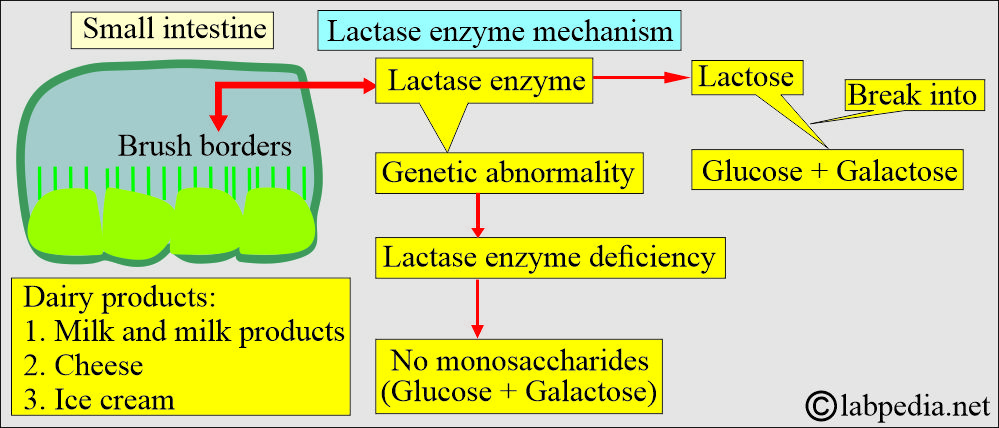
Lactase enzyme deficiency mechanism
What are the types of Lactase enzyme deficiency?
- Primary, Congenital:
- It is the genetic deficiency of the lactase enzyme.
- Lactase enzyme appears between 26 and 34 weeks of gestation, with 1/3 activity compared to that of full-term babies.
- At 35-38 weeks of gestation, it is around 70%.
- Full activity is seen at the 40th week of gestation.
- This deficiency appears between ages 3 and 5.
- This appears in the newborn.
| Gestational age (Fetal age) | Lactase enzyme appearance |
|
|
|
|
|
|
|
|
|
|
-
- These babies will present with vomiting, diarrhea, malabsorption, and failure to thrive.
- This may be seen in premature babies.
- Secondary (acquired):
- The lactase enzyme deficiency is due to:
- Gluten sensitivity enteropathy.
- Enteritis.
- Bacterial growth in the intestine.
- Inflammatory bowel disease, such as Crohn’s disease.
- Giardia lamblia infestation.
- Cystic fibrosis of the pancreas.
- Other causes of lactase enzyme deficiency are:
- There is some degree of lactase enzyme deficiency in adults, but severe deficiency occurs due to the following:
- Inflammatory bowel disease.
- Short-gut syndrome.
- Malabsorption syndrome.
- Severe acute gastroenteritis.
- Prolonged protein-calorie malnutrition.
- Certain antibiotics like neomycin and kanamycin.
- The small bowel is loaded with lactose when lactose is in the intestine.
- Intestinal bacteria lead to its fermentation and give rise to:
- Gas formation.
- The osmotic gradient leads to osmotic diarrhea.
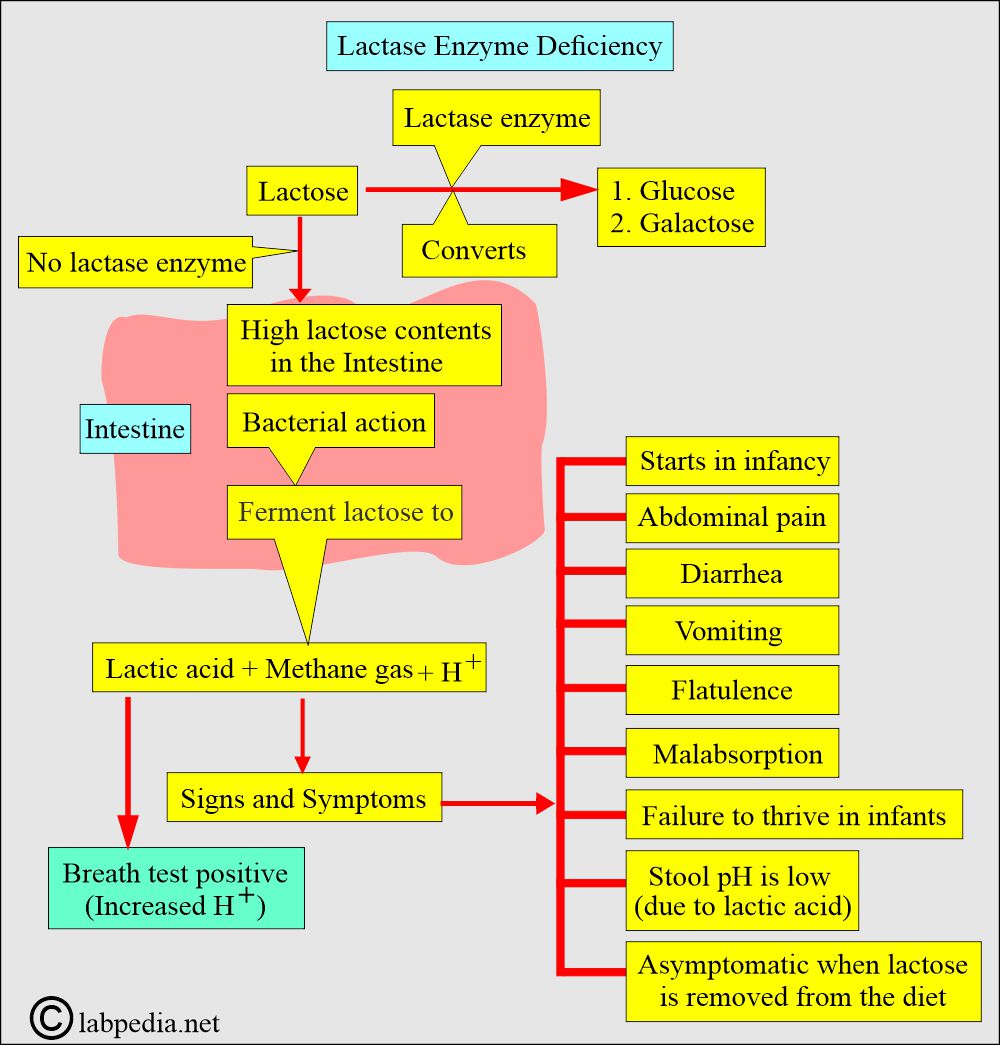
Lactase enzyme deficiency and S/S
What are the clinical features of Lactase enzyme deficiency?
- There is abdominal floating and distension.
- Abdominal cramping.
- There is flatus.
- Diarrhea.
- There is bloating.
- These symptoms are worse after meals.
- Lactase deficiency in full-term babies or young children is rare.
- These patients do not thrive.
What are the normal values of Lactase enzyme deficiency?
- Normal = Glucose change from the normal value = >30 mg/dL (>1.7 mmol/L).
- Inconclusive = 20 to 30 mg/dL
- Abnormal = <20 mg/dL (<1.1 mmpl/L) (positive for lactase enzyme deficiency).
- Breath test (H+) = <10 ppm increase from the baseline is abnormal.
How will you diagnose Lactase enzyme deficiency?
What are the Screening tests for lactase deficiency?
- Stool for pH.
- Normal stool pH is 7.0 to 8.0
- A stool pH below 6.0 suggests lactase deficiency.
- Stool sugar at the time of patient symptoms.
- Check for reducing sugars, including glucose, using the oxidase method.
- The presence of reducing sugars, such as glucose, in the stool suggests lactase enzyme deficiency.
What is the principle of the lactose tolerance test?
- The principle is similar to that of the glucose tolerance test.
- The patient is provided with lactose overload.
- Serum glucose levels are estimated by fasting (before lactose administration) and after administration at 15, 30, 60, and 90 minutes.
- Normal lactase enzyme activity results in postdose glucose elevation of >20 mg/dL (1.1 mmol/L).
- Lactose will not be broken down into glucose and galactose in lactase deficiency; plasma glucose levels will not increase.
- This test is a GTT (glucose tolerance test) to detect a deficiency of the intestinal disaccharidase (lactase) enzyme.
- The fasting glucose level is compared with other glucose levels to determine whether it has increased or decreased.
- What are the precautions for a lactose tolerance test?
- Avoid strenuous exercise.
- Smoking can increase blood glucose levels.
- Don’t allow smoking during the test and 8 hours before the test.
- Enterogenous steatorrhea.
- Patients with diabetes mellitus may have blood glucose levels increased by 20 mg/dL despite lactase deficiency.
- The patient must fast 8 to 12 hours before the test.
- The patient should not eat dark bread, beans, sugars, or high-fiber food within 24 hours of the test.
- Don’t allow gum chewing.
- Don’t allow antibiotic therapy 2 weeks before the test.
- Procedure for lactose tolerance test:
- After an overnight fast.
- Give 50 grams of lactose mixed with 200 mL of water. (1 to 2 grams lactose/kg of body weight).
- You can give this with flavored fluid or soft drinks.
- Draw the blood sample at 0 (fasting), 30, 60, and 90-minute intervals. (Some labs check fasting glucose at 30, 60, 90, and 120 minutes).
- Some labs check galactose instead of glucose levels.
- Interpretations:
- There is flat lactose tolerance, meaning no rise in glucose levels.
- At normal lactase enzyme level, glucose elevation is >20 mg/dL (1.1 mmol/L) over baseline.
- Lactose in the urine produces a positive test for reducing sugars but is negative by the glucose oxidase method.
- Take a single blood sample 40 minutes after the test and check the galactose level.
Hydrogen breath test:
- It is considered the most accurate of the tolerance tests.
- It is based on the expiratory hydrogen in the breath.
- Oral Lactose is given to the patient, and breath hydrogen is retested at 30, 60, and 2- to 4-hour intervals.
- Lactose deficiency results in the deposition of excess lactose in the colon, where bacterial fermentation produces excess hydrogen, which is exhaled through the lungs.
Small intestinal biopsy:
- It can be done by endoscopy to evaluate the contents of the lactose enzyme in the tissue.
- Tissue biopsy has additional advantages for differentiating sprue.
How will you summarize the diagnostic tests for lactase enzyme deficiency?
- Lactose intolerance test.
- Hydrogen breath test.
- Small intestinal biopsy with tissue assay of lactase enzyme.
Questions and answers:
Question 1: Which test is more accurate for lactase enzyme deficiency?
Breath test is more accurate for the diagnosis of lactase enzyme deficiency.
Question 2: What is the advantage of small intestinal biopsy for the diagnosis of lactase enzyme deficiency?
Small intestinal biopsy differentiates lactase enzyme deficiency from sprue.