
Laboratory Glassware, cleaning and Sterilization
Laboratory Glassware
What is the value of cleaning the lab glassware?
- Properly cleaning the glassware in any laboratory is key to obtaining accurate results.
How will you define Glassware?
- Most of the laboratory ware utilized in the clinical chemistry laboratory is either glass or plastic, although different types may be used.
- Glass is a complex silicate, and its properties depend on the types of silicate anions and cations in the structure.
- Adding metal cations, such as iron (Fe+++) or nickel (Ni), to the glass’s basic structure can alter the color.
- Adding boron oxide (B2O3) can change the thermal properties of glass. This is called borosilicate glass and is widely used in clinical laboratories.
Glassware:
What are the properties of borosilicate glass?
- Resistant to high temperatures.
- It has low alkali content.
- It is free of the zinc (Zn) group element.
- It is free of heavy metals like arsenic and antimony.
- It can resist heat, corrosion, and thermal shock.
- At high temperatures, its dimensions change very little, so you can use it for heating or sterilization.
What is the effect of heat on borosilicate glass?
| The durability of the glass | Temperature |
|
|
|
|
|
|
What are the advantages of borosilicate glass?
- These are free of zinc-group elements.
- These are free of heavy metals such as arsenic and antimony.
- These are resistant to heat and thermal shock.
- They are resistant to corrosion.
- Their size changes very little when heated, so they are preferred when heating or sterilizing.
What are the other types of so-called soft glass?
- These are boron-free glassware and are also called soft glass.
- Advantages are:
- These have high resistance to alkali.
- These are used for strongly alkaline solutions.
- Their common use is in solutions or digestion involving strong alkalis.
- Disadvantage:
- Its thermal resistance is much lower than that of borosilicate glass.
What are the types of laboratory glassware?
- Pyrex consists of borosilicate.
- Borosilicate glass is free of zinc and heavy metals.
- These resist heat, corrosion, and thermal damage.
- These are very good for heating and sterilization.
- Corex consists of aluminosilicate.
- These are made strong chemically rather than by heat.
- These are 6 times stronger than borosilicate glass.
- These are resistant to alkali and scratching.
- This glass can withstand high heat >250 °C.
- Examples are cylinders and centrifuge tubes.
- Vycor is also called Corning brand glass.
- This has a high silica content and is acid- and alkali-resistant.
- These can withstand high temperatures (heat shock).
- It can withstand extremes of acids and alkalis.
- These can be heated to 900 °C.
- These can withstand heat shock from 900 C to 0 °C.
- Boron-free glassware has marked resistance to alkali.
- Its thermal resistance is less than that of borosilicate glass.
- It needs heating and cooling carefully.
- This is used in chemical reactions involving strong alkalis and digestion.
- This is often referred to as soft glass.
- The low actinic glass is amber-colored.
- These are amber or red-colored glass due to some chemicals in them.
- Protects the serum from light.
- It is used to handle bilirubin, carotene, and vitamin A. These are sensitive to light in the 300-500 nm range.
- Flint glass has a high index of refraction.
- These are soda-lime glasses consisting of silicon, calcium, and sodium oxide.
- These are the cheapest of all.
- These are not resistant to high temperatures.
- It cannot tolerate heat shock.
- Resistant to chemicals is not strong.
- This glass is easy to melt and shape. These are used to make bottles and some disposable laboratory glassware.
- This glassware must be rinsed with water before first use.
- The most important step is to keep the glassware in a 3% Lysol solution (or another disinfectant) after use for disinfection.
- For suspicion of Tuberculosis, use 1% sodium hypochlorite. This can also kill the HB virus.
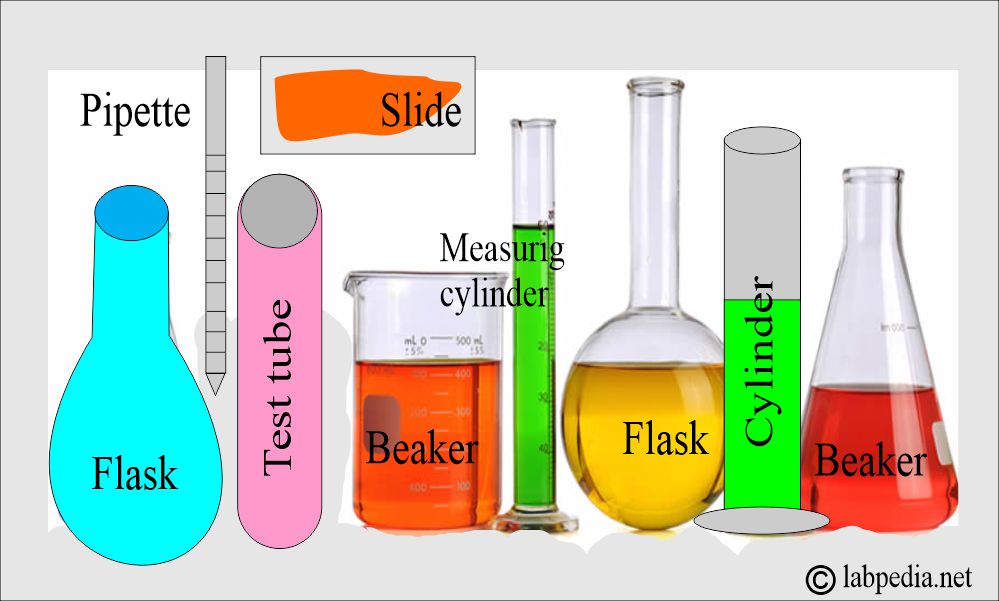
Laboratory glassware
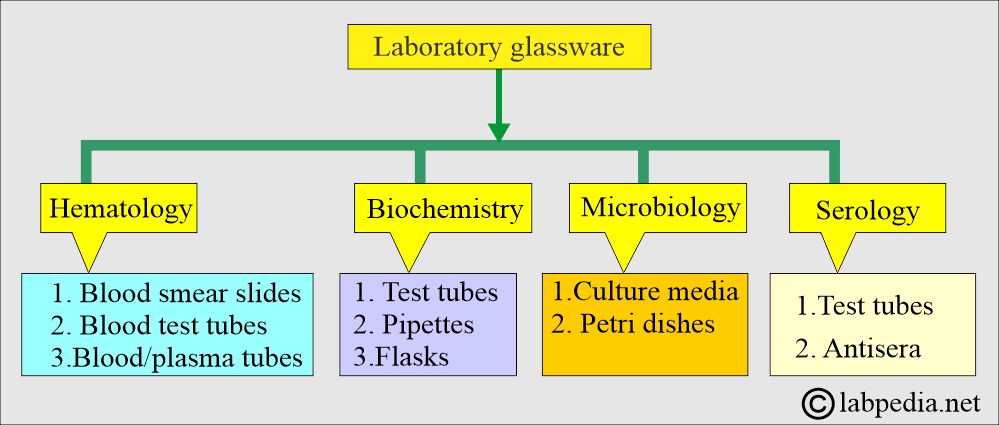
Laboratory glassware
What are the options to clean the glassware?
- In most of the big labs, glassware is washed in three steps:
- Automatic washer:
- Followed by a special rinsing cycle.
- Then, keep it in the automatic dryer (below 100 °C).
- Stream of air or nitrogen: Rinse the glassware with a water-miscible organic solvent and then expose it to a stream of air or nitrogen.
- Chemicals: The most commonly used for cleaning are chemicals.
What are the most common methods to clean glassware?
- Decontaminate the glassware by immersing it in 5% bleach or boiling it.
- Can use any detergent or cleaning powder.
- Autoclaving may be an alternate method.
- If the glassware is soaked in water after use, that is ideal.
- If any is left over, keep it in the detergent solution overnight.
- Now rinse with tap water, then with deionized water.
- The most common disinfectants are:
- Chlorine-releasing chemicals in which chlorine is active against Gram-positive and Gram-negative bacteria, including HIV and HBV.
- Examples include hypochlorite (bleach solution) used for domestic and laundry purposes.
- Aldehydes are formaldehyde and Glutaraldehyde.
- Alcohol used in ethanol or propanol is 70%-80% (v/v).
- Phenols like hycolin, Clearsol, Stericol, and Printol.
- Chlorine-releasing chemicals in which chlorine is active against Gram-positive and Gram-negative bacteria, including HIV and HBV.
- In the case of new glassware:
- Boil the glassware in a detergent solution, which will cause the organism to lyse.
- Cool and wash thoroughly in tap water, followed by draining.
- Dry in a hot air oven.
- Sterilize by autoclave at 15 lbs for 20 minutes.
- In the case of handwashing:
- The detergents must be nonionic, metal-free, and not highly alkaline.
- Also, ensure adequate rinsing.
How will you check the cleaning of glassware?
- The best test to see the cleanliness of the glassware is:
- Observe the glass surface as the final rinse water drains off.
- The water should move with a sheeting action, leaving a thin film over the surface.
- The piece is not clean if the film breaks into droplets or the surface is unevenly wet.
- This process can be made easier if:
- Empty all the glassware after the tests.
- Rinse with water.
- Soak in a detergent solution.
- For sensitive tests, use disposable test tubes.
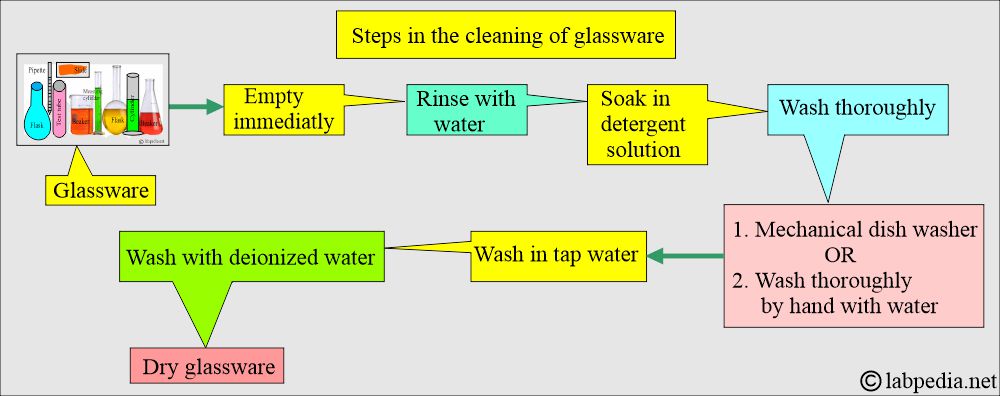
Steps in the laboratory glassware washing
What are the chemical options?
Chemical cleaning Basics steps are:
- It’s generally easier to clean glassware if you do it right away.
- When detergent is used, it can be commercially available in the form of Liquinox or Alconox.
- The detergent should meet the following criteria:
- It can soften the local water supply.
- It should be able to remove organic material at 60 °C.
- It should have a neutral pH after rinsing with water.
- Glassware should be free of the microbiological organism after the following rinsing.
- The detergent should meet the following criteria:
- Much of the time, detergent and tap water are neither required nor desirable.
- You can rinse the glassware with the proper solvent.
- Then, finish up with a couple of rinses with distilled water.
- A final rinse follows this with deionized water.
What are the common Lab Chemicals used for Glassware?
- Water-soluble solutions, e.g., sodium chloride or sucrose solutions.
- Rinse 3-4 times with deionized water.
- Water-insoluble solutions. e.g., solutions in hexane or chloroform. Rinse 2-3 times with ethanol or acetone.
- Rinse 3-4 times with deionized water,
- Strong Acids. e.g., concentrated HCl or H2SO4. Wash under the fume hood.
- Carefully rinse the glassware with copious volumes of tap water.
- Rinse 3-4 times with deionized water. Then let it dry.
- Strong Bases, e.g., 6M NaOH or concentrated NH4OH. Wash under the fume hood.
- Carefully rinse the glassware with copious volumes of tap water.
- Rinse 3-4 times with deionized water, then let it dry.
- Weak Acids, e.g., acetic acid solutions or dilutions of strong acids such as 0.1 M or 1 M HCl or H2SO4.
- Rinse 3-4 times with deionized water and then let it dry.
- Weak Bases, e.g., 0.1 M and 1 M NaOH and NH4OH. Rinse thoroughly with tap water to remove the base.
- Then rinse 3-4 times with deionized water and let it dry.
How will you wash special Glassware used for Organic Chemistry?
- Rinse the glassware with the appropriate solvent.
- Use deionized water for water-soluble contents.
- Use ethanol for ethanol-soluble contents, followed by rinses in deionized water.
- Rinse with other solvents as needed, followed by ethanol and deionized water.
- If the glassware requires scrubbing, scrub with a brush using hot, soapy water, rinse thoroughly with tap water, followed by rinse with deionized water
How will you wash with soap and water?
- Soak the glassware in a soap solution for 10 to 15 minutes, or leave it overnight.
- Scrub with a brush, cloth, or sponge if needed.
- Rinse thoroughly with tap water.
- Again, rinse with distilled or deionized water.
- If you need this glassware soon, rinse it with acetone or ethanol.
How will you clean used Burets (Cleaning)?
- Wash with hot, soapy water, and rinse thoroughly with tap water.
- Then, rinse 3-4 times with deionized water.
- Burets need to be thoroughly cleaned before use in quantitative lab work.
How will you clean Pipettes and Volumetric Flasks (cleaning)?
- May need to soak the glassware overnight in soapy water.
- Clean the pipette and volumetric flasks using warm, soapy water.
- The glassware may require scrubbing with a brush.
- Rinse with tap water and 3 – 4 rinses with deionized water.
How will you dry the Glassware?
- If glassware is to be used immediately after washing, it must be dry.
- Rinse it 2-3 times with acetone. This will remove any water and will evaporate quickly.
- It is not a great idea to blow air into glassware to dry it.
- Acetone may be used for a final rinse of sensitive or urgently needed glassware. The solvent is miscible with water and helps dilute the remaining water in the glassware and wash it away.
Wash labware as quickly as possible after use:
- If a thorough cleaning is impossible immediately, put the glassware in water to soak.
- If labware is not cleaned immediately, it may become impossible to remove the residue.
- Before washing, put into acid water (1% hydrochloric or nitric acid). It can be kept in this solution for several hours.
- Brushes with wooden or plastic handles are recommended as they will not scratch or abrade the glass surface.
How will you clean used, dirty glassware?
Chromic acid method:
- If glassware becomes unduly clouded or dirty or contains coagulated organic matter, it must be cleaned with chromic acid.
- When the chromic acid solution is used, the item may be rinsed with the cleaning solution or filled and allowed to stand.
- Time depends on the amount of contamination on the glassware. Relatively clean glassware may require only a few minutes.
- If it is more contaminated, then keep it overnight.
- Special types of precipitates may require removal with nitric or sulfuric acid. These are undoubtedly very corrosive.
How will you clean hematological glassware?
Hematological glassware used needs special precautions:
- Do not use detergents because if there is a minute concentration, that may lead to RBCs’ hemolysis.
- So, for general Tubes, pipettes, and slides, wash thoroughly under tap water. You can use a brush to remove any leftovers from the glassware.
- Keep the hematology-used material in a dichromate solution for 12 to 24 hours. Then wash thoroughly with tap water.
- Allow draining.
- Dry in the hot oven.
How will you clean the blood pipettes?
- Tap water can be drawn through these pipettes using a suction pump or a handheld one.
- Use distilled water for suction and washing.
- Lastly, can use acetone for the same purpose.
- Let them dry in the air.
- If there are blood microclots, keep them in 10% potassium hydroxide for 12 to 24 hours.
How will you conclude the Important Facts?
- Clean the glassware as soon as possible.
- In the event of a delay, place the glassware in water.
- In the case of late cleaning, the residue may not be removed.
- Before washing, new, slightly alkaline glassware must be soaked in acid water (1% HCl or HNO3) for several hours.
How will you prepare the cleaning solution in the lab?
- Sodium dichromate = 20 grams (technical grade).
- H2SO4 (concentrated, technical grade) = 300 mL.
- Procedure:
- Mix sodium dichromate in water to make a thick paste.
- Add H2SO4 carefully in small quantities while stirring constantly.
- Take the clear upper solution for use.
- Can use it until the dichromate turns reddish.
- Discard when it changes from reddish to green color.
- This solution can remove organic and inorganic materials due to its strong oxidizing power.
- Should not use this solution on plasticware except Teflon.
- After cleaning with sodium dichromate, thoroughly rinse with tap water and reagent water.
- Precautions:
- This is a powerful corrosive reagent, so wear rubber gloves, safety glasses, and a rubber or plastic apron.
- Nitric acid (HNO3)
- Strong nitric acid is used, which is better to use in the hood.
- Hydrochloric acid (HCL)
- This is used as I mol/L or less.
- This will not need a hood.
What are the drying methods for glassware?
Various methods are:
- Air drying.
- Oven at a temperature below 100 °C, and the laboratory ware kept bottom up.
- Sometimes, the glassware is rinsed with a water-miscible organic solvent and then exposed to a stream of air or nitrogen.
- Store the glassware and protect it from dust.
What are the hazards and safety of the glassware?
- The main hazard is an injury while handling this damaged glassware.
- Avoid disposable glassware because it is thin-walled and easily breakable. These are not for cleaning and reuse.
- Buy cover glass No. 2 because these are thicker and less easily damaged.
- Check before use for any cracks, breaks, or chipped ends. These may cause injury while handling. It is better to discard all this glassware.
- Never centrifuge damaged glassware.
- When handling glassware, wear protective gloves.
- Discard the broken glassware in special bags marked with a sharp symbol.
- When there is broken glass on the floor, immediately clean the floor.
Plastic labware (Plasticwares)
- Whenever possible, use plasticware instead of glassware.
- Plasticware is now available in the form of beakers, graduated cylinders, bottles, funnels, centrifuge tubes, pipettes, and tubing.
- Advantage:
- Plasticware is unbreakable.
- It does not release ions like glassware.
- There is high corrosion resistance.
- Disadvantage:
- It tends to bind various solutes, resulting and surface-bound material in the subsequent solution.
- Polyethylene is permeable to water vapor, even in tightly stoppered bottles. This will lead to reagent concentration.
- Polyethylene is not inert and may bind or absorb proteins, dyes, iodine, stains, and picric acid.
What are the types of plasticware?
Polyethylene:
- These are used to make bottles, beakers, jars, jugs, funnels, pipet jars, tanks, buret covers, check valves, needle valves, hollow stoppers, etc.
- Advantages:
- These are cheaper than polypropylene and are used in most disposable plasticware.
- Disadvantages:
- It is permeable to water vapors. This will lead to reagent and calibrator concentration.
- It is not completely inert, and it can absorb proteins, dyes, stains, iodine, and picric acid.
Polyolefins:
- Advantages:
- Concentrated H2SO4 (sulphuric acid) slowly attacks it at room temperature.
- These are unaffected by acids, alkalis, salt solutions, and most aqueous solutions.
- Disadvantages:
- These are chemically relatively inert.
- Aromatic, aliphatic, and chlorinated hydrocarbons cause moderate swelling at room temperature.
- Organic acids, essential oils, and halogens slowly penetrate these plastic wares.
Polypropylene:
- Advantage:
- It can withstand high temperatures.
- It can be sterilized.
- Disadvantage:
- It absorbs pigments and tends to become discolored.
Polycarbonate:
- These are also used to make various laboratory utensils.
- Advantages:
- These are twice as strong as polypropylene.
- These can be used by heating in the range of -100 °C to +160 °C.
- These are used extensively in centrifuge tubes and graduated cylinders.
- Disadvantages:
- These are unsuitable for strong acids, bases, or oxidizing agents.
- Chlorinated aliphatic and aromatic hydrocarbons will dissolve them.
- It is insoluble in aliphatic hydrocarbons, some alcohols, and dilute aqueous acids and salts.
Fluorocarbon resin (plastic, Teflon):
- These are the unique plastic wares that make them chemically inert.
- Advantages:
- These are resistant to corrosion at high temperatures.
- Teflon resists extreme temperatures ranging from -270 °C to +255 °C.
- Bottles and beakers made of this material are suitable for cryogenic experiments.
- These are translucent and white.
- These are inert to corrosive reagents such as boiling HNO3 or H2SO4 acids.
- These will also tolerate boiling hydrocarbons, ketones, esters, and alcohols.
- Teflon is used for self-lubricating stopcocks, stirring bars, bottle cap liners, and tubing.
- It is quite easy to clean and fast-drying.
- Disadvantage:
- It can easily be scratched.
- It can easily be bent.
Physical properties of the various types of plastic wares:
| Type of the plastic | Maximum tolerable temperature | Possibility of autoclave | Transparency |
| Low-density polyethylene | 80 °C | Not possible | Translucent |
| High-density polyethylene | 120 °C | Not possible | Translucent |
| Polypropylene | 135 °C | Possible | Translucent |
| Teflon (fluorinated ethylene propylene) | 205 °C | Possible | Translucent |
| Tefzel (Ethylene-tetra-fluoroethylene) | 150 °C | Possible | Translucent |
| Polycarbonate | 135 °C | Possible | Clear |
| Polyvinyl chloride | 70 °C | Not possible | Clear |
How will you clean the plasticware?
Whenever possible, use plastic laboratory ware.
- Advantages are:
- These are non-breakable.
- Do not release ions into the solution, as glass does.
- This plasticware can be cleaned in the washing machines.
- Ultrasonic cleaners can be used when you keep this plasticware on the transducer diaphragm.
- Polypropylene, Teflon, and polymethylpentene may be repeatedly autoclaved under normal conditions.
- Polycarbonate should be autoclaved at 121 °C for 20 minutes.
- Disadvantages are:
- These tend to bind various solutes.
- Polyethylene is permeable to water vapors.
- This evaporation leads to the concentration of the reagents and standards.
- So don’t keep a small amount of the reagent in oversized plastic tubes.
- Polyethylene is not completely inert and can bind or adsorb proteins, dyes, stains, iodine, and picric acid.
- Avoid doing the creatinine test in plastic test tubes; use glass tubes.
- Colorless reagents may bind to plasticware without being detected.
- It is observed that there is a slow reduction of the ceric and cuprous ions in polyethylene bottles.
- Should avoid abrasive cleaners and strong oxidizing agents.
What are the facts about plasticware?
- Plasticware should be well cleaned and then rinsed with deionized water before sterilization.
- The above cleaning is essential because certain chemicals adversely affect the autoclave temperature.
- Polystyrene, polyvinyl chloride, styrene-acrylonitrile, and polyethylene are not autoclavable, so these may be sterilized with gas (ethylene oxide).
- The above plasticware can also be sterilized by rinsing it with benzalkonium chloride.
- Except for Teflon, no other plasticware should be sterilized in hot air because of oxidative degradation.
- Plasticware may be dried in an oven at 110 °C.
What is the process of Sterilization?
- The following methods can be used for sterilization:
- Dry Heat:
- Sterilization has limited value. Prolonged exposure may cause damage.
- Hot air oven:
- Where heat is transferred by convection, conduction, or radiation.
- A temperature of 100 °C for one hour can destroy the nonsporing organism. Fungal spores need 115 °C for one hour.
- Other bacteria require 160 °C for 1 hour.
- Incineration:
- Where the flame is an effective way of sterilization. Flame heat is needed for the culture loop.
- Moist heat:
- It is the most reliable method of sterilization. This is the most lethal agent to kill microorganisms.
- Microbial death results from the coagulation and denaturation of proteins and enzymes.
- Boiling:
- It is not effective in killing spore-bearing bacteria and for surgical instruments.
- Steam sterilization:
- Steam sterilization, or Tyndallization, involves exposure to steam at 100 °C for 90 minutes. This is a good way to sterilize media containing sugar.
- The autoclave:
- It heats water under pressure, which boils at progressively higher temperatures. This method is good for rubber materials and surgical instruments.
- Membrane filters:
- These are Millipore filters. Filters with a pore of 0.22 micrometers are sufficient for bacteria.
- Seitz filter:
- It is a disposable asbestos pad filter.
- Flaming:
- It is when the material is wetted by alcohol and then flamed. This method is rapid.
- Ultraviolet light:
- It causes damage to bacteria.
- Radiation:
- Radiation in the form of beta and gamma X-rays is used for surgical pads.
- Supersonic and ultrasonic:
- These waves, 9000 cycles per second or above, rupture and disintegrate the cells.
Questions and answers:
Question 1: Is there any complication of dry heat?
Prolonged dry heat leads to damage to the glassware.
Question 2: What are the advantages of the plasticware in comparison to glassware?
Plasticware does not release ions into the solution.
Excellent ,I learn more things from your’s.
Thanks
Thanks for the remarks.
Thank you very much, I really appreciate your efforts.
My Regards
Thanks a lot.
Thank you for your contribution, I’m really appreciate thank you very much
Thanks
Hello! I loved this article and was wondering if you have best practices for using Potash (Potassium Hydroxide) Food Grade to clean/sterilize glassware
I really don’t know, and I think it is safe for foods, but it may not clean the contaminated laboratory glassware.
Hello Sir, can we wash the 50ml centrifuge tubes acetone. If it is possible what is the procedure to clean the tubes with acetone.
Please see this reference:
ACETONE. … Acetone is an excellent way to remove organic residues on your glassware, and it is used like “water” by organic chemists. It can also help dry your newly washed glassware after it has been rinsed with DI water if you plan on using it in the same lab period and don’t have time to wait for your DI water to dry.
Another reference:
Acetone is used for the common cleaning of laboratory wares for a few reasons. Firstly it’s because Acetone is a very good solvent, it is a very polar substance that dissolves almost all organic compounds, which is obviously critical if you’re cleaning. It is water-miscible, so can be used in conjunction with water.
Can glassware containing formaldehyde be cleaned such that it would be considered safe for foods?
These methods are for laboratory glassware. I don’t think we can use it for foods.
why do you need to clean all moisture content on a glassware before putting it in the hot oven air for sterilization?
If you don’t remove moisture, it will leave spots on the glassware.
We have every kind of glassware in our lab and the methods you mentioned are already in use. All I was wondering about was the thing whether there is any liquid in the market for cleaning lab glassware or a spray wipe which will make work easier?
I am sending you some links”
https://www.fishersci.com/shop/products/fisherbrand-losuds-liquid-glassware-detergent/13641730?ef_id=Cj0KCQjwhsmaBhCvARIsAIbEbH5JXUKeoQlJhrssUA-P6Qo4G51i_NyAFXwa3A6kAkGJ11mrYe0dERsaAhv1EALw_wcB:G:s&ppc_id=PLA_goog_16713066638__13641730___7624972691594846525&ev_chn=shop&s_kwcid=AL!4428!3!!!!x!!13641730&gclid=Cj0KCQjwhsmaBhCvARIsAIbEbH5JXUKeoQlJhrssUA-P6Qo4G51i_NyAFXwa3A6kAkGJ11mrYe0dERsaAhv1EALw_wcB
https://www.fishersci.com/us/en/products/I9C8L9O4/labware-detergents-cleaners.html
You can also see options on Amazon.com.
Dear Dr. Riaz, Can you advise on the Class A glassware cleaning? What is the maximum temperature at which it can dry? Do you have any regulatory or manufacturer evidence to justify the same?
Please see this link:
https://www.labmanager.com/lab-health-and-safety/how-to-clean-laboratory-glassware-20325
I really appreciate about such nice information.
Thanks for the comments.
How long can autoclaved glassware last in an open, cool temperature of 21°c?
I am sending you a few references from a google search:
1. Supplies wrapped in double-thickness muslin comprising four or equivalent layers remain sterile for at least 30 days. Any item that has been sterilized should not be used after the expiration date has been exceeded or if the sterilized package is wet, torn, or punctured.
2. Conclusion: For small metal instruments, autoclaved packages in double-wrapped linen or double-wrapped plastic-paper combinations can be stored safely for at least 96 weeks.