
Lab Workup to Diagnose Diseases, Factors Affecting the Tests
Lab Workup to Diagnose Diseases
- There are various tests to diagnose diseases. We can discuss the tests used to diagnose diseases one by one.
What are the various types of tests to diagnose diseases?
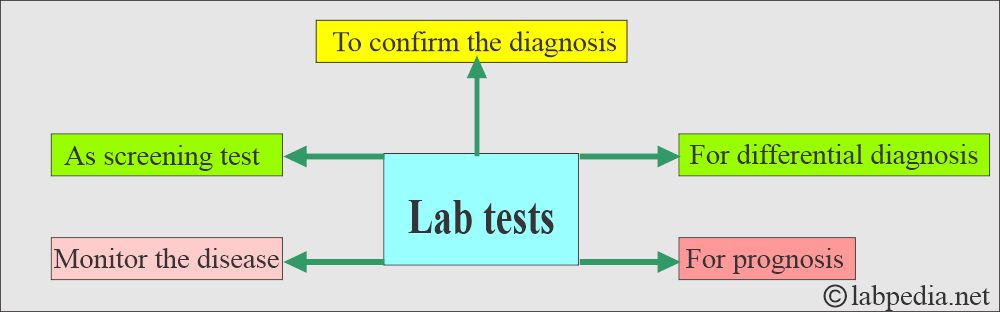
- Various tests are performed to diagnose and monitor diseases. These are as follows:
- Screening test:
- These are the simplest ways to suspect diseases, such as sugar in the urine, which can indicate diabetes.
- Raised levels of PSA may need to rule out the possibility of prostatic cancers.
- Fecal occult blood may need to rule out colon cancer.
- Diagnostic tests:
- These are specific tests to confirm the disease, like a colon biopsy to confirm colon cancer.
- ECG to confirm heart disease.
- Hormones such as T3, T4, and TSH are used to diagnose thyroid diseases.
- Monitoring or follow-up tests:
- These tests are done to know the progress of the disease.
- CA-125 may increase with the uncontrolled spreading of ovarian cancers.
- ESR may become normal in patients with tuberculosis.
- Serial estimation of liver enzymes provides insight into improving or deteriorating liver function.
Lab workup for the diagnosis of various diseases
- Surgical procedures:
- These are like a biopsy or an FNA (fine-needle aspiration cytology), which may provide a diagnosis of cancer or a benign lesion.
- A liver biopsy may give us the grades of chronic hepatitis or malignancy.
- FNA of the breast is a very useful tool for diagnosis with an accuracy of above 95% for benign or malignant breast diseases.
- Radiological procedures:
- Nowadays, radiological procedures have advanced, enabling the diagnosis of various bone diseases, such as benign osteochondroma and malignant osteogenic sarcoma.
- A Barium meal or a Barium enema can diagnose GIT diseases.
- Ultrasonography:
- This specialty has progressed a lot. It is a non-invasive procedure and helps diagnose any mass in the liver, ovary, or any other part of the body.
- This can also be used for tumor follow-up.
- This can be used to guide the FNA procedures.
- CT scan:
- This is computerized tomography, and it gives more detailed information than a simple X-RAY.
- This can also provide a better estimate of tumor size.
- This is a very useful tool for diagnosing brain pathology, such as CNS tumors.
- MRI:
- This is magnetic resonance imaging and is more accurate than a CT scan.
- It can detect a tumor as small as 5 mm in diameter.
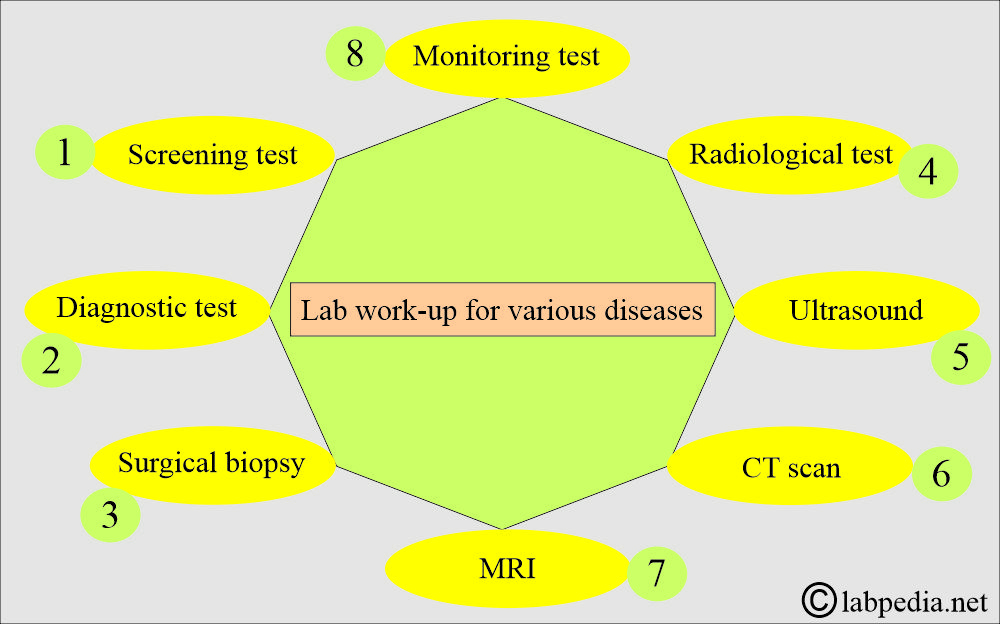
Lab Workup to Diagnose Diseases: Lab workup for diagnosis of diseases
What is the significance of tests in various body fluids?
- Body fluids such as CSF, ascitic fluid, and pleural fluid can also help diagnose various diseases.
- Ascitic fluid cytology may indicate the presence of malignant cells.
- CSF examination differentiates various types of meningitis.
What are the various samples collected from the patients?
- The following body fluid samples are used in routine testing.
Venous blood:
- Venous blood is easy to collect, indicating the body’s physiologic condition.
- Most tests, such as LFTs, Kidney function tests, CBC, and other biochemical tests, are performed on venous blood.
- This sample can be collected using a sterile needle from prominent veins like the arms and hands.
- Risk:
- The major risk in this procedure is a local hematoma, and infection is almost nonexistent.
- Precaution:
- Don’t take the blood when the patient has an intravenous infusion.
- A fasting blood sample:
- This sample refers to a fast of 8 to 12 hours during which no food or liquid is taken.
- The postprandial:
- This is the blood sample taken after a meal.
- Two hours after a meal, postprandial:
- This is the blood sample taken in the patient with diabetes mellitus.
Arterial blood:
- Arterial blood is needed to estimate blood gases.
- The blood sample is usually taken from the femoral artery in the groin.
- The radial artery at the wrist.
- The brachial artery at the elbow.
- Neonates can receive blood from the umbilical artery.
- Drawing blood from an artery requires an experienced person, such as a doctor, trained nurse, or technician.
Capillary blood:
- Capillary blood is taken in newborns or infants.
- Usually, the prick is done on the fingers or heel.
Serum:
- Whole blood is allowed to clot, during which all the clotting factors are removed.
- The best way is to keep the blood at 37 °C for 20 to 30 minutes, then the clear serum will separate, leaving the clotted blood at the bottom; or you can centrifuge the blood to obtain the clear serum.
- Procedure to get good serum:
- Take blood in the test tube, leave it for 20 to 30 minutes, and then centrifuge for 2 to 5 minutes, and you will get the clear serum.
- Not good serum:
- If the serum is reddish, discard it because it shows hemolysis.
- Hemolyzed serum interferes with the various tests.
- Serum is usually used for biochemical tests, hormone assays, and tumor marker assays.
Plasma:
- Plasma is obtained from the blood, which contains an anticoagulant.
- Mix the anticoagulant into the blood and centrifuge it. We will get clear plasma at the top and bottom, with RBCs, WBCs, and some clotting factors and proteins.
- This can be used for various tests but is not a good substitute for serum.
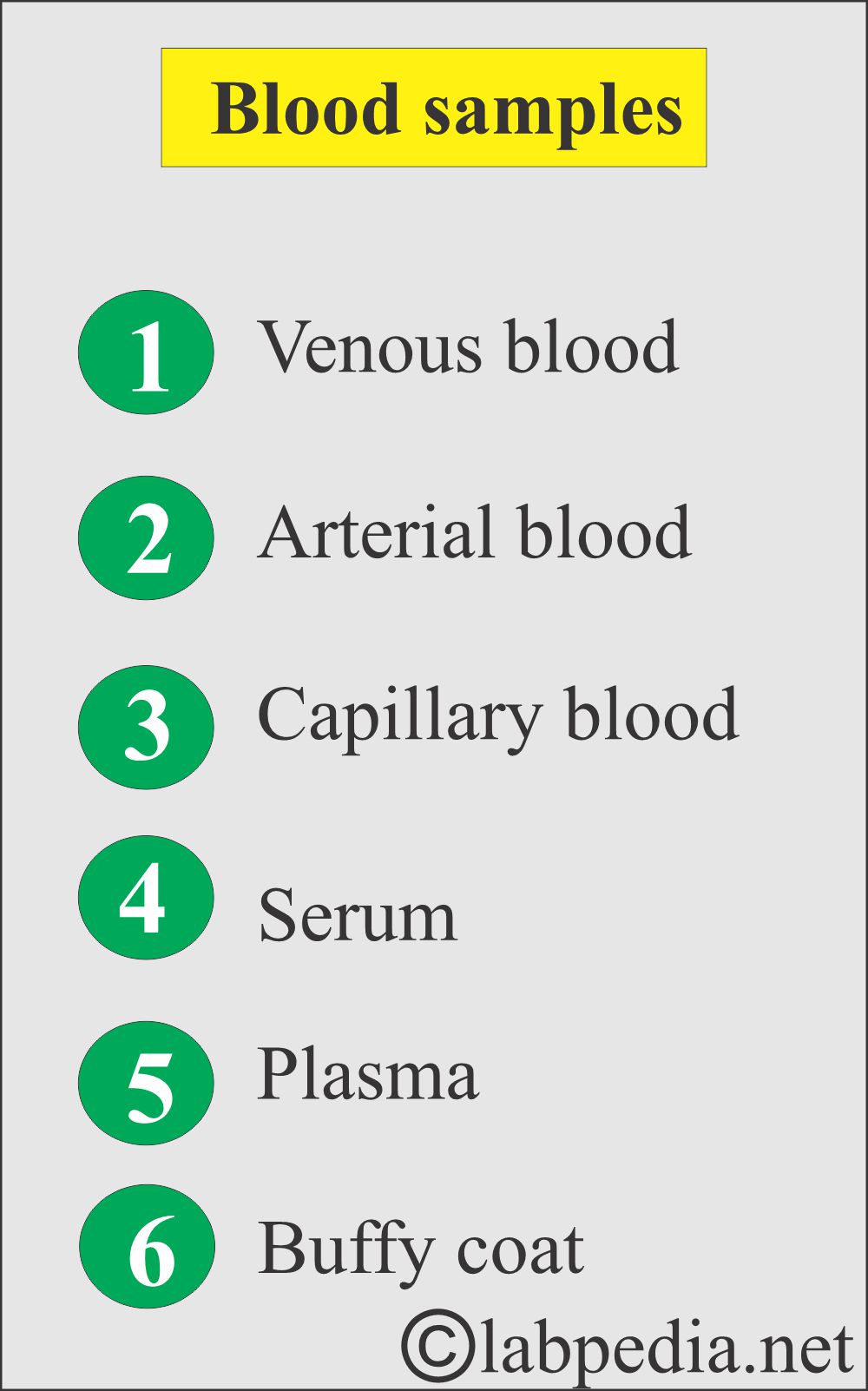
Blood samples
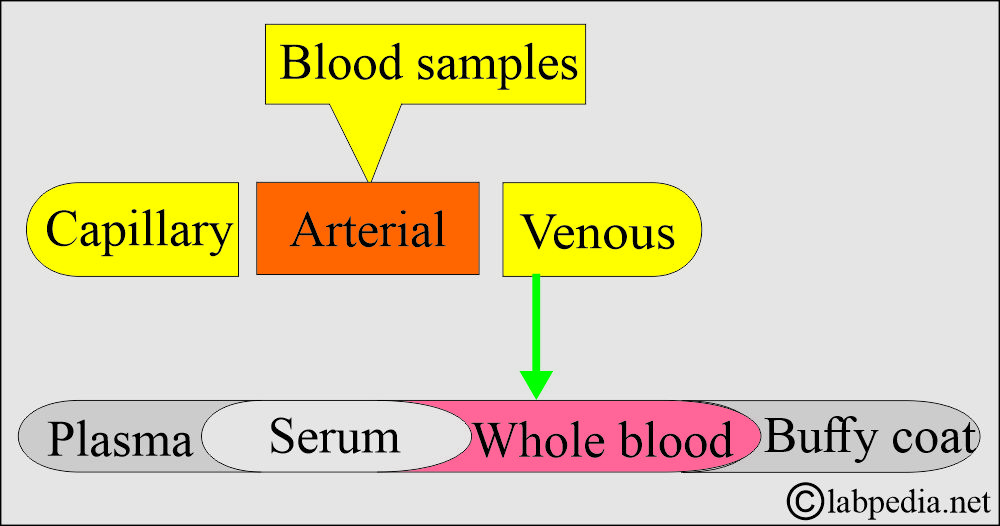
Various Blood sample types
Pleural fluid:
- This fluid is present in the pleural space.
- The needle removes this fluid, and the procedure is called Thoracentesis.
- This fluid is analyzed to diagnose malignancy and may be used for culture and biochemical tests.
Ascitic fluids:
- This fluid is collected from the abdominal cavity in case of ascites.
- This ascitic fluid may be analyzed to diagnose benign or malignancy. Also, some biochemical tests are done.
Synovial fluids:
- This is the joint fluid aspirated aseptically, and its analysis diagnoses its formation.
Cerebrospinal fluid:
- This fluid is present in the spinal canal and brain.
- It is aspirated from the spinal canal aseptically.
- A physician or anesthetist usually does this procedure.
- This fluid is used to diagnose various types of meningitis and can be cultured to find the causative organism.
Urine:
- Random samples may be taken for urine analysis.
- You can also collect 24-hour samples for urinary protein, urea, creatinine, or other biochemicals.
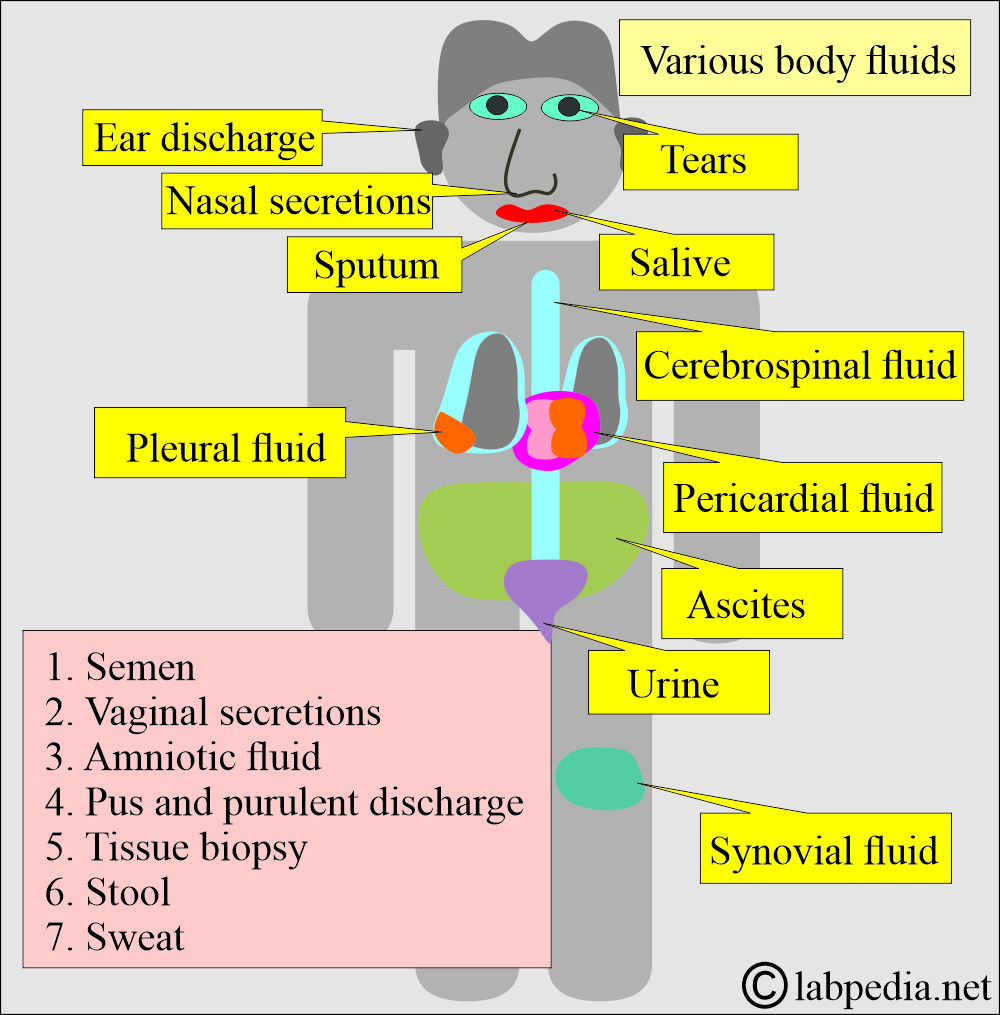
Body fluids from various sites
What factors affect the lab tests?
Hemolysis:
- Whenever there is traumatic venesection that leads to hemolysis due to rupture of the RBC.
- These RBCs release various enzymes and chemicals which interfere with the results. e.g., Potassium is quite high in haemolysed serum.
Anticoagulants:
- If added, an increased amount will affect the results.
Temperature:
- Some tests are temperature-sensitive, and frozen serum or plasma may be needed to preserve those chemicals. For example, the ACTH level needs frozen plasma.
- Some tests need serum to be at room temperature.
Fasting samples:
- Some tests require fasting samples, such as fasting glucose levels.
- We need a fasting sample for the Lipid profile because you will get higher values on the random sample.
Drugs interference:
- Some drugs, such as aspirin, Vitamin C, cold tablets, pain relievers, and antacids, can alter test results.
Sleeping habits and diet:
- It may alter the hormone levels.
Diurnal variation:
- Keep in mind the diurnal variation of some of the tests.
Exercise:
- It may affect the test results.
Food intake, such as:
- Food containing caffeine, which may affect the tests.
- Smoking containing nicotine will affect the tests.
- Alcohol intake will affect the tests.
What precautions will you take when taking a blood sample?
- If you apply a tourniquet and then take blood for calcium testing, the values will not be accurate.
- If you squeeze the finger to obtain sufficient blood, the values will be less accurate due to the dilution effect.
- When interpreting test results, keep in mind age, sex, height, and weight.
What precautions will you take before performing the lab tests?
- It is best to perform all the tests within 45 minutes to one hour after collection.
- Separate the plasma as soon as possible; don’t delay more than two hours.
- Premature separation of the serum will cause microclots. It may block the pipettes.
- Coagulation in the plastic containers is delayed more than 20 to 30 minutes.
- If the test is delayed, properly store the sample at the appropriate temperature.
- If the serum’s separation is delayed, keep the blood at room temperature to avoid hemolysis.
- If the test is not performed immediately, keep the serum at 4 °C.
- Centrifuge the tubes with the caps on; otherwise, evaporation will occur.
- The serum is needed for electrophoresis.
- For gases and ammonia, whole blood is needed.
- Serum is the preferred option for clinical chemistry, but plasma may be used.
- For plasma preparation, centrifuge the blood within one hour of sample collection for 10 minutes at 850 to 1000 X gravity.
- Cap the bottle to avoid evaporation.
How will you do the abdominal tap for ascitic fluid?
- Tapping peritoneal fluids is advised during this procedure:
- Usually, an 18- or 20-gauge needle is used.
- Usually, the lateral side of the abdominal wall, lateral to the umbilicus, is used; this site is sterilized before the procedure.
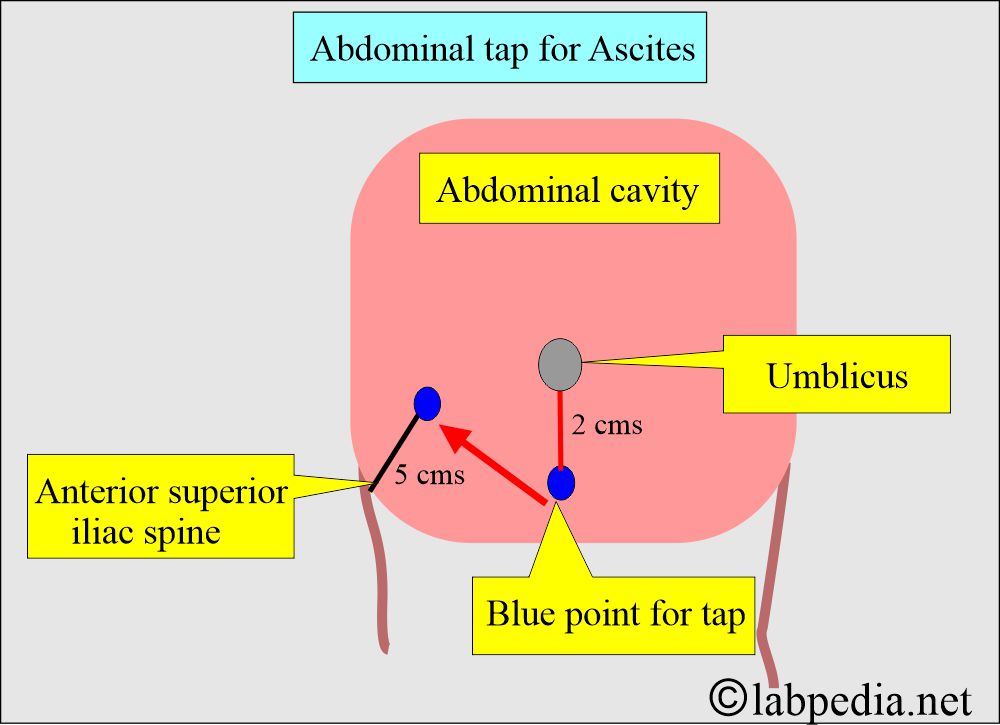
Ascites for abdominal tap
- One of the useful values in peritoneal fluid is the protein level, which is low in transudate (<3 g/dL) and high in exudate (> 3 g/dL). The high protein may be due to inflammation or malignancy.
- Unclotted blood indicates hemorrhage in the peritoneal cavity.
- The presence of inflammatory cells suggests pancreatitis, appendicitis, organ rupture, or malignancy.
- Normally, there are few mesothelial cells.
Questions and answers:
Question 1: How much is protein in the exudate?
Protein in the exudate is <3 grams.
Question 2: Is there any effect of diurnal variation on the lab tests?
Some of the hormones have diurnal variation.