
Intrinsic factor Antibody (IF-Ab)
Intrinsic Factor Antibody (IF-Ab)
What sample is needed for Intrinsic Factor Antibody (IF-Ab)?
- The patient’s serum is needed.
- This test can also be done on the plasma.
- The sample is stable for 4 hours at room temp.
- When refrigerated, the sample remains stable for 3 days.
- For the assay of intrinsic factors (IF), gastric juice aspiration is required.
What are the Indications for Intrinsic factor Antibody (IF-Ab)?
- To diagnose pernicious anemia.
What are the precautions for Intrinsic Factor Antibody (IF-Ab)?
- Avoid injection of vit. B12 within 48 hours of testing.
What is the mechanism of megaloblastic anemia?
- Megaloblastic anemia is due to vitamin B12 deficiency, the major cause.
- Intrinsic factor is secreted in the stomach, which is needed to absorb the vit. B12.
- The intrinsic factor is the protein produced by the parietal cells.
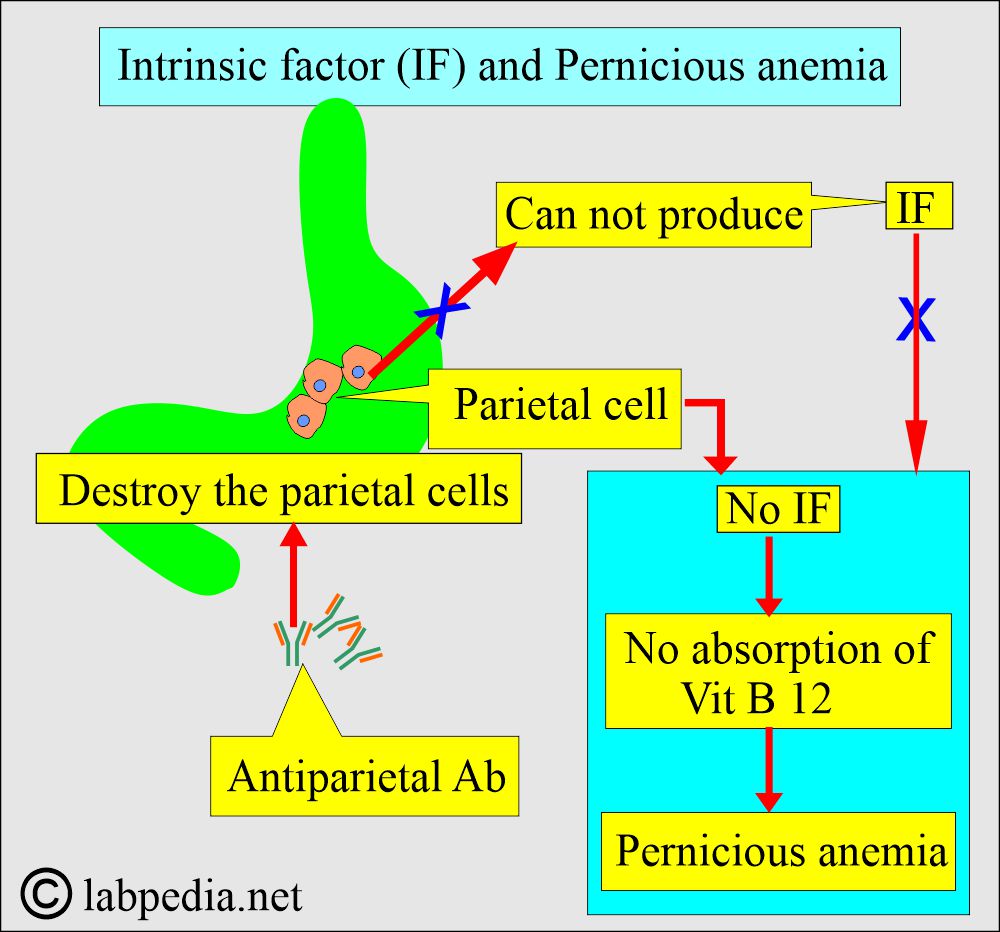
Intrinsic Factor Antibody (IF-Ab): Pernicious anemia mechanism
- The activation of the immune system produces antibodies against the intrinsic factor.
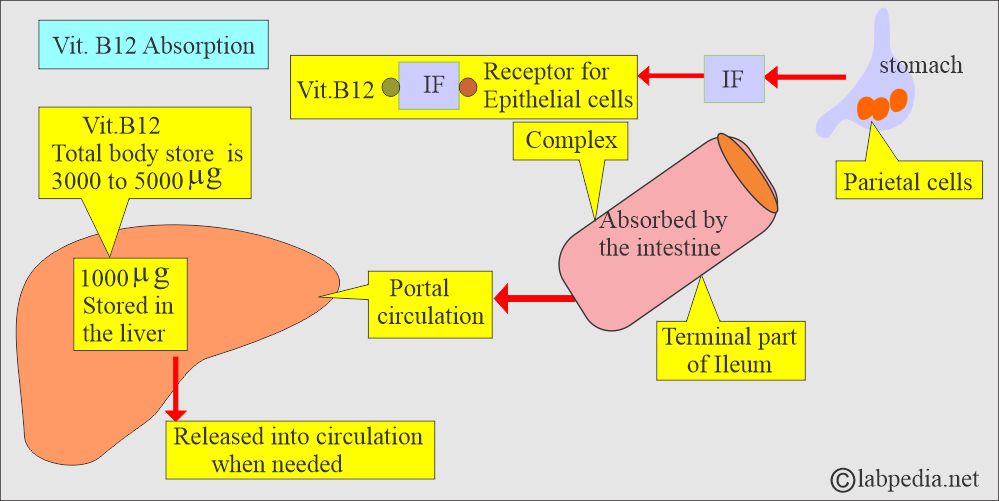
Intrinsic factor Antibody (IF-Ab): Vit. B12 + IF absorption
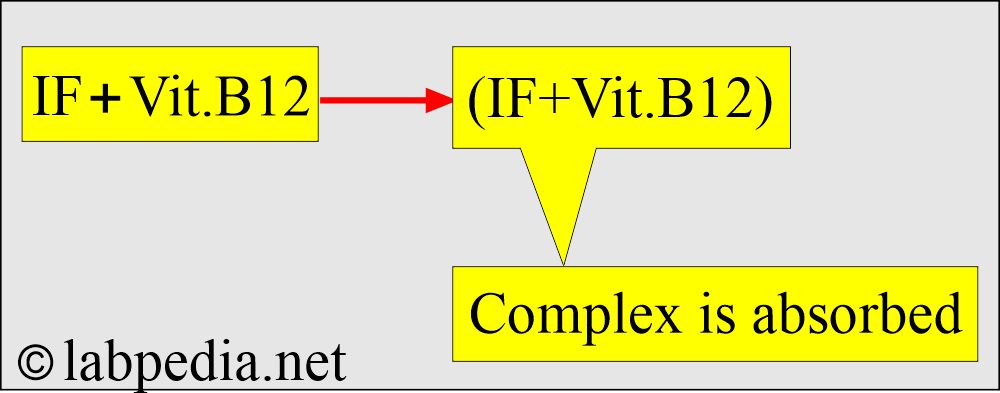
IF+Vit.B12 absorption
What is the mechanism of Pernicious anemia?
- In Megaloblastic anemia, IF is decreased or absent.
- This may be due to autoimmune diseases.
- IF-Ab is found in a high percentage of children with juvenile pernicious anemia.
- IF-Ab is positive in 50% to 70% of patients with pernicious anemia.
- IF-Ab is of two types :
- Type 1 blocking Ab, which is more common, blocks the binding of vit. B12 to IF. It is found in the serum of patients with pernicious anemia at around 40% to 50%.
- Another reference states that this antibody is typically present in 60% to 75% of patients with pernicious anemia.
- This antibody is diagnostic of pernicious anemia.
- Type II binding Ab (antibody) binds with the site on the intrinsic factor and is away from the vit. B12 site or combined with IF + Vitamin B12 complex.
- These are found in 40% of the pernicious anemia cases.
- The second antibody is less common and affects IF binding in the ileum.
- Type 1 blocking Ab, which is more common, blocks the binding of vit. B12 to IF. It is found in the serum of patients with pernicious anemia at around 40% to 50%.
- A positive IF-Ab is confirmatory and indicates the cause of the disease.
- A negative IF-Ab does not rule out megaloblastic anemia because 50% of patients do not show this antibody.
- One can supplement IF-Ab with an anti-parietal antibody test to diagnose Pernicious anemia.
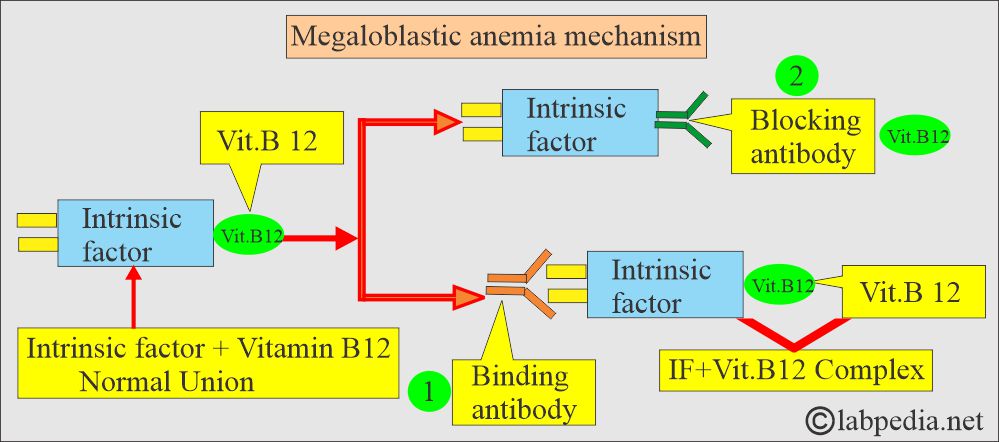
Megaloblastic anemia mechanism (intrinsic factor)
- Pernicious anemia rarely needs the vit B12 absorption test called the Schilling test.
- Testing the intrinsic factor antibody and the anti-parietal antibodies is easier, quicker, and more accurate.
- False-positive result:
- False-positive results are reported in diabetes mellitus, adrenal insufficiency, thyroid diseases, and various gastric abnormalities.
What do you know about Anti-parietal cell antibody?
- It is detected in 76% to 91% of the cases with pernicious anemia.
- It is much more nonspecific than the IF-Ab test.
- It is found in:
- 5% to 10% of the normal person.
- 30% to 60% of the patients with idiopathic atrophic gastritis.
- 12%-28% of patients with diabetes mellitus.
- 25%-35% of patients with thyrotoxicosis.
- 25% of the patients with Hashimoto’s thyroiditis.
What is the normal value of Intrinsic Factor Antibody (IF Ab)?
- Intrinsic factor antibody = Negative.
What are the conditions under which a Positive test for Intrinsic Factor Antibody (IF-Ab)?
- Increased IF-Ab is seen in a patient with pernicious anemia.
- The IF antibodies are present in 3% to 6% of hyperthyroidism and insulin-dependent diabetes.
Questions and answers:
Question 1: What is the mechanism of antibody for pernicious anemia?
IF antibody will block the site for vitamin B 12 site or occupy the other site on intrinsic factor.
Question 2: What is the mechanism of pernicious anemia?
It is caused by the antibody against the intrinsic factor, and this is an autoimmune disease.