
Immunoglobulin M (IgM), Waldenstorm’s Macroglobulinemia
Immunoglobulin M (IgM)
What sample is needed for Immunoglobulin M (IgM)?
- Fresh patient serum is needed.
- Analyze the sample as soon as possible or store it at 4 °C for a few hours (less than 72 hours).
- The sample is stable at -20 °C for 6 months.
What are the indications for Immunoglobulin M (IgM)?
- Used to detect monoclonal gammopathy.
- It diagnoses Waldenstrom macroglobulinemia.
- It is advised for those with immune deficiencies.
- It is advised in acquired IgM immunodeficiencies.
- The earliest immunoglobulin (IgM) is used in the diagnosis of infectious diseases.
What are the important facts about Immunoglobulin M (IgM)?
- IgM exists in two forms:
- The monomeric IgM form exists as a B-cell receptor for antigen.
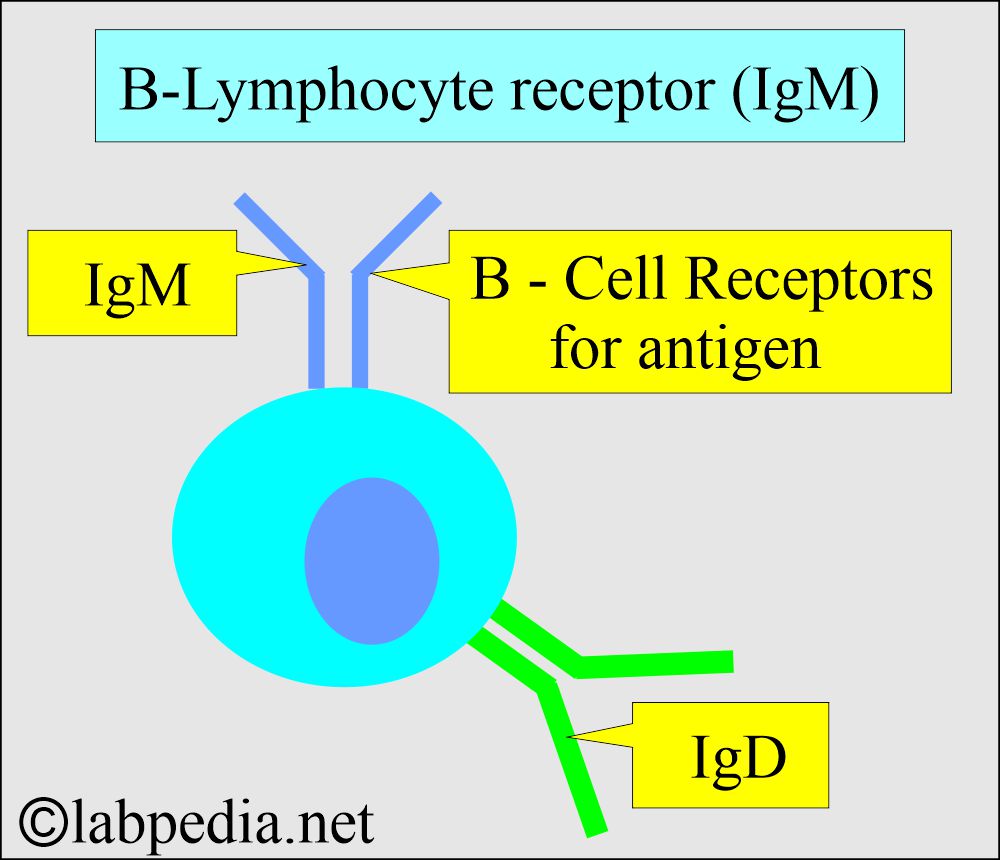
B- Lymphocyte receptor IgM
- The pentameric IgM form is present in the blood. It consists of five basic units and is joined by the J-chain.
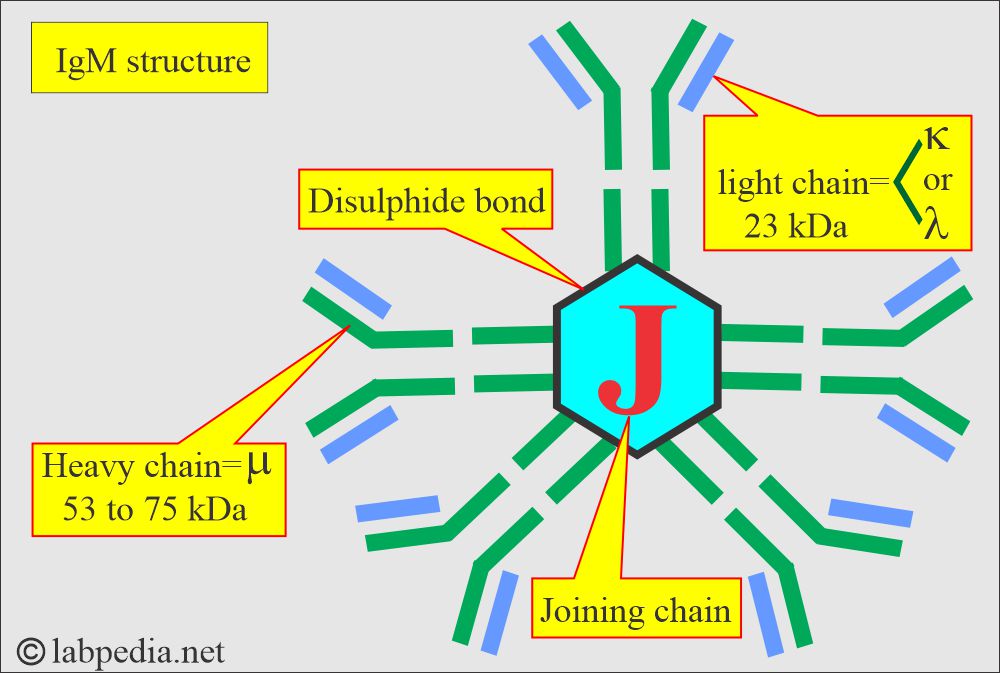
IgM structure
- It is 10% of the total immunoglobulin with a molecular weight of 900,000 and is 19S.
- Its concentration is 120 mg/dl.
- Its molecular weight is 900,000 and 19S.
- There are 10 potential antigen-binding sites.
What are the functions of IgM?
- IgM is the first antibody produced in response to antigenic stimulation, as part of the primary immune response.
- In primary response, B-Lymphocytes are stimulated, forming the plasma cells and producing IgM.
- IgM, as a pentamer form, is the most effective stimulator of the complement system for a lytic reaction.
- This is the first immunoglobulin to appear in fetal life, and its raised level in neonates indicates intrauterine infection.
- IgM has a half-life of 10 days.
- It is predominantly present in the intravascular spaces.
- It is a poor toxin-neutralizing antibody.
- It can not cross the placental barrier.
- Cold agglutinins are IgM antibodies.
- These are usually directed against the antigen on the RBC membrane.
- These may be 15% to 30% of the Coomb’s positive antibodies.
Waldenstrom’s macroglobulinemia:
How will you define Waldenstrom’s macroglobulinemia?
- Waldenstrom’s macroglobulinemia is a hyperviscosity syndrome caused by low-grade small-cell lymphoma and characterized by the production of abundant monoclonal IgM immunoglobulin.
- These are lymphoproliferative disorders characterized by monoclonal IgM production.
- This IgM has a molecular weight of 1,000,000 daltons, or 19S.
How will you discuss S/S of Waldenstrom’s macroglobulinemia?
- This condition has typical clinical S/S:
- There is hyperglobulinemia with rouleaux formation.
- There is a hyperviscosity syndrome. This may lead to the following:
- Neurological abnormalities.
- Shortness of breath.
- There are visual abnormalities and retinal changes.
- In some patients, it is interpreted as malignant lymphoma.
- Lymphadenopathy.
- Hepatosplenomegaly.
- ESR is markedly raised.
- Lymph node biopsy shows a mixture of mature lymphocytes and plasmacytoid lymphocytes.
- In some cases, the picture is of diffuse lymphocytic lymphoma.
- Bone marrow aspirate shows:
- Normal changes or hypercellular marrow.
- In some cases, this aspirate may be hypocellular.
- Nonspecific lymphoid infiltrates, and there are atypical lymphocytes.
- Lymphoma-like infiltrate.
- Radiological studies do not show punched-out osteolytic lesions, as seen in myeloma.
What is the normal level of Immunoglobulin M (IgM)?
Source 1
| Age | mg/dL |
|
|
|
|
|
|
|
|
|
|
|
|
|
|
|
|
- To convert into SI unit x 10 = mg/L
Source 2
- Adult = 55 to 375 mg/dL
- Children = 20 to 200 mg/dL
Another source
- 0 to <5 months = 26 to 122 mg/d
- 15 to <24 months = 46 to 152 mg/dL
- 2 to <4 years = 37 to 184 mg/d
- 10 to <13 years = 41 to 255 mg/dL
- 16 to <18 years = 49 to 201 mg/dL
- More than 18 years = 37 to 286 mg/dL
- Values vary from different methodologies.
What are the causes of decreased levels of Immunoglobulin M (IgM)?
- Decreased levels are seen in congenital deficiency diseases.
- In protein-losing syndrome.
- Non-IgM myeloma.
- Infancy and early childhood.
What are the causes of increased levels of Immunoglobulin M (IgM)?
- Elevations in IgM may be due to polyclonal immunoglobulin production, as seen in various infections.
- An isolated increase in IgM levels may be seen in viral infections, e.g., Viral hepatitis, infectious mononucleosis, and the early response to bacterial or parasitic infections.
- Increased levels of IgM may be seen in Rheumatoid arthritis, biliary cirrhosis, and some other chronic disorders.
- Raised levels are also seen in hyper-IgM dysgammaglobulinemia, active sarcoidosis, collagen vascular diseases, and nephrotic syndrome.
- Monoclonal raised levels are seen in :
- Waldenstrom’s globulinemia.
- Lymphomas.
- Chronic infections.
- Liver diseases.
Questions and answers:
Question 1: What is the diagnosis of Waldenstrom's macroglobulinemia?
There is an IgM peak on serum electrophoresis.
Question 2: What is the role of IgM?
IgM acts as an antibacterial, and its monomer form acts as an antigen-receptor.