
Homocysteinemia and Interpretation
What sample is needed for Homocysteine (Homocysteinemia)?
- This test can be done on the patient’s serum.
- Separate serum immediately and freeze within one hour.
- This can be detected in the urine.
What are the precautions for Homocysteine (Homocysteinemia)?
- 10 to 12 hours of fasting before the test is required.
- Patients with renal disease will have elevated homocysteine levels. This is due to poor protein excretion.
- The patient with a low Vitamin B intake has an elevated homocysteine level.
- Men have a higher level than women.
- Smoking will lead to a higher level of homocysteine.
- Drugs increase Homocysteine levels, such as methotrexate, nitrous oxide, phenytoin, and carbamazepine.
- Oral contraceptives influence the level.
What are the indications to measure Homocysteine (Homocysteinemia)?
- To diagnose homocystinuria.
- This is done to measure the plasma homocysteine level (homocysteinemia).
- It is done to detect a genetic or acquired excess of homocysteine.
- The patients are at risk of developing folate deficiency and cobalamin deficiency.
- In patients with unexplained anemia.
- Recurrent spontaneous abortion.
- Delayed development or failure to survive in infants.
- In cases of peripheral neuropathy and myelopathy.
- For the evaluation of cardiovascular disease.
- Where will you advise homocysteine to be estimated?
- This can be used to monitor malnutrition.
- In vegetarians who are not taking a B12 supplement.
- In patients aged 75 years or older.
- The patient is on the treatment of antiepileptic drugs and methotrexate.
- Increased risk for pregnancy complications and neural tube defects.
How will you define Homocteinemia?
- Homocysteinemia is caused by the genetic deficiency of methionine synthase, which is present on chromosome 1q43.
- There is an elevated level of Homocysteine.
- Homocysteine is the reduced (sulfhydryl) form, while homocystine is the oxidized (disulfide) form of homologous cysteine and cystine.
- This may also be caused by inherited disorders in folate or cobalamine metabolism.
- The above terms refer to the combined pool of homocystine and homocysteine and their mixed disulfides.
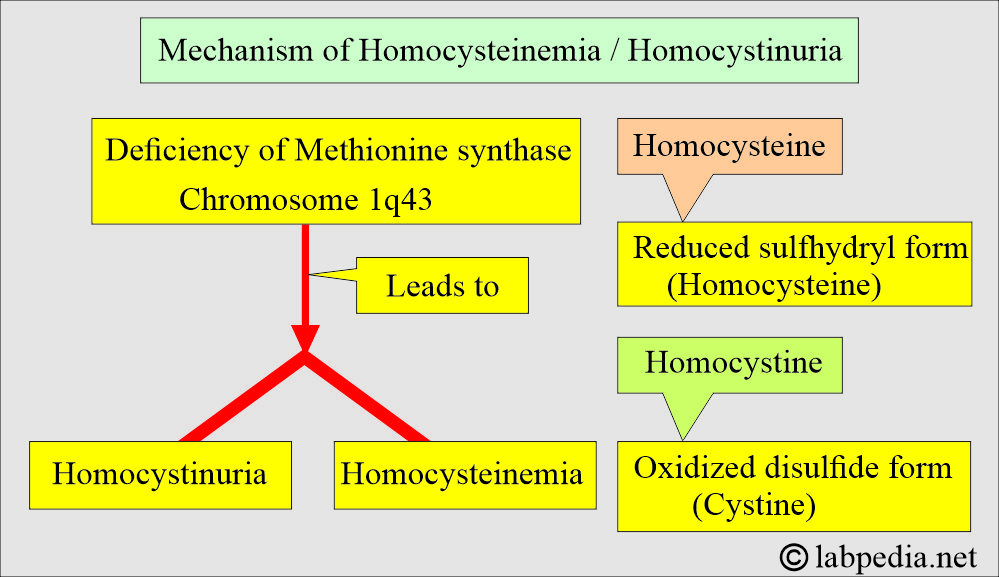
Introduction to Homocysteinemia /Homocystinuria
How will you describe the pathophysiology of Homocysteinemia?
- Homocysteine is a sulfur-containing amino acid.
- It is formed during the metabolism of methionine.
- It requires folic acid as a cofactor.
- It may be catabolized to cysteine in the presence of Vitamin B as a cofactor.
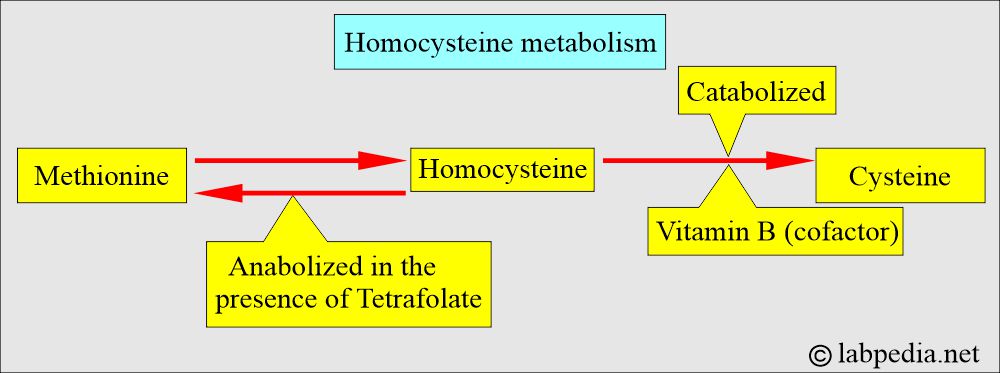
Homocysteine Metabolism
- Homocystine is an intermediate amino acid in the metabolism of methionine to cystine.
- The most common cause of homocystinuria is a deficiency of the enzyme cystathionine synthetase, resulting in elevated plasma and urinary homocystine levels.
- Homocysteinemia is the elevation of homocysteine in the blood.
- Vitamins are the cofactors involved in the metabolism of Methionine to homocysteine.
- Folic acid acts as a cofactor.
- The common non-genetic elevated level of homocysteine is caused by a deficiency of B6, B12, or folate.
- Homocysteine does not accumulate in the blood because it is unstable in an aqueous solution; when it is in excess, it will undergo oxidation and give rise to homocystine.
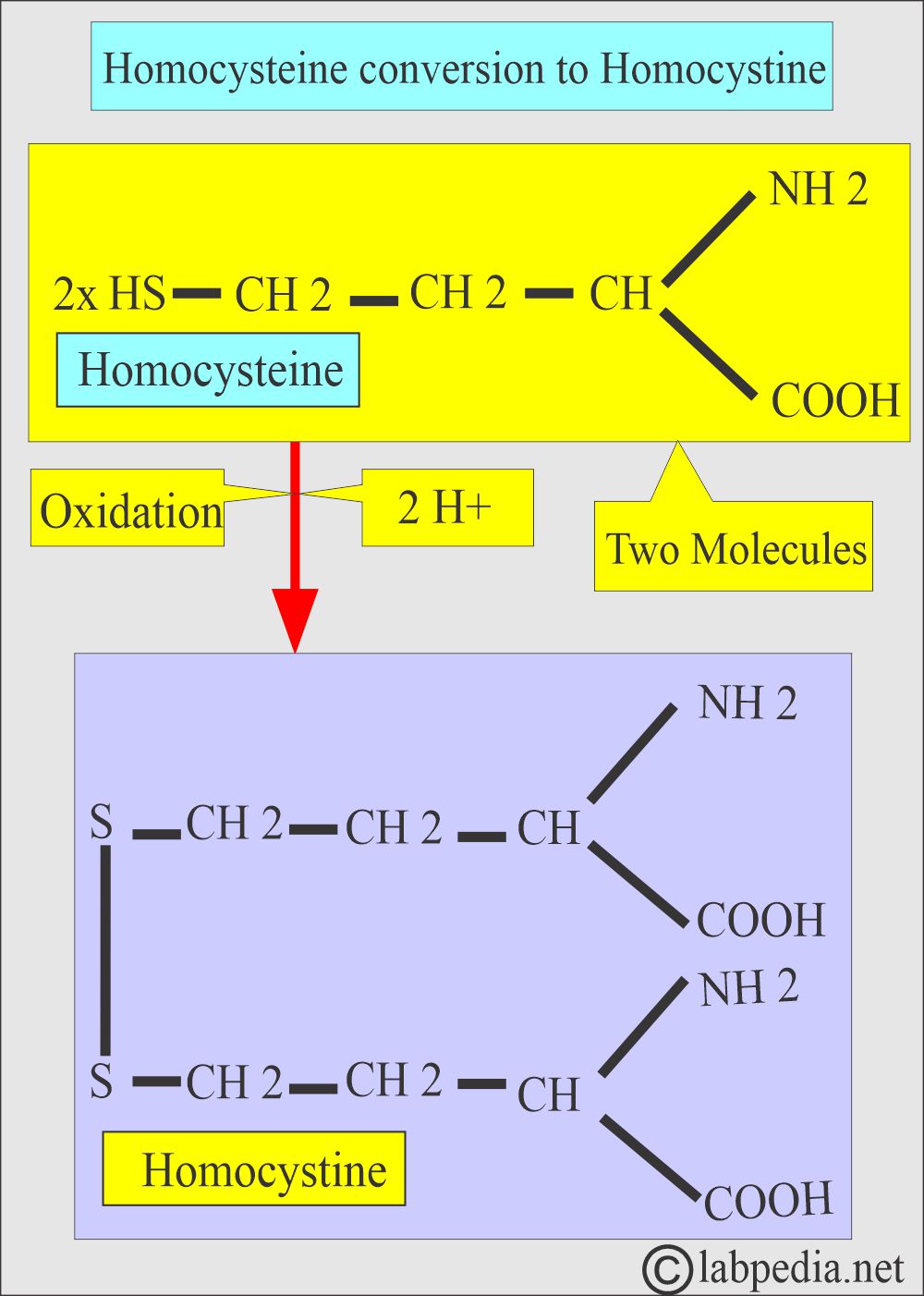
Homocysteine conversion to Homocystine
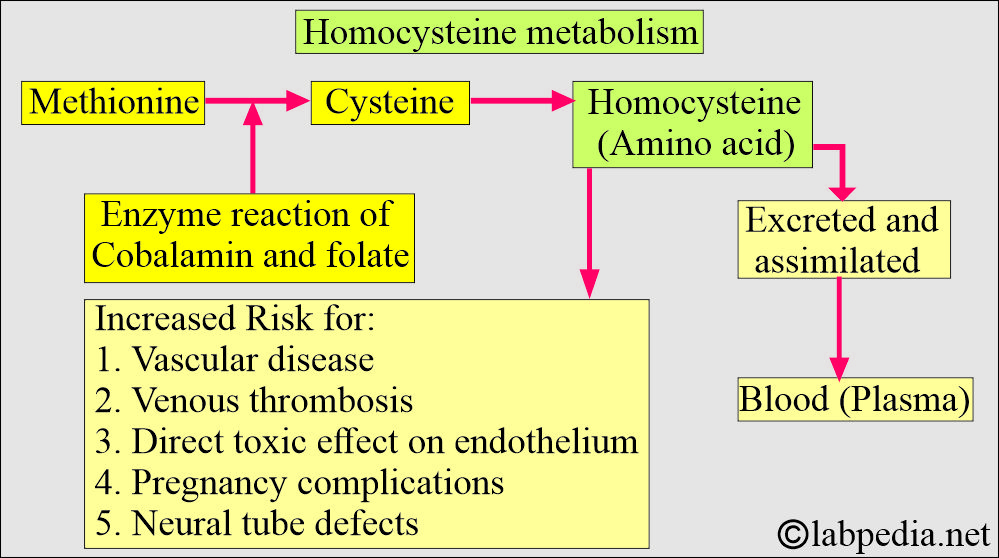
Homocysteine metabolism
What are the causes of Homocysteinemia?
- Genetic predisposition.
- Nutritional and environmental factors.
- Specific medications.
- Amino acids are naturally made products, which are the building blocks of all the proteins in the body.
- Homocysteine is an intermediate amino acid formed during the metabolism of methionine.
- So, the homocysteine blood level is helpful for diagnosing vitamin deficiencies.
- Homocysteine levels may be elevated in patients with megaloblastic anemia before other abnormal tests are found.
- Homocysteine may be used as an early indicator of these patients, and treatment can be started early.
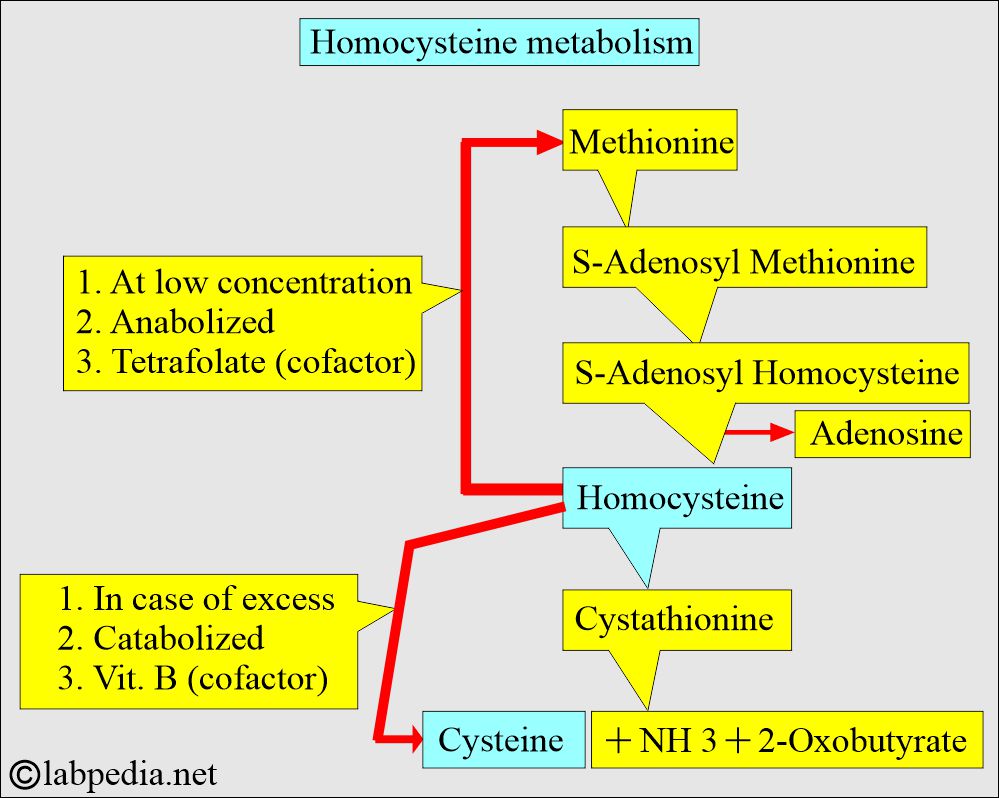
Homocysteine cycle
What are the complications of Homocystinemia?
- Patients <40 years of age with a history of cardiovascular disease should exclude homocysteinemia.
- Patients at high risk for cardiovascular disease should be tested every 3 to 5 years.
- How often should homocysteine be tested?
- This may be measured every 3 to 5 years.
- In newborns at the age of 3 to 5 days.
- Stroke.
- Venous thrombosis.
- Increased atherosclerosis by causing damage to the endothelial lining.
- Increased LDL deposition.
- Increase vascular smooth muscle growth.
- Increased risk for vascular diseases.
- Increased risk of venous thrombosis.
- Increased risk for pregnancy complications and neural tube defects.
- The patient with increased homocysteine has 5 times more risk of stroke, dementia, and Alzheimer’s disease.
- Increased homocysteine level is also a risk factor for osteoporotic fractures in older men and women.
- Increasing the homocysteine level will increase the risk of coronary artery disease and thrombosis risk.
- Homocysteinemia >15 µmol/L leads to:
- Increased atherosclerosis.
- Although lipoproteins are normal.
- In the absence of other risk factors.
- Increased atherosclerosis.
- Some researchers believe these patients may be treated with vitamins B6, B12, and folate.
- Affected children suffer from homocystinuria and have very premature atherosclerosis at an early age.
What are the clinical Presentations of Homocysteinemia?
- Increased Homocysteine is associated with the following:
- Various vascular and cardiovascular diseases.
- The birth defects.
- Complications in the pregnancy.
- Psychiatric disorders.
- Mental impairment in older adults.
What is the Normal Homocysteine?
Homocysteine
Source 2
- Fasting level = 4 to 17 µmol/L (0.54 to 2.3 mg/L).
Source 4
- 4 to 17 µmol/L
Another source
- Serum = 13 to 18 µmol/L
- Plasma = 10 to 15 = µmol/L
- Children = 3.7 to 10.3 µmol/L
Urine
- Negative
How will you interpret Homocysteinemia?
- Normal less than 15 µmol/L
- Moderate increase = 5 to 30 µmol/L.
- Intermediate increase = 30 to 100 µmol/L.
- Severe disease = >100 µmol/L.
- There is an unexplained thromboembolic phenomenon.
- Homocysteinemia is a risk factor for premature arteriosclerosis of the coronary, cerebral, and peripheral vessels.
- Homocysteinemia is a risk factor for thromboembolic disease.
- Gradient response to the risk of thrombosis = Risk for thrombosis = <7 µmol/L.
- No risk = 9.0 µmol/L.
- Low risk = 14.0 µmol/L.
- Moderate risk = >14.0 µmol/L.
Where will you see Homocysteine?
- Folic acid deficiency.
- Vit.B12 deficiency.
- Cardiovascular diseases.
- Cerebrovascular diseases.
- Peripheral vascular diseases.
- Malnutrition.
- Homocystinuria.
What is the cause of raised homocysteine?
- To exclude homocystinuria, total homocysteine is recommended in patients with cardiovascular disease <40 years.
- To know the prognosis and mortality, total homocysteine is measured in patients with cardiovascular disease.
- Cardiovascular disease patients with >15 µmol/L are in high-risk groups. These patients need all kinds of precautions to prevent cardiovascular attacks. Such patients need a healthy life.
- Risk for thrombosis = <7 µmol/L.
- Keep a low level of methionine, around 20 to 150 µmol/L, with a low methionine diet and pyridoxine therapy.
- >30 µmol/L is a prognostic factor for mortality and cardiovascular disease attack.
What are the conditions under which Homocysteine is raised?
- A few drugs, like methotrexate, phenytoin, and theophylline.
- Hypothyroidism.
- In pregnancy, to screen for folate deficiency.
What are the differences between homocysteinemia and homocystinuria?
| Clinical parameters | Homocysteinemia | Homocystinuria |
|
|
|
|
|
|
|
|
|
|
|
|
|
|
|
|
|
|
|
|
|
|
|
|
Questions and answers:
Question 1: What is the mechanism of homocystinuria/Homocysteinemia?
There is a deficiency of the enzyme methionine synthase.
Question 2: What is the level of Homocysteine for severe disease?
The level of Homocysteine is >100 µmol/L.