
Growth Hormone (GH)
What sample is needed for Growth Hormone (GH)?
- This test is done on serum (clotted blood, 3 to 5 ml).
- A serum sample is preferred.
- Plasma (EDTA) has lower values with some methods.
- The patient should fast and rest for at least 30 minutes before taking the blood.
- It is stable for 8 hours at 2 to 8 °C.
- It can be kept for an extended period at -20 °C.
What are the precautions for Growth Hormone (GH) estimation?
- Perform the test immediately, as the half-life of GH is 20-25 minutes.
- Immediately refrigerate the serum.
- The patient should be fasting after midnight.
- The patient must fast and rest for 30 minutes before the sample is taken because this may increase the level.
- Avoid stress and low blood glucose, and exercise during the sample collection.
- EDTA plasma gives lower values.
- Random measurement is not helpful because of episodic variation in the GH level.
- Drugs that may increase the level are Amphetamine, Estrogen, Dopamine, Insulin, Methyldopa, Levodopa, Histamine, and Nicotinic acid.
- Certain drugs that decrease GH levels are Phenothiazine and Corticosteroids.
What are the indications for Growth Hormone (GH)?
- Growth hormone (GH) is used to identify its deficiency in:
- Adults with short stature.
- Delayed sexual maturity.
- Or other growth abnormalities.
- To diagnose gigantism or acromegaly,
- This can be used to identify the pituitary hypofunction or hyperfunction.
How will you define Growth Hormone (GH) and its structure?
- Growth hormone (GH) is a peptide secreted by the pituitary gland’s acidophilic cells.
- GH is produced and secreted by somatotropes in response to the hypothalamic secretion of growth hormone-releasing hormone (GHRH) and is inhibited by somatostatin.
- GH is also called somatotropin.
- Hypothalamus hormones:
- Growth hormone-releasing hormone (GHRH) stimulates Growth hormone (GH) release.
- Somatostatin inhibits the release of Growth hormone (GH).
- The growth hormone is a single-chain polypeptide with a molecular weight of 21,500 Da (22 kDa) and 191 amino acids.
- It has two intramolecular disulfide bridges.
- Its structure is similar to prolactin.
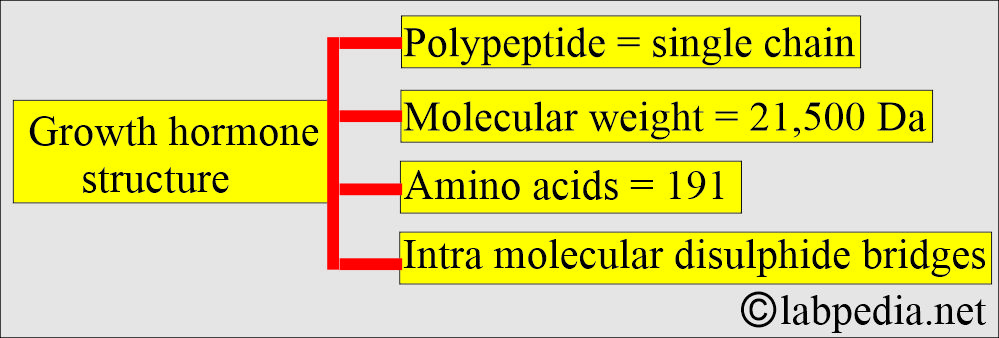
Growth Hormone (GH) structure
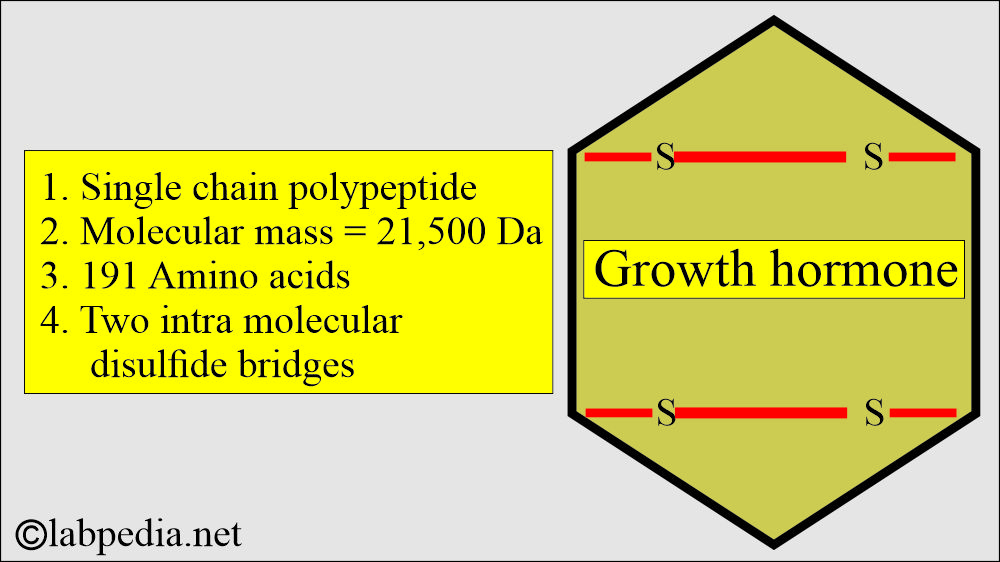
Growth hormone structure
- This is one of the hormones involved in growth produced by the pituitary gland.
- Somatotropin is a man-made hormone.
- It is stored in the cells as intracellular granules.
- Growth hormone production is pulsatile.
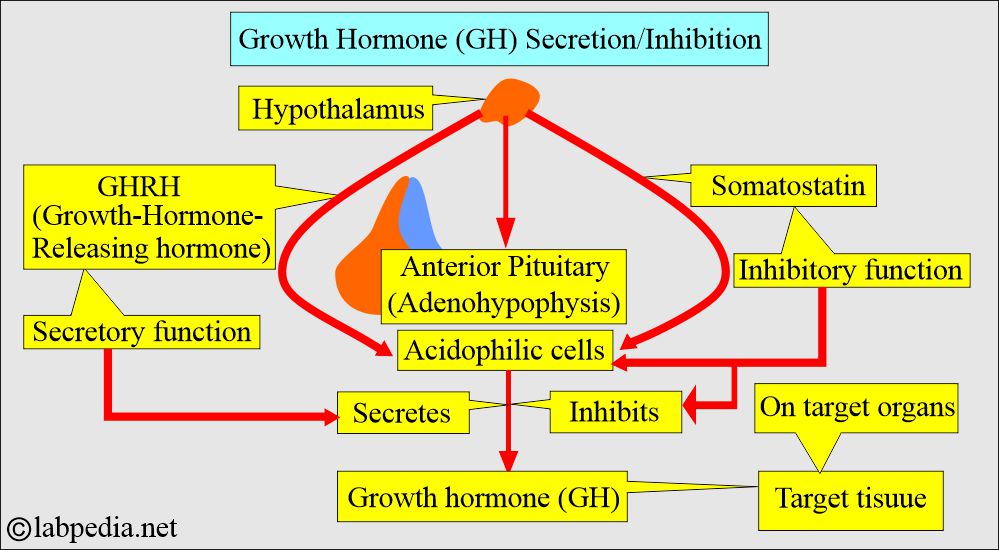
Growth hormone (GH) secretion and inhibition
How will you discuss the pathophysiology of growth hormone (GH)?
- Growth hormone (GH) plays a role in growth from birth until the end of puberty.
- GH promotes protein synthesis and stimulates skeletal growth.
- Various factors increase Growth hormone (GH) secretion.
- Growth hormone (GH) is produced by the anterior pituitary gland’s acidophilic cells and stored within the intracellular granules.
- Growth hormone (GH) secretion occurs predominantly during sleep in irregular pulses or bursts.
What are the types of adenohypophysis (anterior Pituitary gland) hormones?
| Hormones | Type of the cells | Shortcut names |
|
|
|
|
|
|
|
|
|
|
|
|
|
|
|
|
|
|
|
|
|
What is the difference between the pituitary gland and the adenohypophysis?
| Features | Pituitary gland | Adenohypophysis |
|
|
|
|
It consists of:
|
|
|
|
|
The pituitary gland is involved in the regulation of:
- Growth.
- Development.
- Adrenal function.
- Thyroid function.
- Gonadal function.
- Water and salt homeostasis.
How will Growth Hormone secretion be?
- Anterior pituitary gland (acidophilic cells secrete):
- Growth hormone.
- Prolactin.
- Thyroid-stimulating hormone (TSH).
- Follicle-stimulating hormone (FSH).
- Luteinizing hormone (LH).
- Insulin-like growth factor.
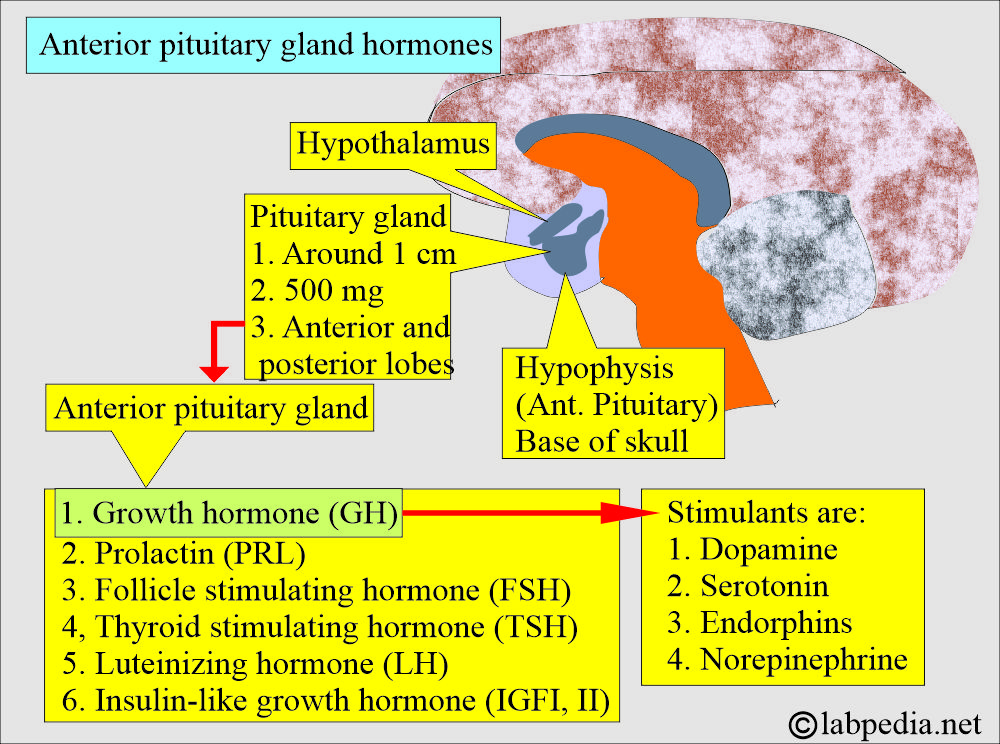
Anterior pituitary gland and hormones
- Hypoglycemia stimulates the pituitary gland to secrete GH.
- It is an antagonist to insulin.
- This was used as a stimulation test, but it was not safe.
- Arginine stimulates GH secretion.
- Growth hormone (GH) increases glucose by:
- Inhibiting the entry of glucose into the muscle cells.
- By inhibiting glycolysis.
- By inhibiting the formation of triglycerides from glucose.
What is the Growth hormone (GH) controlling mechanism?
- Two hypothalamic factors secreted into the portal circulation from nerve terminals in the median eminence control growth hormone (GH) release.
- Growth hormone-releasing hormone (GH-RH) stimulates GH release into the circulation.
- Somatotropin release-inhibitory factor (SRIF) will inhibit the GH release into the circulation.
- SRIF is found in pancreatic islet delta cells and other sites in the digestive tract.
- SRIF also has another important function: inhibiting the release of insulin and glucagon.
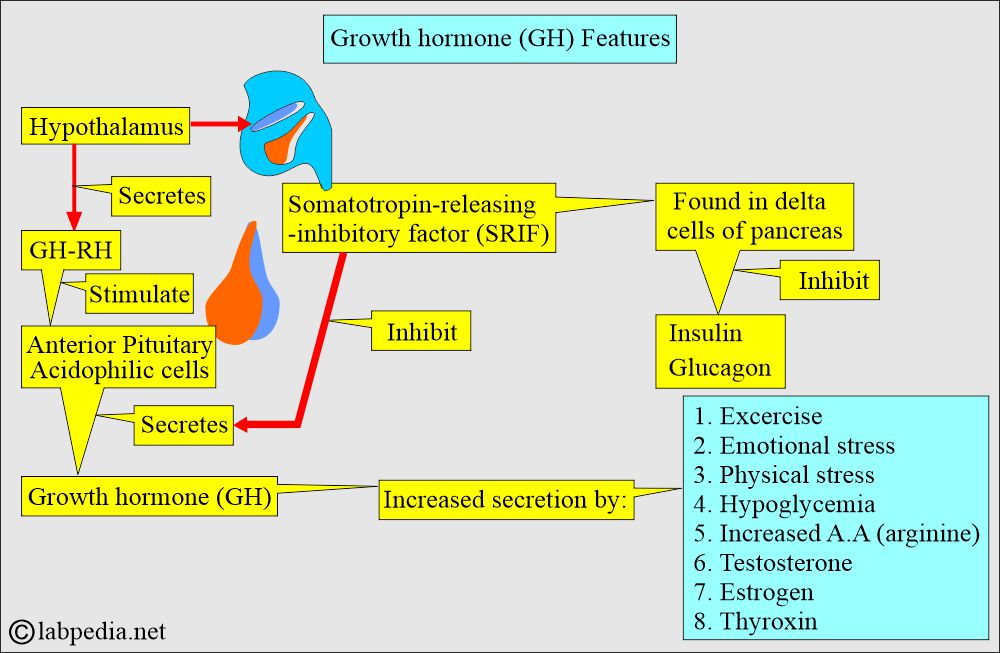
Growth hormone (GH) features
- Growth hormone (GH) affects many tissues through a group of peptides (Somatomedins).
- Increased levels of Somatomedins lead to increased production of Somatostatin, which is released from the hypothalamus.
What are the variations in Growth hormone (GH) production?
- GH has a diurnal variation in concentration.
- Stimuli leading to an increase in Growth hormone (GH):
- Exercise.
- Physical and emotional stress.
- Ingestion of protein.
- In hypoglycemia.
- Spike occurs after 3 hours of meals or exercise.
- The level is low during the day and is around 5 ng/mL (another reference says <2 ng/mL).
- For adults and children in the evening, it is the highest level.
- GH secretion is episodic and variable; the level may reach 40 ng/ml in a healthy subject.
- The highest values are noted during the deepest sleep level. So its level is increased during sleep.
- So the best time is 60 to 90 minutes after a deep sleep.
- Or do the exercise for 30 minutes and get the GH sample, which will be at the highest level.
- The GH may increase ten times the normal level during sleep.
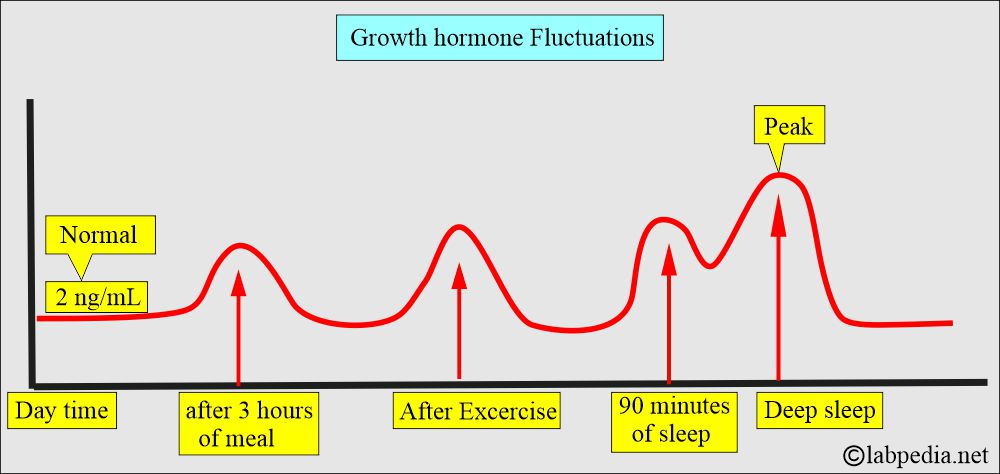
Growth hormone (GH) fluctuations
- GH test may be used to monitor the acromegaly treatment.
- Obesity reduces GH release and the insulin response.
- Hypoglycemia stimulates the pituitary to secrete GH.
- The ability to secrete GH in response to conventional challenges decreases with age.
- GH is tested in case of retarded growth or short stature.
What are the stimuli for the growth hormone (GH) secretion?
| The stimulus for the secretion of Growth hormone (GH) | Time of peak level of Growth hormone (GH) |
|
|
|
|
|
|
|
|
|
|
|
|
|
|
|
|
|
|
|
|
What are the functions of the growth hormone (GH)?
- GH in insufficient amounts leads to:
- Limited growth.
- Its deficiency leads to dwarfism.
- Delay in maturity.
- GH overproduction leads to :
- Its excess leads to gigantism.
- Acromegaly. (Increase in bone thickness and width).
- It promotes protein synthesis in muscles.
- It promotes protein synthesis in the liver.
- It stimulates skeletal muscle growth.
- It directly stimulates amino acid uptake.
- GH is important for anabolic and repair functions and proper skeletal growth.
- GH has an anti-insulin effect on carbohydrate metabolism.
- In fasting, insulin secretion decreases, and GH secretion increases, stimulating the body to use fatty acids instead of glucose.
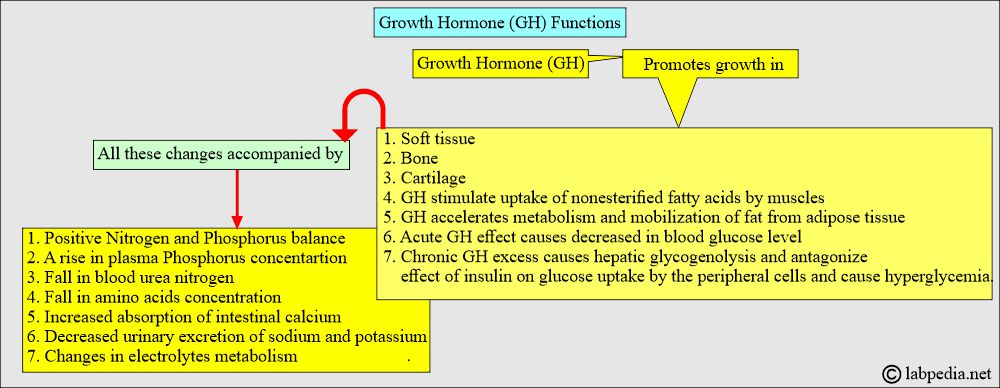
Growth hormone (GH) functions
What is the Clinical presentation of growth hormone (GH) excess?
- Excess GH is seen in the eosinophilic or chromophobe adenomas of the pituitary gland.
- 75% of these tumors can be diagnosed on CT scans or MRIs.
- Prolonged exposure to GH leads to overgrowth of the skeleton, muscles, and soft tissues.
- It is usually seen in adults and is called Acromegaly.
- This condition is called Pituitary gigantism, when excess GH is seen before long bone growth is complete.
What are the various types of growth hormone (GH) tests?
- A growth stimulation test can be done to evaluate the deficiency.
- An exercise stimulation test can be advised for GH.
- Brisk exercise increases GH.
- This test can be done in the morning after an overnight fast or at any time.
- The patient is advised to exercise vigorously for 20 minutes.
- Collect blood immediately after exercise terminates.
- If GH is >7 ng/ml, it is less likely to be due to a deficiency.
- 3 to 6 ng/mL is an intermediate response, considered a suspected case.
- The growth suppression test is performed in adults with gigantism and acromegaly.
- An oral glucose tolerance test is very helpful for determining glucose levels. Normally, GH is suppressed. However, in acromegalic patients, there is a slight or no decrease in GH.
- Give 75 to 100 grams of glucose over 5 minutes, then collect a GH sample at 30, 60, 90, and 120 minutes.
- In an insulin-induced hypoglycemia stimulation test:
- Hypoglycemia triggers the release of GH and ACTH from the pituitary glands in a normal person.
- Give I/V insulin to overnight fasting patients.
- Insulin 0.1 to 0.15 U/Kg body weight is injected I/V.
- Collect the blood sample after a 30-minute rest period for GH, ACTH, and cortisol.
- Collect blood samples at 30, 60, and 90-minute intervals.
- Estimate glucose, GH, ACTH, and cortisol.
- The patients may become symptomatic and develop hypoglycemia <40 mg/dL.
- This test is contraindicated in patients with seizures and ischemic heart disease.
- GH level reaches >10 ng/mL.
- Cortisol level reaches a peak value of >20 µg/dL.
- Direct Measurement of Growth hormone (GH) can be performed by bioassay, receptor assay, and immunoassay.
Acromegaly:
How will you define acromegaly?
- Acromegaly in adults is caused by increased growth hormone (GH) secretion.
- The most common cause may be the eosinophilic adenoma of the pituitary gland.
- Roughly 2/3 of the patients are female.
How will the clinical presentation of the acromegaly be?
- The excess of GH leads to Acromegaly.
- Pituitary gigantism is seen before the long bone growth is complete.
- The patient’s physical appearance can help diagnose this.
- There is an overgrowth of soft tissue and bone.
- There is coarse, oily skin.
- There is a large tongue.
- There are prominent supraorbital ridges.
- The spacing between teeth is increased.
- Hands are thick, spade-like.
- The patient will have arthralgia and kyphosis.
- The voice is coarse.
- The patient may develop proximal muscle weakness.
- Sweating and headaches are common.
- The patient will have progressive heart failure.
- The reversibility of the physical changes depends upon the duration of the disease.
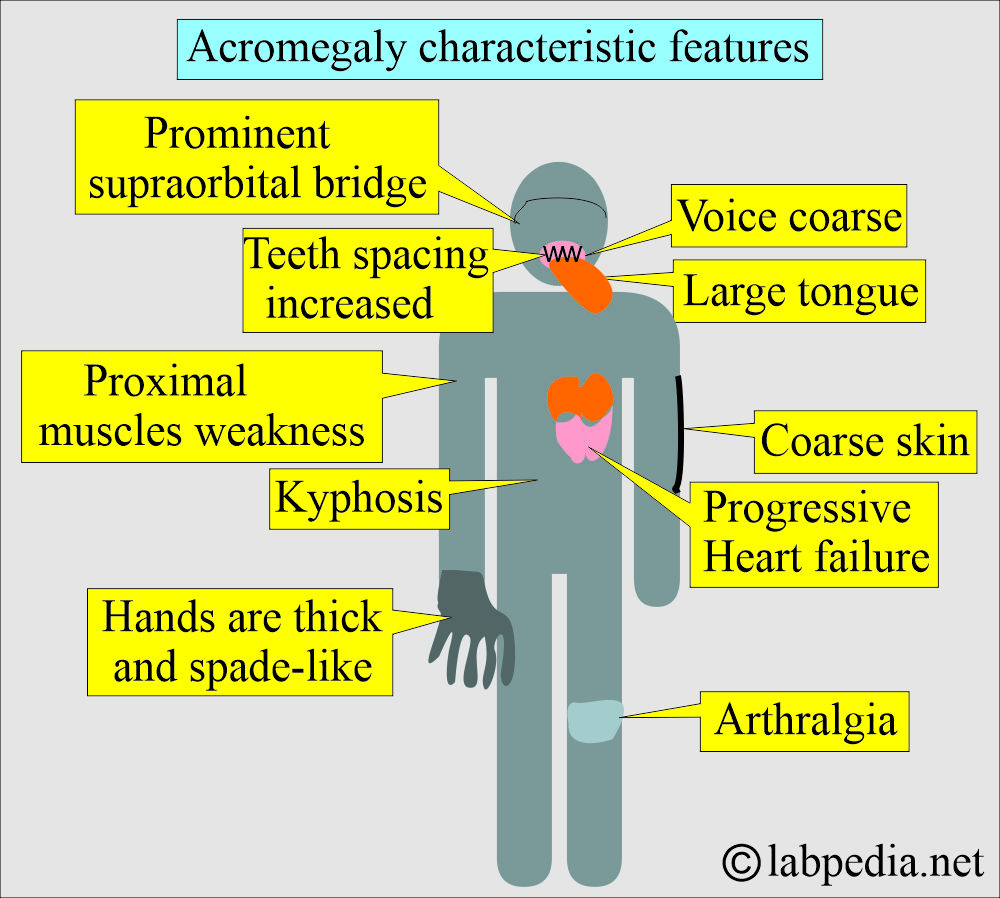
Acromegaly’s characteristic features
- Acromegaly may lead to severe disability or death due to cardiac or neurological complications.
- There is an abnormal GH response to oral glucose administration.
- A normal person shows <1 ng/mL of GH after an oral dose of glucose.
What are the Complications of Acromegaly?
- The patient may develop diabetes mellitus.
- The patient will have hypertension and cardiomegaly.
- There is obstructive sleep apnea.
How will you diagnose Acromegaly?
- The diagnosis of acromegaly depends on elevated growth hormone (GH) levels.
- Advise the glucose tolerance test:
- Collect a blood sample at 0, 30, 60, and 90 minutes.
- Estimate both glucose and GH.
- The values will be suppressed at around <1.0 ng/mL.
- Another test is IGF-1 (insulin-like growth factor-1), whose concentration increases in acromegaly.
How will you treat the Acromegaly?
- Acromegaly due to an adenoma is treated with a transsphenoidal resection of the tumor.
- Another method is gamma knife multiport irradiation.
- Somatostatin (SST) long-acting needs only one dose per month.
What will be the presentation of the deficiency of growth hormone?
- This is usually seen in hypothalamic and pituitary tumors.
- Growth is a sign of dwarfism and short stature in the child.
How will you diagnose growth hormone (GH) deficiency?
- Advice: Two stimulating tests, such as insulin hypoglycemia or arginine.
- Measure GH at 30, 60, and 90 minutes.
- Normal patients show an increase in GH to >8.0 ng/mL.
What is normal growth hormone (GH)?
Source 1
| Age | ng/mL |
|
|
|
|
|
|
|
|
|
|
|
|
|
|
|
|
|
|
|
|
|
|
- To convert into SI units x 1.0 = µg/L
Source 2
|
|
|
|
|
|
|
|
- The random GH level provides little diagnostic information.
- A single estimate may not be helpful due to variation in GH levels throughout the day.
What are the causes of increased Growth hormone (GH)?
- Pituitary gigantism (Acromegaly = up to 400 ng/ml).
- Ectopic GH secretion, e.g., Stomach neoplasm, lung.
- Renal failure.
- Cirrhosis.
- Stress, exercise, prolonged fasting.
- Uncontrolled diabetes mellitus.
- Anorexia nervosa.
- Starvation and malnutrition.
- Hypoglycemia.
- Major surgery.
- Exercise.
What are the causes of decreased growth hormone (GH)?
- Pituitary dwarfism, hypopituitarism.
- Adrenocortical hyperfunction.
- Hyperglycemia.
- Delayed sexual maturity.
- Growth hormone deficiency.
Questions and answers:
Question 1: When is the peak level of GH?
GH is secreted during deep sleep at night.
Question 2: What are the complications of acromegaly?
Patients with acromegaly may develop diabetes mellitus, hypertension, and cardiomegaly.