
Acid phosphatase and Prostatic phosphatase
Acid phosphatase and Prostatic phosphatase
What sample is needed for Acid phosphatase and Prostatic phosphatase?
- It is done on the patient’s serum, and tests are performed within one hour.
- How to get good serum: Take 3 to 5 ml of blood in a disposable syringe or a vaccutainer. Keep the syringe for 15 to 30 minutes and then centrifuge for 2 to 4 minutes to get the clear serum.
- The serum should be separated immediately from the RBCs and stabilized by adding disodium citrate monohydrate (10 mg/ml of the serum).
- Add acetic acid (5 mol/L) or 50 µL for 1 ml of the serum. This will lower the serum’s pH to 5.4, where the sample is stable.
- With all these precautions, the serum is stable at 37 °C (at room temperature) for several hours and one week if the serum is kept in the fridge.
- EDTA plasma is better because it stabilizes the acid phosphatase.
- A morning sample is preferred.
- The sample is stable for 24 hours at 2 to 8 °C.
- Try to do the test immediately.
- The enzyme will stabilize if serum is acidified below a pH of 6.5.
What Precautions are needed for Acid phosphatase and Prostatic phosphatase?
- Avoid hemolysis.
- It has poor stability in whole blood.
- ACP is unstable at room temperature >37 °C.
- Serum left at room temperature and exposed to air will decrease the acid phosphatase by even one hour.
- ACP is unstable if the pH is >7.0.
- The serum is separated immediately, and the test is performed within one hour.
- Or refrigerate the sample immediately.
- EDTA plasma is preferred because it stabilizes the AP.
- Avoid prostatic massage in the last 48 hours.
- Rectal examination, prostatic massage, urinary catheterization, or instrumentation of the prostate in the previous 2 days before the test may give false high values.
- Hemolysis falsely raised the value and should be rejected.
- The lipemic serum also gives a false value.
- 50% of the activity is lost if kept at room temperature.
- Drugs leading to elevated AP levels are:
- Androgens in females.
- Clofibrate and antilipiodemic drugs.
- Specimen received >15 minutes after the collection, and the hemolyzed sample gives false values.
What are the Indications for Acid phosphatase and Prostatic phosphatase?
- Diagnosing prostatic carcinoma requires advising the estimation of total acid phosphatase and the prostatic component.
- This test is more accurate in diagnosing advanced prostatic cancer than the early diagnosis.
- These two enzymes stage prostatic carcinoma and monitor the effectiveness of treatment.
- The test for acid phosphatase can be done on a vaginal swab in rape cases because the seminal fluid is rich in acid phosphatase.
- Acid phosphatase levels in rape cases peak between the first 12 hours and remain increased till <4 days.
How will you define Acid phosphatase?
- Acid phosphatase is a hydrolytic enzyme secreted by various cells.
- Acid phosphatase has five isoenzymes.
- The maximum amount is found in the semen (prostate).
- Acid phosphatase is also found in bone, liver, spleen, kidneys, RBCs, and platelets.
- Types of Acid phosphatase:
- Prostatic acid phosphatase.
- Bone acid phosphatase.
- Liver and spleen acid phosphatase.
How will you discuss the pathophysiology of Acid phosphatase and Prostatic phosphatase?
- Acid phosphatase (AP) includes all phosphatases with optimal activity below a pH of 7.0.
- The prostatic AP has an optimum pH range of 5 to 6.
- AP is unstable at temperatures>37 °C and pH levels>7.0.
- The prostatic AP in serum is labile and may lose >50% of the AP in one hour at room temperature.
- If you pacify the serum to a pH <6.5, it will stabilize the enzymes.
- Prostatic acid phosphatase (PAP):
- It is a tumor marker.
- When raised, it indicates metastatic prostatic carcinoma.
What are the sources of Acid Phosphatase?
- Acid phosphatase enzymes are found in various tissue lysosomes like the Prostate, bone, kidney, platelets, semen, liver, and spleen, except RBCs.
- The prostate is the richest source. The majority of AP arises from the RBCs and prostatic tissue.
- Extralysosomal AP is also found in many cells.
- High levels are also found in white blood cells, such as monocytes and lymphocytes.
- Total acid phosphatase consists of a one-half prostatic component and the rest of the liver, disintegrating platelets and RBCs.
- The prostate has 100 times more acid phosphatase activity than other tissues, so it is the richest source.
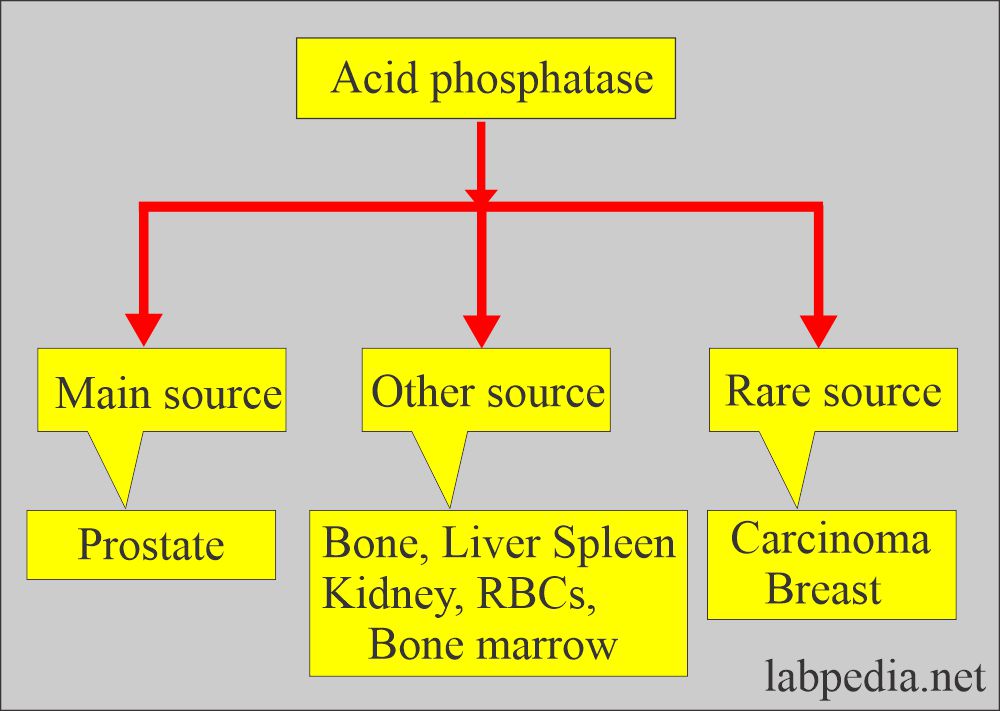
Acid phosphatase sources
- Acid phosphatase (AP), derived from the prostate, has an optimum pH range of 5 to 6.
- All phosphatases have optimal activity below a pH of 7.0
The difference in activity between acid phosphatase and alkaline phosphatase as regards pH:
| Acid phosphatase | Alkaline phosphatase | |
| pH | At pH 5.0 = Optimum reaction | At pH>7.0 = Optimum reaction |
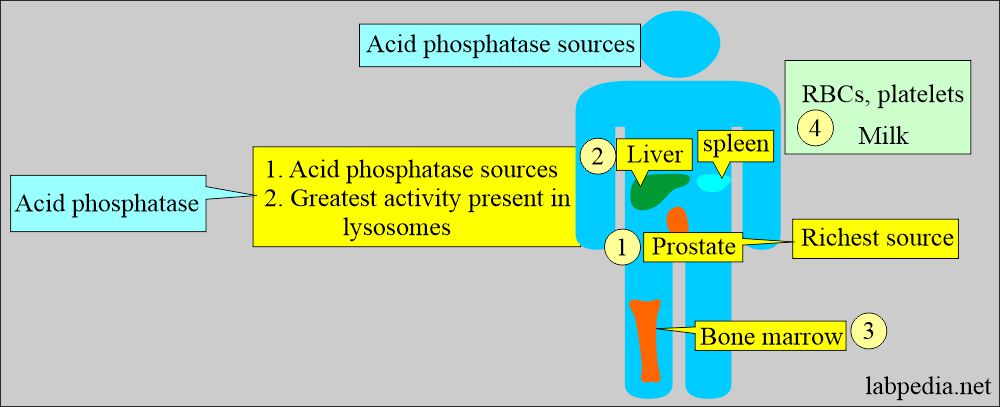
Acid phosphatase distribution
- As the prostatic component (PAP) is not raised in early prostatic diseases, this is not a good screening enzyme.
What is the significance of Acid-phosphatase?
- Acid phosphatase is a lysosomal enzyme, so the prostatic enzyme is found in the lysosome of the prostatic epithelium and is a glycoprotein.
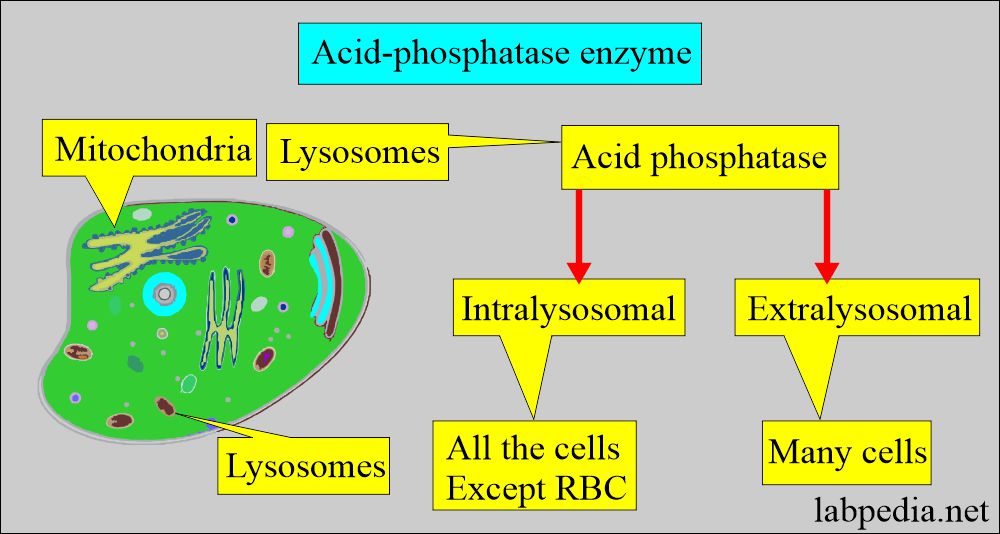
Acid phosphatase lysosome
- Once prostatic cancer spreads, AP’s level rises significantly when there is metastasis, particularly in the bone.
- The raised level in 80% of the patients with metastasis is age-related.
- It is raised in Prostatic carcinoma, particularly its prostatic component.
- Total AP is raised in Bone diseases.
- Prostatic acid phosphatase needs to be differentiated from non-prostatic sources like RBCs source.
- Total AP = AP after tartarate inhibition = Prostatic AP.
- Some of the inhibitors discriminate between prostatic and nonprostatic AP.
- Prostatic AP is inhibited by the dextrorotatory tartrate ions when there is no action on the RBC isoenzyme AP.
- RBC AP is inhibited by formaldehyde and cupric ions, whereas prostatic AP is resistant.
What are the Normal values of Acid phosphatase and prostatic component?
- Total acid phosphatase
- 2.5 to 3.7 ng /mL or 2.5 to 3.7 µg/L.
- or less than 3.0 mg /L.
- Prostatic acid phosphatase = <2.5 ng/mL (0 to 0.6 U/L).
- Another reference:
- Adult 0.13 to 0.63 units/L at 37 °C
- or 2.2 to 10.5 units/L (SI units).
- Child 8.6 to 12.0 units/mL at 30 °C.
- Newborn 10.4 to 16.4 units /mL at 30 °C.
- Another source:
- Prostatic AP = 0 to 0.6 U/L.
- RIA = 3 µg/L.
- Immunoassay = <20 µg/L.
What causes Moderately raised Acid phosphatase levels other than prostatic carcinoma?
- Niemann-Pick disease.
- Gaucher’s disease.
- Prostatitis and Benign prostatic hyperplasia ( BPH ).
- Urinary retention.
- Any cancer that has given metastasis to the bones.
- Myeloid Leukemia.
- Multiple myelomas.
- Paget disease.
- Sickle cell anemia.
- Renal diseases.
- Liver diseases like cirrhosis.
- Thrombocytosis.
- Hyperparathyroidism.
What are the causes of the raised level of Acid phosphatase?
- Significantly raised level seen in prostatic carcinoma.
- Benign prostatic hyperplasia. It is seen in 5% to 10% of the cases.
- Prostatitis.
- Prostatic infarct can increase Acid phosphatase levels for a short time.
- Metastatic carcinoma of the prostate.
- Metastases to the bones.
What is the variation of Acid phosphatase in the case of carcinoma prostate?
- AP values vary according to the methodology, such as RIA and immunoassay.
- The level of AP is related to the clinical staging of prostatic carcinoma.
- 5% to 10% of prostatic carcinoma confined to the prostate has an elevated level of AP.
- 20% to 25% of prostate carcinomas show elevated values with the extension of prostatic adenocarcinoma outside the prostate capsules without distant metastasis.
- 75% to 80% of the cases show elevated AP with bone metastasis.
What is the significance of acid phosphatase for prostatic carcinoma?
| Stage of the prostatic carcinoma | % positivity | Acid phosphatase level |
|
|
|
|
|
|
|
|
|
How will you compare Acid phosphatase/PSA according to the stage of prostatic carcinoma?
| Clinical stage of prostate cancer | Acid phosphatase levels raised | Prostatic specific antigen (PSA) |
|
|
|
|
|
|
|
|
|
|
|
|
|
|
|
|
|
|
What are the Important facts about the acid phosphatase?
- After the surgery, its level will drop in 3 to 4 days.
- With estrogen, therapy takes 3 to 4 weeks to drop the level.
- Acid phosphatase is not recommended for prostatic carcinoma screening because its level is not usually significantly raised until the tumor metastases.
- Acid phosphatase is not advised in routine to diagnose prostatic carcinoma, in case the following parameters are recommended:
- Per-rectal digital examination.
- Transurethral ultrasound image.
- Histologic examination of the prostatic biopsy.
- Total body scan.
- The Prostatic specific antigen is advised.
What is the medicolegal importance of acid phosphatase?
- There is a high concentration of AP in the semen, so its measurement is important in rape cases.
- Take the vaginal swab, keep it in 2.5% of broth, and store it at 4 °C or room temperature.
- Result: In noncoital ladies, its value is 10 U/L, and in the coital lady is >50 U/L.
- However, PSA is more specific and sensitive than acid phosphatase.
What is the importance of acid phosphatase for a layman?
- This test is advised for the diagnosis of prostatic cancer.
- It can be advised in case of rape on the vaginal swab.
Questions and answers:
Question 1: What is the value of prostatic phosphatase for the diagnosis of prostatic carcinoma.
PSA is a better test than prostatic phosphatase.
Question 2: What is the pH for the acid phosphatase activity.
The best pH is 5.0
Please join our group for updated topics: https://www.facebook.com/share/g/1DaAFg4Vrw/
Fantastic
Thanks.
The figures’ subtitles say Alkaline phosphatase instead of Acid Phosphatase
Thanks, corrected.
What about acid phosphatase in sarcoidosis?
Particularly hepatic one!!
Acid phosphatase’s primary source is the prostate. I do not think acid phosphatase has any diagnostic value in sarcoidosis, particularly if the liver is involved.
good job.