
Hemoglobin: – Part 1 – Hemoglobin (Hb) structure and Functions
Hemoglobin (Hb)
What sample is needed for Hemoglobin (Hb)?
- The blood sample is taken in EDTA.
- EDTA salt of sodium or potassium is the preferred sample.
- The blood sample is stable for 48 hours at 4°C and 24 hours at 23 °C.
What are the precautions for Hemoglobin (Hb)?
- Avoid clotting (micro-clots may form), which will lower the Hb.
- Falsely high results may occur due to prolonged venous stasis during venipuncture.
- Increased turbidity, paraproteins, and nucleated RBCs give high values.
- Lipemic blood also gives high values.
- There is a falsely low Hb in pregnancy due to increased blood volume.
- At high altitudes, Hb will be high.
- Gentamicin and methyldopa may increase Hb value.
- Antibiotics, chemotherapy, aspirin, and sulphonamide give low values.
What are the indications for Hemoglobin (Hb) estimation?
- It is done to diagnose anemia.
- It tells the severity of anemia.
- It will monitor the effectiveness of anemia treatment.
- This is done to evaluate polycythemia.
- This is a part of the complete blood examination.
How will you define Hemoglobin (Hb)?
- Hemoglobin is an oxygen-carrying compound present in the RBCs.
- Total hemoglobin depends upon the number of RBCs in the blood.
- RBCs are the hemoglobin carriers.
- Hemoglobin is a hemoprotein whose primary function is to transport oxygen from the lungs to the body tissues.
- It was first isolated in 1849.
What is the structure of Hemoglobin (Hb)?
- Hb is a globular protein with a diameter of 6.4 nm in diameter.
- Hb A has a molecular weight of 68,000, and one RBC contains 640 million Hb molecules.
- Hb comprises four polypeptide chains, 2α and 2β, and heme groups. The 4 iron atoms are in the ferrous state (Fe++).
- Heme synthesis takes place in the mitochondria.
- The blood sample contains 96% of the Hb.
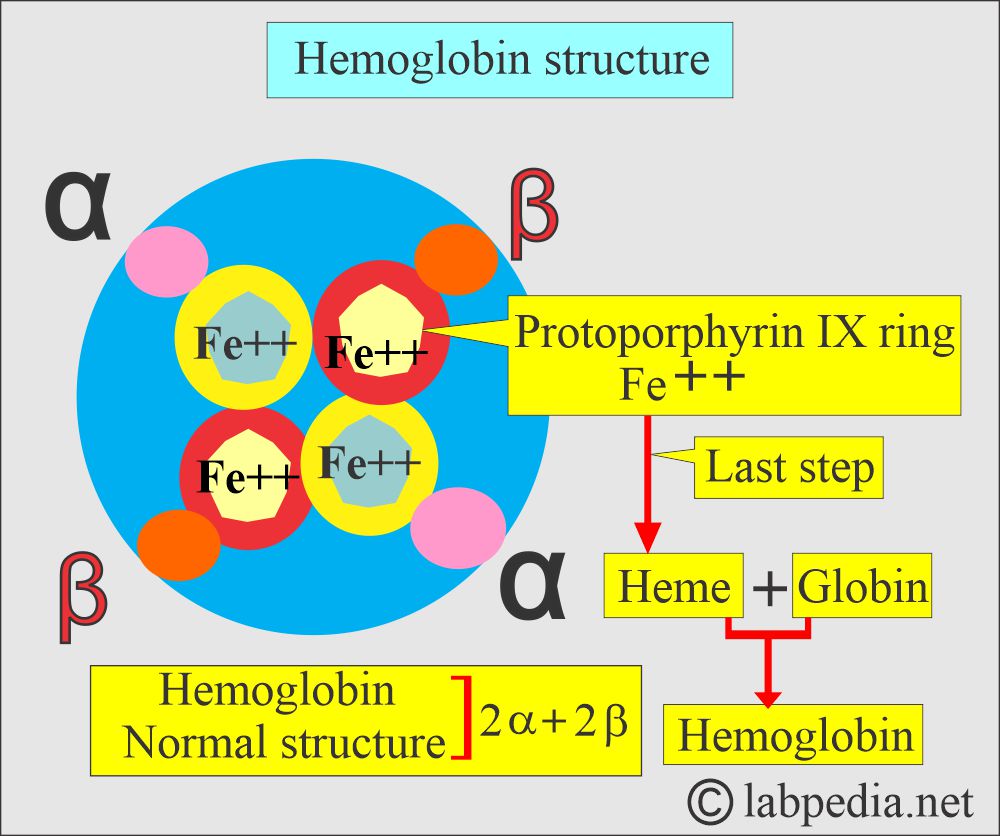
Hemoglobin (Hb) normal structure
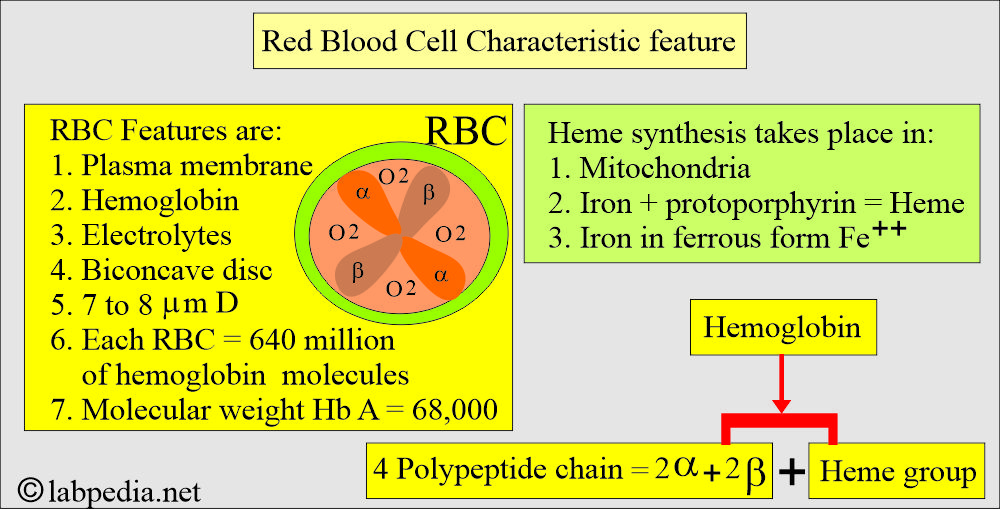
Red blood cell (RBC) characteristic features
- When Fe++ forms oxidizes into Fe+++, the compound becomes methemoglobin.
- Methemoglobin can not transport oxygen.
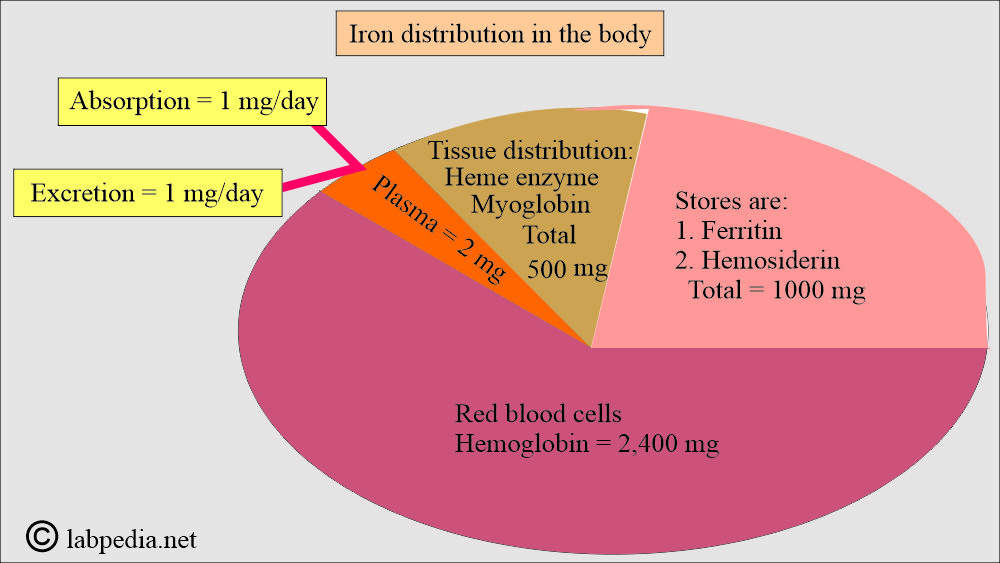
Iron distribution in the human body
What are the types of Hemoglobin in red blood cells?
| Age or stage of the fetus | Hb type | Structure |
|
|
|
|
|
|
|
|
|
- Zeta (ζ) chain production ceases at the gestational age of around 4 months.
- Production of the α-chain and β-chain starts at about the 6th week of gestation.
- Hb F (α2 γ2) increases in concentration, becoming the main hemoglobin in the fetus.
- Hb A (α2β2) starts at the gestational age of 28 weeks and can form up to 15% of the total hemoglobin at birth. The rest is mainly HbF and a very small amount of Hb A2.
- Production of the γ-chain decreases after birth.
- Normal adult Hb F values are obtained in infants one year old. In some cases, it may be raised for 2 years.
- The environment and chemicals modify a hemoglobin molecule, and the types are:
- Carboxyhemoglobin.
- Methemoglobin.
- Sulfhemoglobin.
What is the location of the globin gene on the chromosome?
- The gene that controls the α-chain and ζ-globin chains is located in a cluster on chromosome 16 at 16p 13.3, near the chromosome 16 telomere.
- The β, γ, and δ globin genes are clustered closely on chromosome 11.
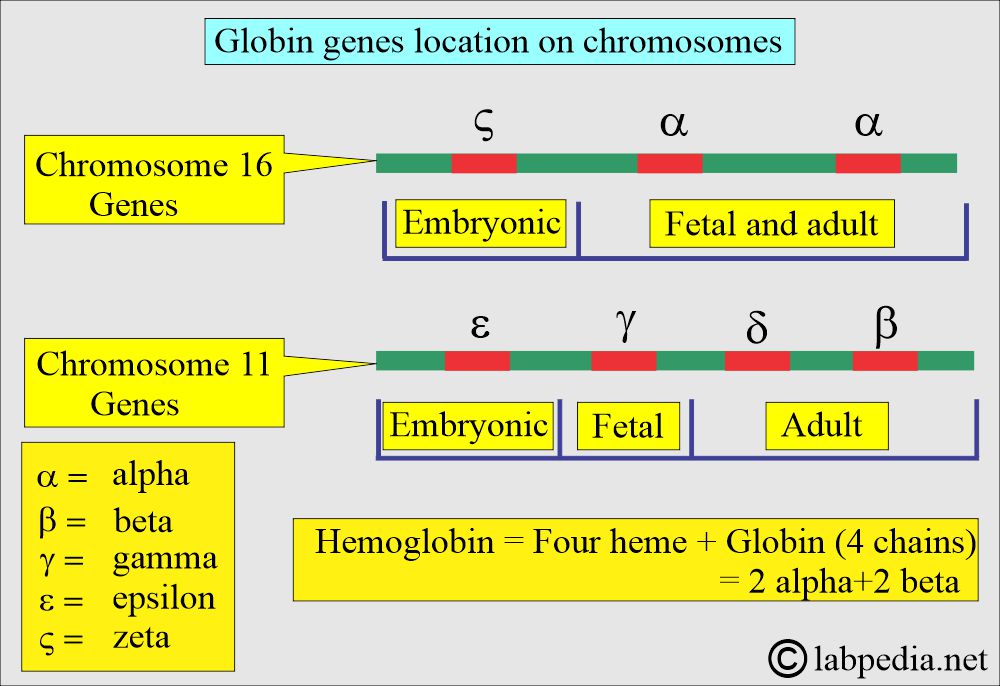
Hemoglobin gene location
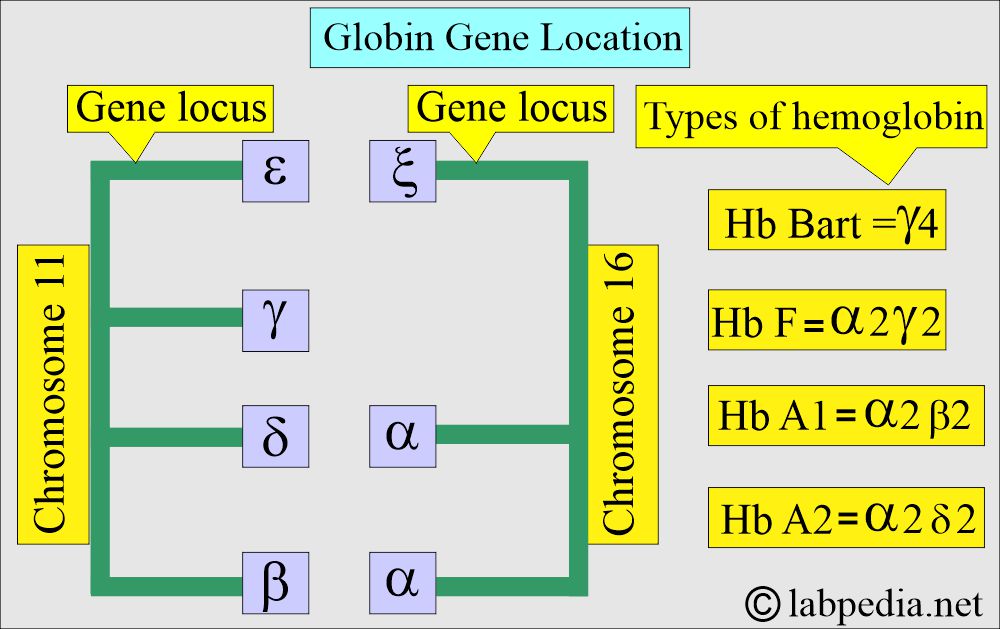
The hemoglobin (Hb) gene locus, encoding
How will you discuss the synthesis of hemoglobin?
- The biosynthesis of hemoglobin requires the synthesis of heme and globin polypeptide chains.
- Hb consists of protein portions, such as Globin, and iron parts, such as heme.
- Hemoglobin synthesis is a complicated process. This takes place in the red blood cells.
- Amino acids are assembled in the ribosomes, giving rise to α2 β2 globulin.
- Transferrin gives Iron, which will combine with the haem molecule.
- The heme molecule will have protoporphyrin from the chemical combination of glycine and succinyl-CoA in the presence of Vitamin B6, and form heme.
- The heme molecule consists of protoporphyrin IX protein and iron (Fe++).
- Protoporphyrin IX + Fe++ = Heme.
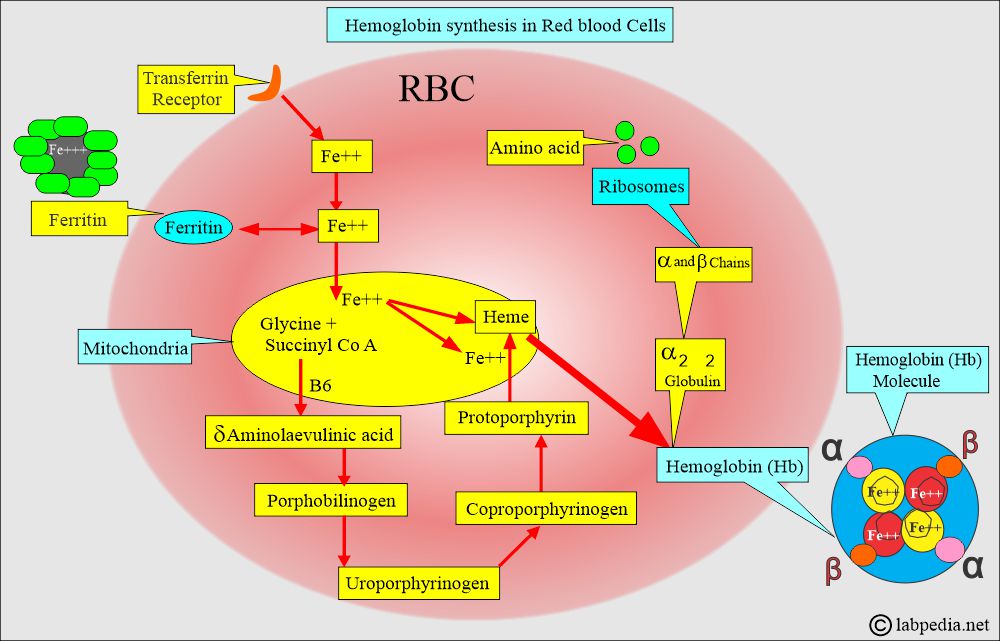
Hemoglobin (Hb) synthesis in RBC
What is the mechanism for the transport of Oxygen (O2)?
- Hb is the iron-containing pigment of the RBCs, carrying oxygen to various body parts.
- A central part of the Heme (iron-porphyrin) group is the site of Oxygen uptake and release.
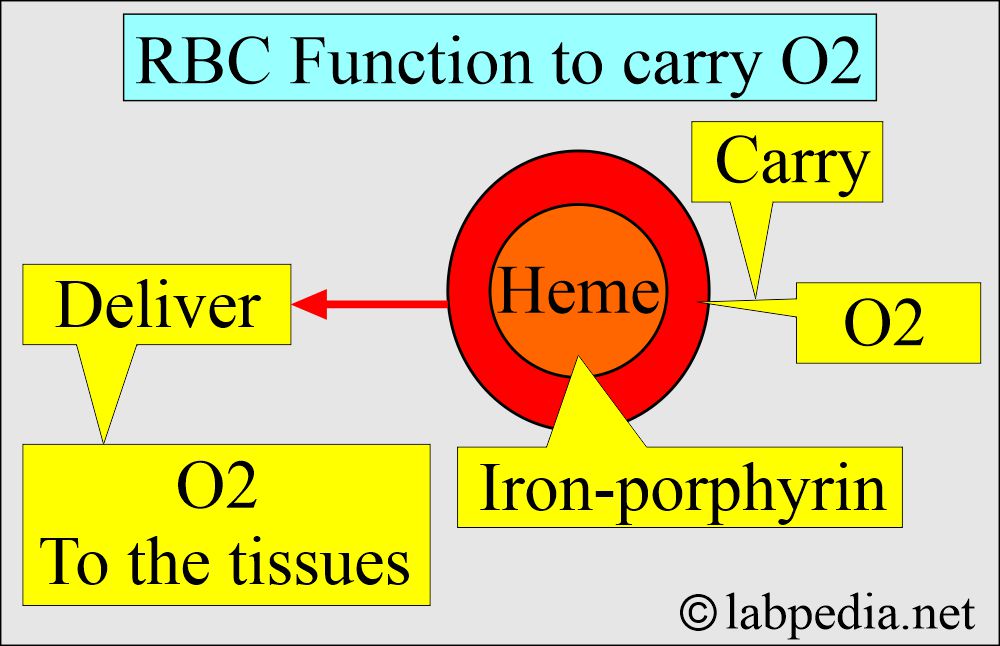
RBC (Heme) carries O2 to other tissues
What are the types of hemoglobin (Hb)?
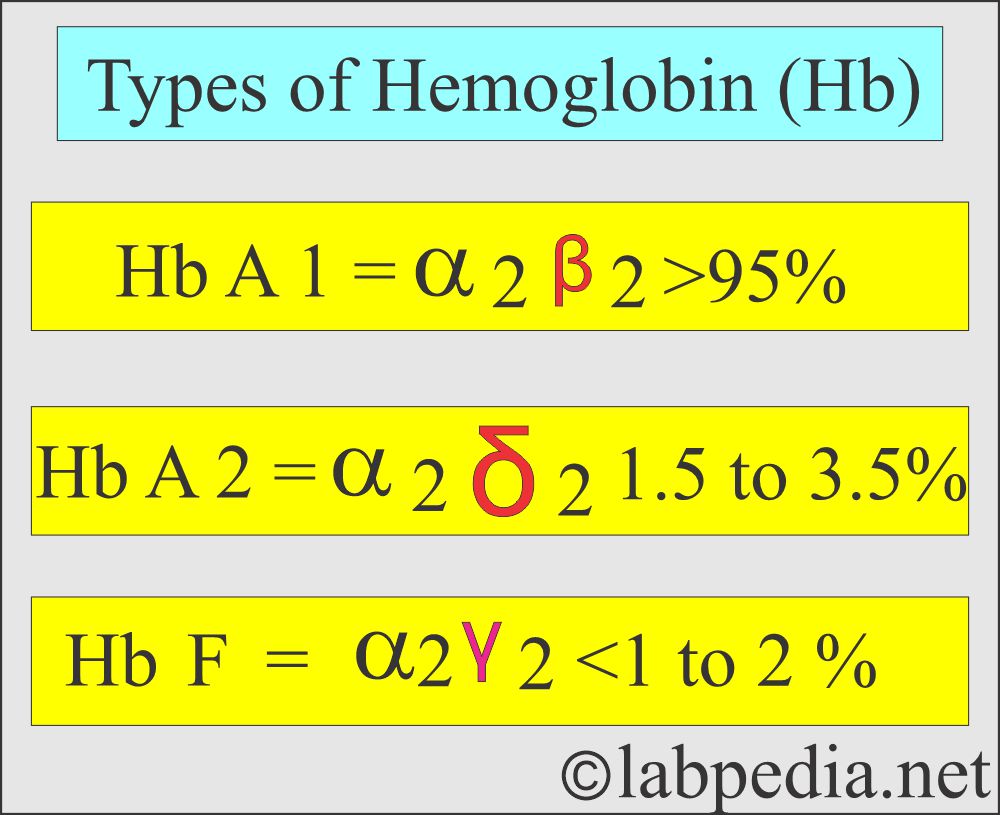
Hemoglobin (Hb) types
What are the functions of Hemoglobin (Hb)?
- Hb serves as the primary carrier of oxygen and carbon dioxide.
- It carries oxygen from the lungs to tissues.
- CO2 from the tissue to the lung.
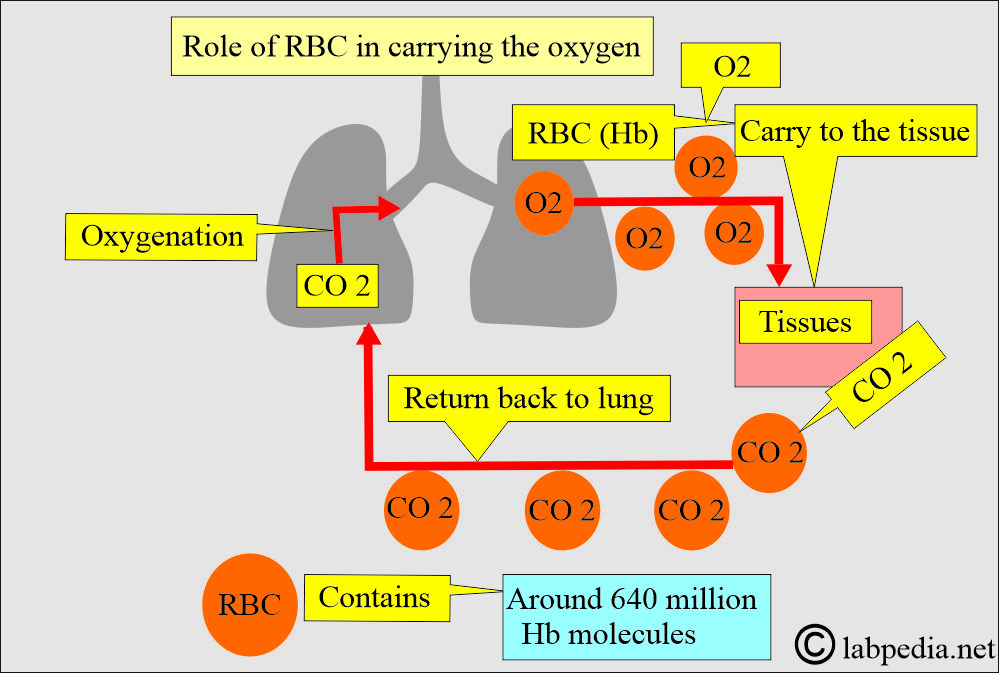
Hemoglobin (Hb) role in oxygen carriage
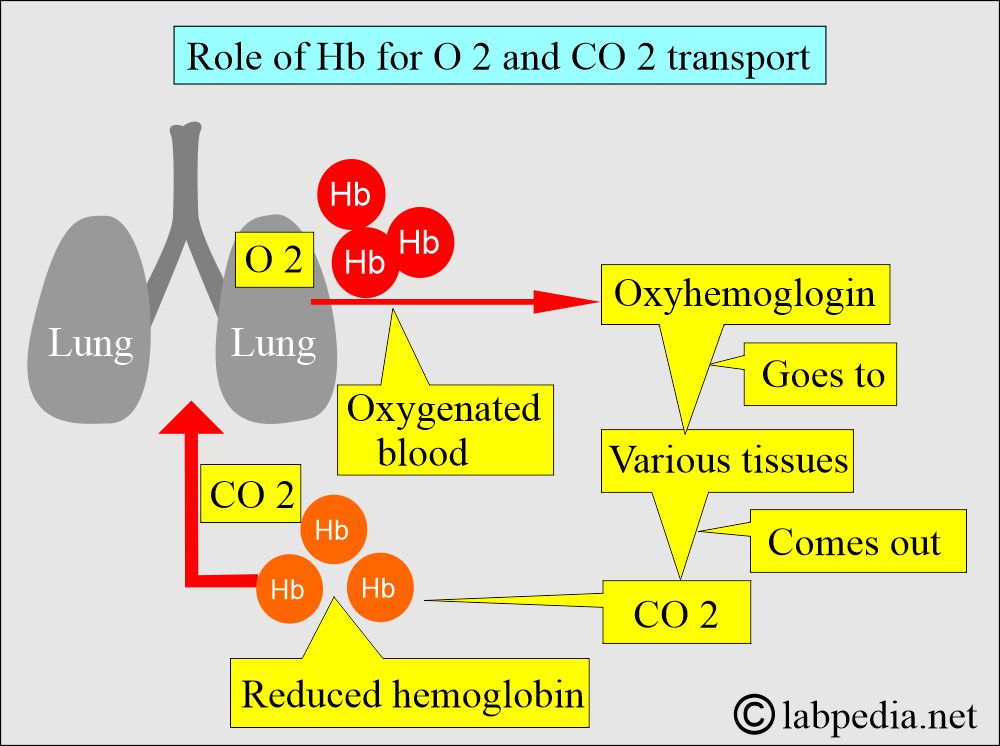
Hemoglobin (Hb) role in Oxygen and CO2 carriage
- Iron combines with oxygen and gives it a red color.
- The oxygen-carrying capacity is directly related to Hb concentration, not to the number of RBCs.
- The iron of heme is in Fe++ form, and it can combine irreversibly with oxygen and has a major role as an oxygen carrier.
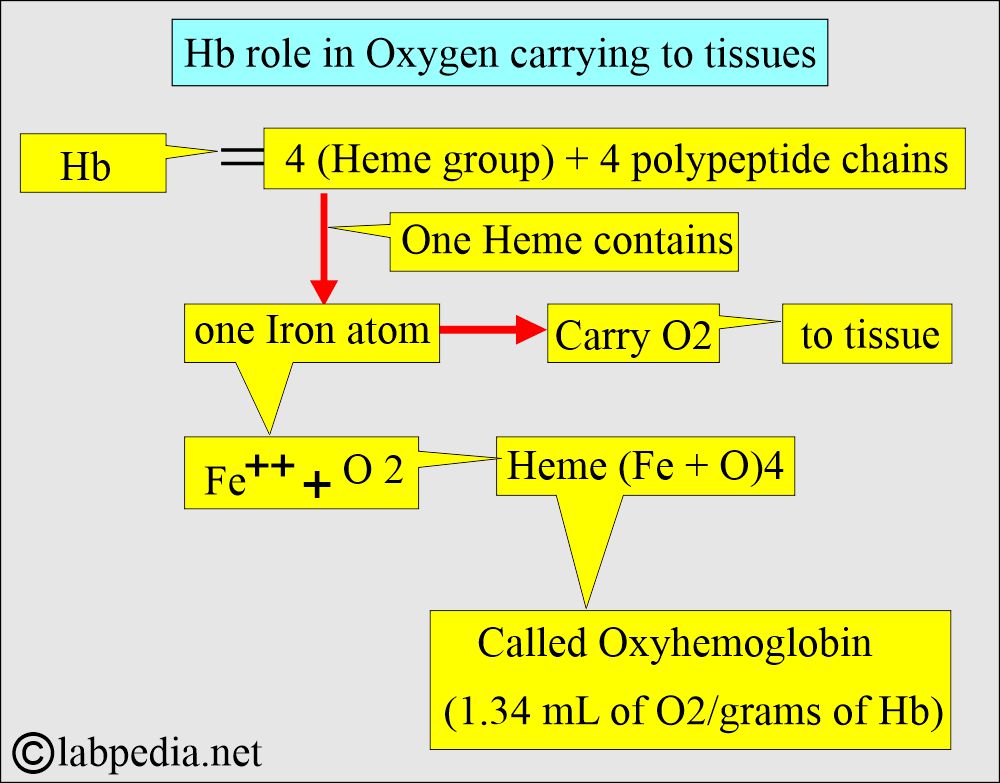
Hemoglobin (Hb) carries oxygen
- Hb acts as a buffer in extracellular fluid (the acid-base buffer system).
- In tissues, the oxygen concentration is lower, and the CO2 and H+ ion concentrations are higher.
- When the pH is lower, oxygen dissociates from Hb.
- Now, deoxygenated Hb will bind to H+ ions and raise the pH.
- CO2 diffuses into RBCs and forms carbonic anhydrase, converting CO2 to HCO3¯ and protons.
- Protons are bound to Hb HCO3¯ ions and leave the cell.
- Every HCO3¯ ion leaving the cell will lead to the entry of a chloride ion.
- This buffer system depends on the lungs and kidneys to eliminate CO2 and HCO3¯.
- Abnormalities in the globin structure lead to hemoglobinopathies such as sickle cell anemia and Hb C disease.
- In thalassemia, the globin chain synthesis is abnormal.
- Hb closely reflects the hematocrit and RBC count.
- Hb at birth is usually lower in premature infants.
- There is no significant change in Hb concentration after 85 years.
- The main function of hemoglobin is to transport oxygen to the tissues and remove carbon dioxide.
What are the signs and symptoms due to the Hemoglobin (Hb) level?
- There are >800 variants of hemoglobin. Only 9 variants and thalassemia have significance.
- Low Hemoglobin (Hb):
- It places a strain on the cardiopulmonary system to maintain oxygen levels.
- There is a risk of angina, heart attack, and congestive heart failure.
- Stroke.
- High Hemoglobin (Hb):
- The chances for intravascular settling.
- Stroke.
- Infarction in other organs.
What are the normal values of Hemoglobin?
Source 1
| Age | Hb g/dL | |
| Fetal Hb | ||
|
18 to 20 weeks |
11.7 ± 0.78 | |
| 21 to 22 weeks | 12.28 ± 0.89 | |
| 23 to 25 weeks | 12.40 ± 0.77 | |
| 26 to 30 weeks | 13.35 ± 1.17 | |
| Cord blood | 13.5 to 20.5 | |
| Infants | ||
| 0.5 month | 13.4 to 19.8 | |
| 1 month | 10.7 to 17.1 | |
| 2 month | 9.4 to 13.0 | |
| 4 month | 10.3 to 14.1 | |
| 6 month | 11.1 to 14.1 | |
| 9 month | 11.4 to 14.0 | |
| one year | 11.3 to 14.1 | |
| Child | ||
| 0.5 to 2 years | 11.0 to 14.0 | |
| 2 to 5 years | 11.0 to 14.0 | |
| 5 to 9 years | 11.5 to 14.5 | |
| 9 to 12 years | 12.0 to 15.0 | |
| Male | Female | |
| 12 to 14 years | 12.0 to 16.0 | 11.5 to 15.0 |
| 15 to 17 years | 11.7 to 16.6 | 11.7 to 15.3 |
| Adult | ||
| 18 to 44 years | 13.2 to 17.2 | 11.7 to15.5 |
| 45 to 64 years | 13.1 to 17.2 | 11.7 to 16.0 |
| 65 to 74 years | 12.6 to 17.4 | 11.7 to 16.1 |
- To convert into SI units x 10 = g/L
Another source
- Women = 12 to 16 g/dl
- Men = 14 to 17.4 g/dl
- Pregnant women = > 11 g/dl.
Another source
What are the normal Values in Infants and Children?
| Age | Hemoglobin level |
|
|
|
|
|
|
|
|
|
|
Normal value in Cord blood
- 9 month = 11.4 to 14 g/dl
- The normal values should be determined based on the populations of various countries.
What are the Normal values of a different fraction of Hemoglobin (Hb) in the adult?
- Hemoglobin A2 = 1.5 to 3.5 % of the total Hb.
- Hemoglobin F = <1% of total Hb.
- Hemoglobin in plasma = 0.5 to 5.0 mg/dL.
- Methemoglobin = < 1% of total Hb.
What are the critical values of Hemoglobin (Hb)?
- Blood transfusion is not recommended as long as the Hb is above 8 g/dl and Hct is above 24%.
- Hb <5 g/dl is critical and needs a blood transfusion.
- Blood transfusion is recommended in older patients when the Hb level is below 10 g/dl.
- Critical value:
- When Hemoglobin <7 g/dL.
- When hemoglobin >20 g/dL.
What are the conditions where Increased Hemoglobin (Hb) is seen?
- Polycythemia.
- Polycythemia vera.
- Congestive heart failure.
- Chronic obstructive pulmonary disease (COPD).
- After vigorous exercise.
- Hemoconcentration, like dehydration, burns, and severe vomiting.
- Intestinal obstruction.
- Severe dehydration, such as diarrhea and burns.
What are the conditions where Decreased Hemoglobin (Hb) is seen?
- Anemia.
- Drugs that cause aplastic anemia.
- Drugs that cause hemolysis (G6PD deficiency).
- Immune hemolytic anemia.
- Iron deficiency anemia.
- Thalassemia.
- Pernicious anemia.
- Hemoglobinopathies.
- Liver diseases and Cirrhosis.
- Hypothyroidism.
- The hemorrhage is acute or chronic, like bleeding hemorrhoids or ulcers.
- Malignancies:
- Hodgkin’s disease.
- Leukemia.
- Lymphomas.
- Carcinomatosis.
- Multiple myelomas.
- Autoimmune diseases.
- SLE.
- Sarcoidosis.
- Rheumatoid arthritis.
- Dietary deficiency.
- Deficiency of iron.
- Deficiency of vitamin B12 and folic acid.
- Malabsorption syndrome.
Questions and answers:
Question 1: What is the main function of the hemoglobin?
Question 2: What is the role of hemoglobin in the extracellular space?