
Urine changes When Urine is Left at Room Temperature, and Without Preservatives
Urine Changes When Urine is Left at Room Temperature and Without Preservatives
How will you define urine analysis?
- Urine analysis is one of the most important tests that do not cause any injury to the patient.
- This simple test will discover any disease in the entire urinary tract.
What are the precautions in the collection of urine?
- Proper collection and handling of urine are important to get accurate results. It depends upon:
- The containers should be clean, dry, and appropriate for the sample.
- Should follow proper collection procedure.
- Storage conditions are also important.
- A suitable preservative is also important to get accurate results.
- Disposable inert plastic containers with a secure cap are the best for urine collection.
- Biochemical and microbiological changes occur when urine is left in the lab at room temperature for longer (maybe over 24 hours).
- For routine urine analysis, freshly voided urine is better than the catheterized sample.
- Avoid urine contamination from the vaginal secretion (discharge) or hemorrhage.
- Get clean, voided midstream urine, particularly for the bacteriological examination.
- It may be necessary to pack the vagina or use the tampoon to avoid vaginal contamination.
- The best sample to check urine glucose is voided 2 to 3 hours after the last meal.
- This is the exception of the early first-morning sample.
- The key importance is to check the fresh or suitably preserved urine, usually refrigerated.
- The best option is to examine urine within 30 minutes of the collection, as the changes (decomposition) start during this time.
- Examine the urine in the first 1 to 2 hours of collection.
- Urine is the best culture media for the growth of bacteria.
- If it is delayed, then refrigerate the urine at 4 °C.
- Urine left at room temperature >2 hours is not acceptable.
- Urine preservatives are only accepted for 24 hours of urine collection, not routine examinations.
What urine samples are to be rejected?
- When urine has incorrect preservatives.
- When the urine quantity is insufficient.
- When urine is not collected with all needed precautions.
- When there is a missing or incomplete request form.
- When urine has no proper identification.
- When urine shows contamination, such as in stool, etc.,
Some articles favor that urine should be examined within two hours of collection.
What are the changes when Urine is left in the lab at room temperature?
- These changes may be:
- Physical.
- Chemical.
- Microscopic.
- Now, we will discuss these changes one by one.
- Appearance:
- Urine normally becomes hazy or cloudy when left at room temperature.
- This can be reversed by adding a few drops of acid.
- Vaginal contamination is quite a common cause of cloudy urine in female patients.
- After the food (vegetable/meat), urates or phosphate may produce cloudiness in the urine.
- Color:
- The normal color of the urine darkens when standing for longer than 30 minutes due to the oxidation of urobilinogen to urobilin.
- Some foods, like beets, can cause red-colored urine.
- Odor:
- If urine is kept for a long time at room temperature, it will give an ammonia smell produced by the bacteria, which will decompose the urea in the urine.
- pH:
- The growth of the proteus will change the pH to alkaline.
- If urine is left at room temperature, after some time, it will become slowly alkaline due to bacterial growth.
- The urine becomes alkaline after being kept on the table at room temperature due to the bacteria’s urea-splitting enzyme.
- Specific gravity:
- When urine is kept in the fridge, its specific gravity increases (false value).
- Red blood cells:
- These are distorted because of the lack of isotonic solution.
- RBCs become crenated or swell, which makes them difficult to recognize.
- Finally, RBCs disintegrate.
- White blood cells:
- When kept at room temperature for >2 hours, the WBCs will disintegrate.
- WBCs will also disintegrate in a hypotonic solution.
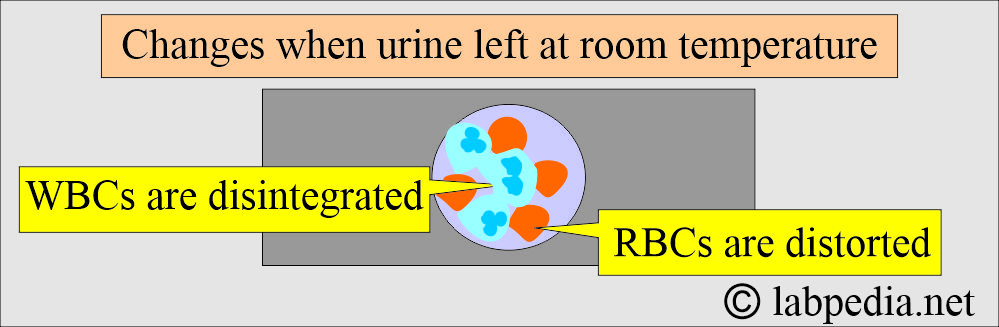
Urine left at room temperature changes
- Cast:
- These will disintegrate, especially as the urine becomes alkaline, but these casts need acidic urine and solute to exist in it.
- The alkalinity of urine:
- Other substances appearing in the acidic urine will disappear in the alkaline urine.
- Alkalinity develops because of the growth of bacteria and the production of ammonia.
- Bacteria:
- These will multiply and obscure the various components.
- Glucose:
- After some time, urine glucose decreases due to glycolysis and utilization by the bacteria.
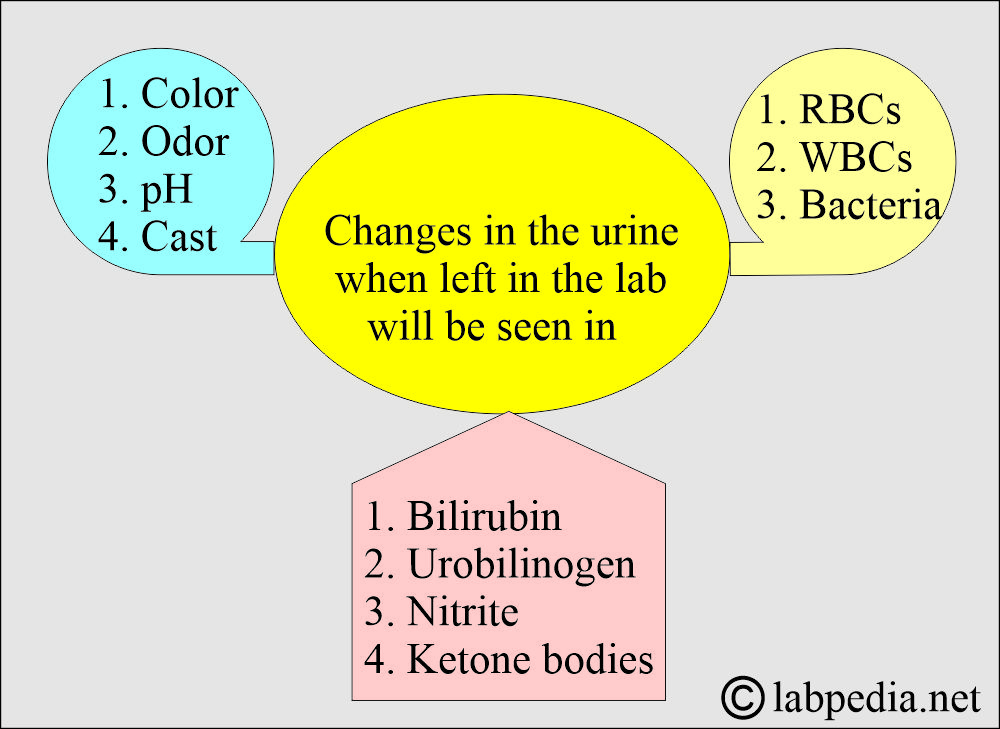
Urine changes when left at room temperature
Can you summarize the changes when urine is left for a longer period at room temperature?
| Urine characteristics | Changes taking place | What is the mechanism of changes |
|
|
|
|
|
|
|
|
|
|
|
|
|
|
|
|
|
|
|
|
|
|
|
|
|
|
|
|
|
|
|
|
|
|
|
|
|
|
|
|
|
|
|
|
|
What are the changes in Urine without preservatives?
| Parameters | What is the mechanism of change without preservatives? |
|
|
|
|
|
|
|
|
|
|
|
|
|
|
|
|
|
|
|
|
|
|
|
|
|
|
|
|
|
|
|
|
|
|
|
|
|
|
|
|
|
|
|
|
|
|
|
|
|
|
What is the purpose of the Urine preservatives?
- Preservatives are added to reduce the growth of the bacteria, the action of the bacteria, or chemical decomposition.
- Preservatives prevent the precipitation of chemical substances.
- The best option is to keep urine immediately in the fridge after collection.
- If you add chemical preservatives and immediately keep them in the fridge, it is the best option.
- Acidifying the urine (24-hour sample), and pH is <3, Helps preserve calcium, steroids, and VMA estimation.
- Sodium bicarbonate (NaHCO3), or sodium hydroxide (NaOH), is used to preserve the estimation of porphyrins, urobilinogen, and uric acid.
What are the urine preservatives in use?
- Refrigeration.
- Sodium fluoride.
- Formalin.
- Boric acid.
- Thymol.
- Toluene.
- Phenol.
How will you summarize the various urine preservatives?
| Urine preservatives | Benefits | Drawbacks |
|
|
|
|
|
|
|
|
|
|
|
|
|
|
|
|
|
|
|
|
|
What preservatives are used for 24 hours of urine samples?
| Preservatives for 24 hours of urine | Concentrations per volume of urine |
|
|
|
|
|
|
|
|
|
|
What are the routine preservatives used for special tests?
| Name of the test | Preservative used |
|
|
|
|
|
|
|
|
|
|
|
|
Summarize the urine collection for examination?

Questions and answers:
Question 1: What is the benefit of formalin as a urine preservative?
Question 2: Why is thymol used as a urine preservative?
Can bacteria in an Amies transport swab with charcoal survive for 13 days in the tube if testing is delayed,namely klebsiella pneumonaie,and enterococcus faecalis?
All these transport media are for a limited time and not for many days. You can see the following link:
https://microbeonline.com/amies-transport-medium/
What happens to protein in unpreserved urine?
Normal urine will be negative for protein.
I want to use urine as fertilizer. Is there any chemical suitable to increase the pH faster?
You can acidify urine by adding any acid like HCL (Hydrochloric acid). Urine is normally acidic.
I agree with you
I agree with you
How long can urine that has been collected in BD Vacutubes sit out at room temperature?
I think you can keep it for 2 hours, that will be fine. But for culture, this sample may not be suitable. You can keep the sample in the fridge meanwhile.
Hello, I kept my urine in a clear and clean container for about 24hours and it changes color. The color is a bit darken. Please I hope nothing is wrong with me
This is normal when you keep urine, it will change the color.
How long can a urine sample for microalbumin be kept at room temperature? How long refrigerated?
Ideally, urine should be tested within 30 minutes of collection. After 2 hours, discard the urine. You can refrigerate for few hours (1 to 2 hours) or add the adequate preservative.
What happens when urine is allowed to stand for a long time without a preservative
I think I have described in detail when the urine is left for a long time. Please read this link.
https://www.labpedia.net/urine-analysis-part-7-changes-when-urine-left-at-room-temperature-without-preservatives/
Does protein increase or decrease when urine is left on the bench for 24hours?
I could not find any reference about the protein if left. But I can imagine there will be minimal effect on urinary proteins.
My urine changes colour, smells strongly and also has white settlements and something particles that floats. Please I hope I am fine?
If you don’t have a fever, then this may be crystalluria. I will advise for the routine urine extenuation.
I accidentally left my 2 week old bottle of Urin next to the bed during the night next to my water and picked up the wrong one I spat it out but it tasted foul. Will it do me any harm?
I don’t think there will be any harm. Urine is good culture media, but stomach acidity (HCL) will kill all the bacteria.
The color of my urine changes and it becomes turbid. After 10 to 15 hours of urinating in the bottle, I see some talachani, what are these semen and solutionp
The color of my urine changes and I swallow, the sediment is seen in the urine bottle after 10 to 15 hours. Which is probably the solution to semen
Your question is not clear to me. When you keep urine for some time, its color will change and be turbid due to the growth of the bacteria in the urine.
I take a bottle of urine and after 10 to 12 hours I see a white clot under the bottle. I think these are semen. Nothing can be seen when the urine is taken in a bottle. The health is getting worse day by day.
hello,
I sit my urine for 3 hours in 23o degrees before doctor perform a urinalysis and it comes with a result of a bacterial infection.
Can this result might be influenced by this poor urine storage?
hello,
I sit my urine for 3 hours in 23o degrees before doctor perform a urinalysis and it comes with a result of a bacterial infection.
Can this result might be influenced by this poor urine storage?
When you keep the urine at room temperature, there will definitely be the growth of bacteria. Urine must be checked within 30 minutes or a maximum of 2 hours.
Will the nitrogen increases or decreases in an unpreserved urine sample?
The bacteria grow in unpreserved urine. If you mean urea nitrogen, that will depend upon the kidney function.
I placed a 3oz bottle of urin in the fridge for about 24 hours, im taking my sample in but there’s now something white floating in there, will this give me a bad test reading?
This white cloudiness is due to the precipitation of the crystals. Refrigeration only helps to stop the growth of bacteria. 24 hours is a long time, and you may get some changes in the results.
You can give urine in the lab instead of being in doubt.
Is there anything simple to add to prevent bacteria growth? Planning to do a lab on this. Thank you
For a limited time, you can keep the urine in the refrigerator, which will inhibit the bacterial grwoth.
This is SO interesting. I can see urine decomposes (or undergoes changes) after a short time, but would medication/drugs in urine decompose?
Can urine be tested for drugs (of any kind) weeks or months after collecting the urine? Would the sample need to be refrigerated if so?
Thank you!
I think the drugs may not change unless affected by the growth of bacteria. Bacteria multiply at room temperature. Testing the urine for drugs depends on its half-life. Most of the drugs are excreted in the urine. Why do you want to test drugs after weeks or months? If you have any doubt, it is better to try as early as possible.
What is the principle involved in most qualitative tests for sugar?
What is the significance of the presence of sugar in urine?
What urine preservative may give rise to false positive result for sugar?
1. Please see Benedict’s reaction to urine glucose.
https://labpedia.net/diabetes-mellitus-part-5-glucose-in-urine-glycosuria-urine-sugar/
Glucose can be checked by the oxidase method.
2. Urine sugar appears when the renal threshold of glucose is >180 mg/dL.
3. You don’t need any preservatives; check the urine sugar immediately.
Thanks for the details. That is, the temperature at 95+ degrees did not allow any growth of the bacteria. Your blood group O-negative has no role.
I keep my urine to later extract stuff from it. That doesn’t matter. What matter is I have a bottle I urinate in to collect it and I urinated in it last night and finished filling the gallon jug, sealed it up. Everything was ok. I went to grab the bottle this afternoon to empty it and the entire bottle had turned dark black. It was normal yellow last night. I’ve never had this happen before and I can’t find anything about it. Should I go get checked out? I mean the bottle looks like I filled it with black ink, it’s that black.
Would you mind asking your physician to rule out metabolic errors like porphyrinuria, etc.?
Great article, thank you!
I study Microbiology and Genetics, Organic Chemistry too 🙂
You listed everything in great detail, some of the information I did not know about before, but I do now!
Learning something new everyday!
(I studied at Pnt Prk, that was 20 years ago!)
Thanks again 🙏👍😊
Thanks for the encouraging remarks.
Dr. Riaz,
Can the Creatinine level change based on the handling of the urine sample? Example: Provided sample is stored at room temperature in a plastic tube, then shipped to the lab and tested 2-3 days later?
Thanks and I look forward to your feedback,
AW
I think if you keep urine for three days, then that sample is not reliable. As I know, all urine collected for 24 hours needs preservatives and refrigeration.
Hi Dr. Riaz, can you help me to answer the following question? in my opinion should be protein. Thanks in advance.
—If, Lab Tech performs test after 2 hours of specimen arrival. Which of the following would be least affected in a urine specimen?
– Urobilinogen- Ketones- Protein –Nitrite — or Specific Gravity
Please see the following link carefully; most of your questions are answered.
https://bit.ly/3nimaQ3
What happens when urine is allowed to stand for a long time without a preservative and Why?
Please carefully read this link.
https://bit.ly/3nimaQ3
I submitted a urine sample last week for a drug screen. Job called me yesterday and had me do a second one today due to inconclusive PH levels. I had this tested at the clinic while I was there and my PH levels were fine. It takes 5 days to get results back for the urine sent out. Isn’t that too long to wait to analyze?
I think this may be the policy of the lab to deliver the result after five days.
Can the Leukocyte esterase increase if sample sits too long in non-preserved container? Say in house sample is Small in the AM, then sent out to ref lab for further testing and microscopic analysis, they get a large Leukocyte esterase, is that common with the degradation of the Leukocytes present? Can the “leaking” of esterase cause this?
I think you are right; that is the reason for the release of leukocyte esterase.
After leaving urine for an hour, tiny bubbles accumulate at the top. What could be the reason behind this?
Most likely gas produced by the bacteria.
Hi Dr.Díaz, I left a urine sample around 4 days in room temperature and I noticed a few small red crystals. These look like bilirubin crystals when I search it. Could this mean any health problems or is it normal for small crystals to form over time?
My question is, have you seen it under the microscope? Keeping urine for four days has no significance.
Hi. Did you ever find out the answer to the small red salt like crystals in your urine? I left cup of urine in a cup out for a day and notice the same.
Please let me know the nature of the cup. If it is contaminated with something, the crystals are from that contaminants.
If I urinate around 2:00am can it be considered as early morning urine for urine analysis and MCs.
When you get up in the morning is a fasting (morning) sample. I don’t think that the 2 a.m.sample is a morning sample.
Hi. Did you ever find out the answer to the small red salt like crystals in your urine? I left cup of urine in a cup out for a day and notice the same.
For an ETG and ETS test, how long can urine be stored at room temperature – any CDC or gov’t guidelines?
Please see this reference:
https://www.mayocliniclabs.com/test-catalog/overview/63421#Specimen
This is CDC reference:
https://medicine.musc.edu/departments/psychiatry/divisions-and-programs/programs/cnl/heavy-alcohol-testing/etg
How did my clean urine that sat out for 2 weeks without refrigeration and preservation when tested give a false positive for methamphetamine and amphetamine
It can be detected in the urine in weeks’ time. Please read this article.
https://americanaddictioncenters.org/meth-treatment/how-long-in-system
Why specific gravity increase when urine sample by refrigeration ?
And what’s happened on ca oxalate when we leave the sample over night in my lap it formed and increases but what’s mechanism?
1. Most urinometers are calibrated at 15C or 20C. For each 3C difference, add 0.001 if above or subtract if below the calibration temperature. Fridge temperature is 4C to 8C.
2. If you leave urine for a long time, bacteria will grow and change the pH to alkaline.
For urine specimen tested using urine dipstick for Protein Only (using bromophenol blue reagent), do you anticipate the protein is stable in solution and the test would remain accurate (for protein only) if left out at room temperature for 24-72 hrs? (I found this excellent article but noticed that spot protein measurement is not mentioned). Thanks!
Please see the following link:
https://labpedia.net/urine-analysis-chemical-examination-and-interpretations/
Sir plz , can a freshly voided urine sample that has casts after its being viewed and discarded ,then the next morning you decided to recheck fr that same cast, still retain the casts in it?
It depends on what type of crystals you have seen. Rest most of the crystals depend upon the food intake.
I have a couple scenarios. Say your on a pier fishing and he peed and you did as well. Well a fish was on the line and a wound on your leg was almost closed from surgery. Well it had been in 90 degree heat for hrs and you knocked it over and it poured down your injured leg from total knee reconstruction surgery. Week before you tested pos. For mrsa. But your mrsa was just cleared up. What infection would this cause
2) what if you thought it was a beer you opened and you drank some from some that was left out for hrs and it stunk so bad worse than amonia on both scenarios.
Thank you. My email is [email protected] in case i dont get an alert
I can not understand your question. Sorry for that.
my urine is sometime cloudy. it come and go over days. cloudy urine is clearing up rapidly and not present on same day when.peeing more than once. Ive been told to add couples of drops or acetic acid to see what happen… the urine get clear almost instantly. why this happen…is it serious?
Some of the crystals are soluble in an acidic medium.
My fiancée is having to undergo random urine test by court order. He’s almost done with the program and had a altered urine sample may 24th and again June 30th. He has to give his urine sample infront of an employee in the justice department. It takes 2 weeks for results from lab. Lab is saying that it’s not possible that it’s his OWN Urine!!! Nor that it’s human!!!! HOW IS THIS POSSIBLE? IN A SUPERVISED URINE TEST COLLECTION. ??? Lab also reported that it’s got Gravity. My Fiancée is 60, Has high blood pressure is on lots of medication, takes legal supplements. During these times it’s been hot weather and he drinks too much coffee, not enough water adds powder packets from grocery stores with electrolytes. The Judge doesn’t believe him that it’s his own urine SAMPLE!!!! PLEASE HELP! IM SCARED for his health and he put him in jail for 5 days! He used to be a Heavy Drinker, and had triple bypass surgery in his early 50’s. Could he be having kidney problems that has altered his URINE?
Please this is a legal issue and better consult a lawyer.
Dr.Riaz maybe you could help me.
I’ve gotten many urine tests and are clean except noted sediments.
Is there any concern to this? How can I find out the cause?
Also I have noticed when my urine is left in a water bottle over night there is a white/cloudy substance that settles near the bottom. Very distinct. Is this cause for concern?
Urine sediments are not to worry about. Normally urine contains crystals. On a vegetarian diet, you may see calcium oxalate crystals. When you leave urine overnight, some of the crystals appear due to the change of pH by bacterial growth. No need to worry about it.
If you take a UA and it sits out for about an hour in room temp, can it still be tested? Or will the results be false? If it sits out and is then sent to the lab for further testing, would this also give false results?
What happens when a UA is left out in room temp for an hour, will the results be accurate or will it give false data? If it is left out, can it still be sent to the lab for further testing or will this also give false results? Can bacteria or e.coli be present if you do not do a catch mid-stream or a good clean catch?
All your questions are answered. Please read the topic carefully “urine changes when left at room temperature.” Urine must be examined within 30 minutes is the best option.
Dr Riaz – I’ve heard that after 30 days of storage at ambient temperature that urine will be free of any toxins and can be discharged into the environment? Would it also be safe to drink at that point? Or at least shower with? I’m working on off-grid systems for living.
When you keep urine for some period of time, this will leads to the proliferation of the bacteria. Urine is a very good source of bacterial growth.
Dr.Riaz if I have to give you UA for drug screen and I have clean urine that I want to use but it’s been in a dark bottle in a cool dark spot. When I use it do you think they will be able to tell they use a strip test?
It depends upon the drug’s use; some drugs take a longer time to clear from the urine.
Thanks for your effective essay Dr.Riaz. Very helpful
Welcome.
What a wonderful work
Thanks.
Dr. Riaz, sir how does Specific gravity increased when you stored the urine in the fridge?
When urine is kept in the fridge, the specific gravity will change due to the solvents and temperature.
urine should come to room temperature or can be corrected by adding or subtracting 0.001 to the specific gravity for each 3 C above or below calibration temperature.
Hello Dr.Riaz,
I have done a few experiments with stored urine for agriculture. I have observed that in a plastic container stored urine will cause the bottle to push in on itself. Unrelated but if i put sugar in a bottle with water plus heat it will expand and compromise the seal of the container and leak out or “explode” eventually. But with urine the bottle contracts, as if something inside is chemically reducing the air volume and causing the bottle to contract. This also happens in empty bottles that once had urine in them. I’ve found a solution by letting the urine remain in glass containers, however I am wondering why this might happen. Is the urine in the plastic bottle consuming the gas in the bottle through some process?
Thank you,
Jimmy
Actually, urine contains nitrogen in different forms. That may explain your experiments in different form.
Hi Dr. Riaz,
How does direct sunlight affect urine being tested for things like codeine, amphetamines, and opiates?
Most of the drugs have potential for photodegradation or other chemical reaction.
Hi, I had 4 samples urine to test glucose for a pregnant person. Red and White cells were seen. After 4-5 hours the samples were retested to do a urinalysis. The red cells were less on the first sample, none seen and 2nd and 3rd sample but red cells seen in the 4th sample. Could you give some guidance as to why this ocurred?
Urine needs to be tested in first 30 minutes. If you test same urine after some time, definitely the result will be not the same. So, forget about later on test report on the same urine.
Thank you for your guidance.
Dr Riaz, I need your help with a matter I am dealing with. Can I reach you directly?
Yes, you can email me.
Thank you, Can you please provide me with your email? I’m having trouble locating it.
Our urine samples arrive in the late afternoon. The samples are kept in the fridge overnight and we do urinalysis in the next morning. But crystals are always found in the samples, how can we solve the problem?
https://labpedia.net/urine-changes-when-urine-left-at-room-temperature-and-preservatives/
I think this topic covers your question. Please add preservative and refrigerate the urine sample.
My urine sample had mucus and Squamous Epithelial cell count above normal. The RN said probably because left at room temperature too long. Should I be concerned?
When you leave urine at room temperature, epithelial cells will degenerate. There might be more mucus and epithelial cells.
What type of Casts decomposed first ?
Cast needs acidic urine, when it becomes alkaline, I do not think any difference will be for the cast to disappear.
My baby’s urine colour turned black after some time her urination. It is her congenital issue. Sir please tell me is this serious problem? And one thing extra that her left kidney is ectopic and situated in pelvis . Is this urination issue related with this kidney’s abnormalities?
The color changes as you described may be due to 1. Breakdown of RBCs. 2. Dehydration 3. Medication. 4. or liver diseases.
Other possibility is Homogentisic acid abnormality. Please consult pediatrician.