
Folic Acid and Folate
Folic Acid and Folate
What Sample is Needed for Folic Acid and Folate?
- Fasting venous blood is needed to prepare the serum.
- Some of the labs take a sample without fasting.
- Protect the blood from light.
- If RBC folate is needed, then blood in EDTA is taken.
- The sample is stable for 24 hours at 4 °C.
- 6 to 8 weeks at -20 °C.
- Also, perform a hematocrit.
- Avoid hemolysis.
- Avoid repeated freezing and thawing.
What are the precautions for Folic Acid and Folate?
- Certain drugs decrease folic acids, such as alcohol, PAS, Ampicillin, Antimalarial, Erythromycin, Methotrexate, Oral contraceptives, Chloramphenicol, penicillins, Aminopterin, tetracyclines, and Phenytoin.
- Avoid administration of radionuclides for at least 24 hours.
- Hemolysis gives a falsely elevated level.
- Iron-deficiency anemia causes a false increase.
- Draw blood before the administration of the B12 injection.
What are the Indications for folic acid?
- It is advised in megaloblastic anemia.
- This test is advised in the following conditions:
- To rule out the folic acid deficiency.
- In iron-deficiency anemia.
- In Hypersegmented neutrophils.
- It is advised during pregnancy.
How will you define the structure of folic acid and Folate?
- Folic acid and folate are different types of vitamin B9.
- Folates are naturally occurring compounds with a structure similar to folic acid.
- Folic acid is a synthetic form and is available as a supplement and in fortified foods.
- Folic acid and Folate are used for a family of compounds related to Pteroic acid.
- Folic acid or pteroylglutamic acid is the parent compound of the folate complex.
- Folacin is the generic term for folic acid and related substances that have the activity of folic acid.
- Folic acid or folates consist of:
- A pteridine is a base.
- It is attached to one molecule of p-aminobenzoic acid.
- And glutamic acid.
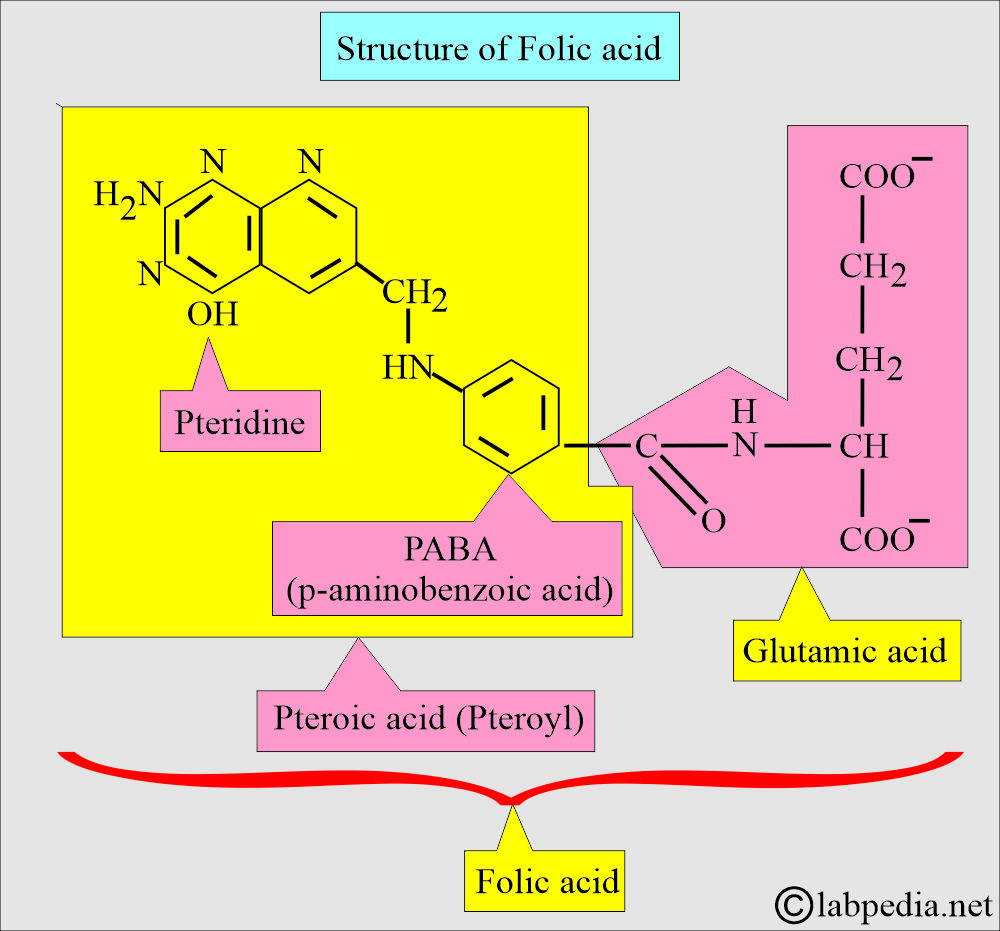
Folic acid structure
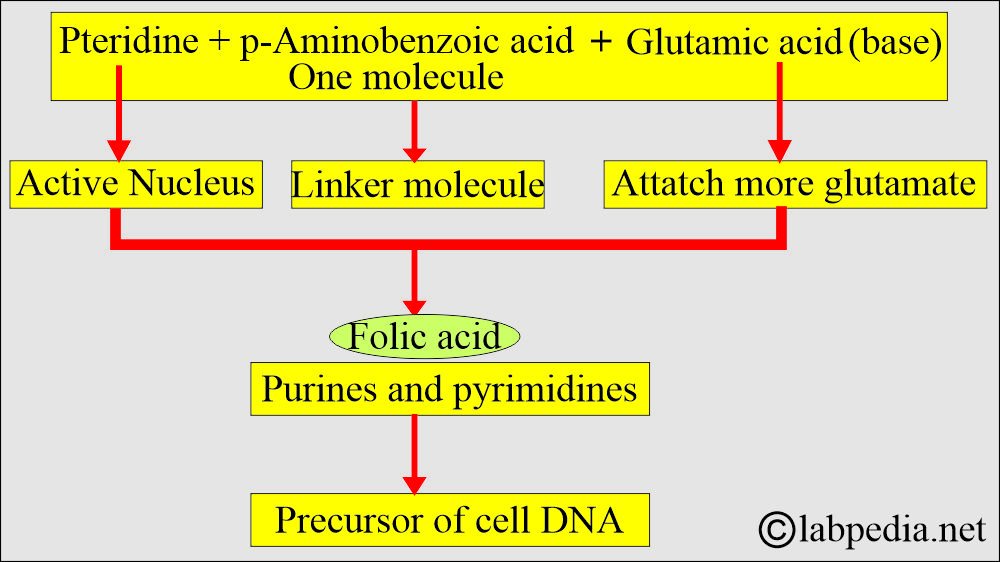
The role of folic acid in DNA
- Pteridine and p-aminobenzoic acid are called Pteroyl.
- The rest of the names are given according to the number of glutamic acids, such as pteroyl monoglutamate or pteroyl polyglutamate.
- Folic acid /folates are a generic term for a family of compounds that function as coenzymes for processing one-carbon units.
- Another definition:
- Pteroic acid, combined with one molecule of L-glutamic acid, will form pteroylglutamic acid (Folic acid).
- It will reduce to dihydrofolic acid or tetrahydrofolate. These reduced forms are biologically active.
- Folic acid and folates (B9) are forms of water-soluble vitamins like Vit. B 12.
What are the differentiating features of folic acid and folate?
| Clinical parameters | Folic acid | Folate |
|
|
|
|
|
|
|
|
|
|
|
|
|
|
|
What are the important facts about Folic Acid and Folate?
- Humans cannot synthesize p-aminobenzoic acid or attach glutamic acid to pteridine.
- This is the reason that folates occur naturally in food like:
- Yeast.
- Liver.
- Leafy vegetables.
- Folic acid is a synthetic form of the vitamin.
- Folate activity is around 95% in the RBCs.
- The activity in the serum is about 40% and is protein-bound.
- Vitamin B12 and Folate are linked by the transfer of the methyl group from the 5-methyltetrahydrofolate (5-MTHF).
- In cobalamin deficiency, 5-MTHF is metabolically inactive.
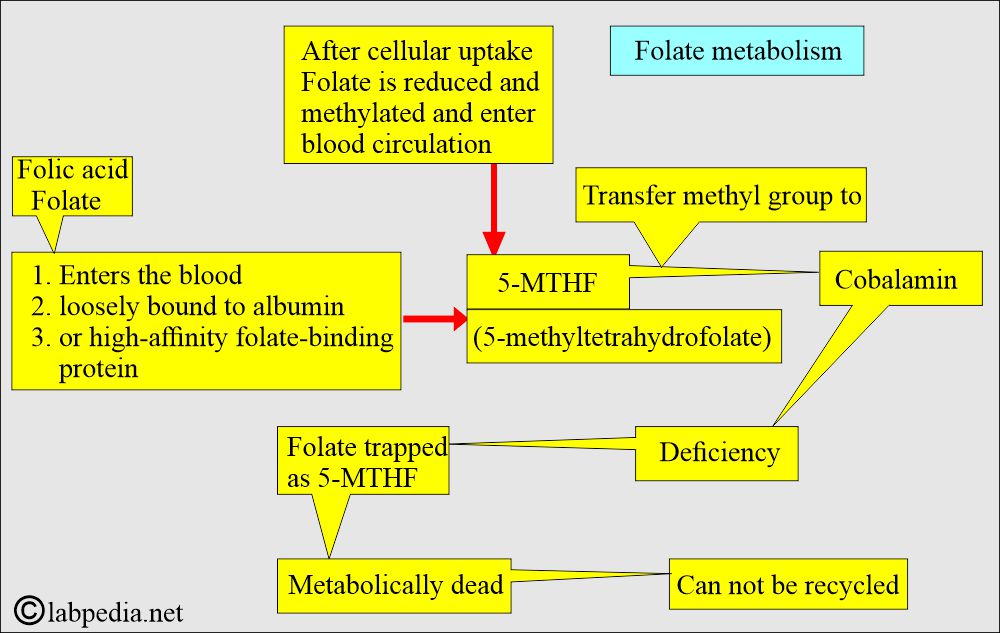
Folic and Folate metabolism
What are the requirements of Folic Acid and Folate?
- A normal diet consists of 500 to 700 µg of Folate, and 50 µg is absorbed daily.
- Another source states that the normal dietary intake of Folate is 200-250 µg.
- The minimum daily adult requirement is 100 to 150 µg.
- Another source says the daily requirements range from 60 to 280 µg to replace losses.
- The body storage is 10 to 12 mg and is sufficient for 4 months (another source storage for one month).
- Another source reports that total body stores range from 12 to 28 mg.
What is the synthesis and site of absorption of Folic Acid and Folate?
- Its absorption site is the duodenum and jejunum.
- The bacteria form folic acid in the intestine.
- Folic acid is stored in the liver.
- A liver biopsy shows half of the body’s folate stores.
- 0.5 to 1% of the body’s stores are catabolized or excreted daily.
- The intestinal enzyme cleaves folate derivatives in the diet to monoglutamyl Folate for absorption.
- Folate reductase reduces (enzyme) it to tetrahydrofolate using NADPH as a donor.
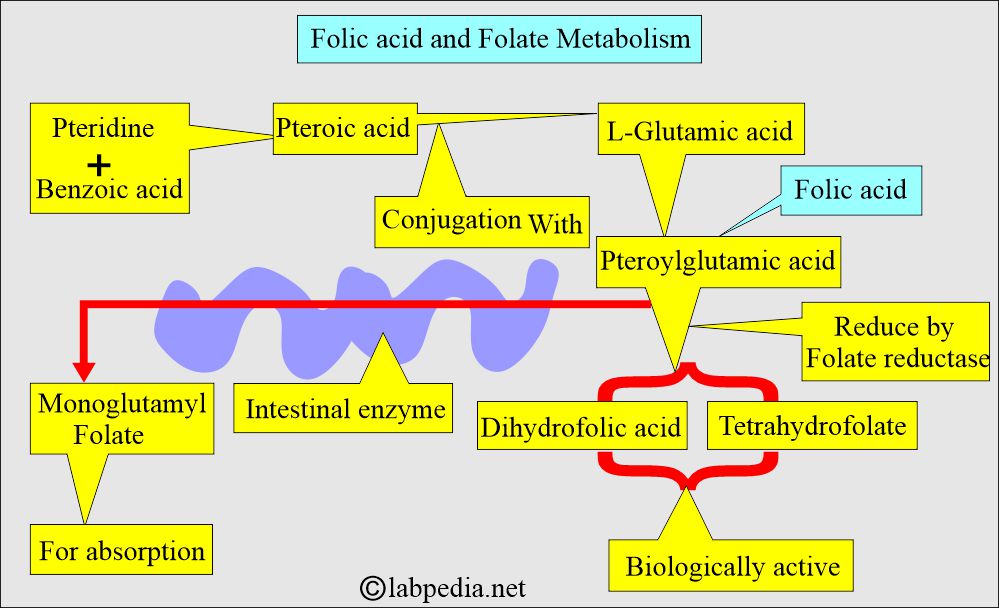
Folic acid metabolism
What are the sources of Folic Acid and Folate?
- It is present in:
- Eggs and milk.
- Leafy vegetables (spinach, broccoli, and lettuce).
- Okara, and asparagus.
- Fruits (bananas, melons, lemons).
- Orange juices and tomato juices.
- Beans, yeast, mushrooms, and meat (beef liver and kidney).
- Liver.
- Yeast.
- Orange juice.
- Folic acid is added to:
- Cereals.
- Bread.
- Flour.
- Pasta.
- Bakery items.
- Cookies.
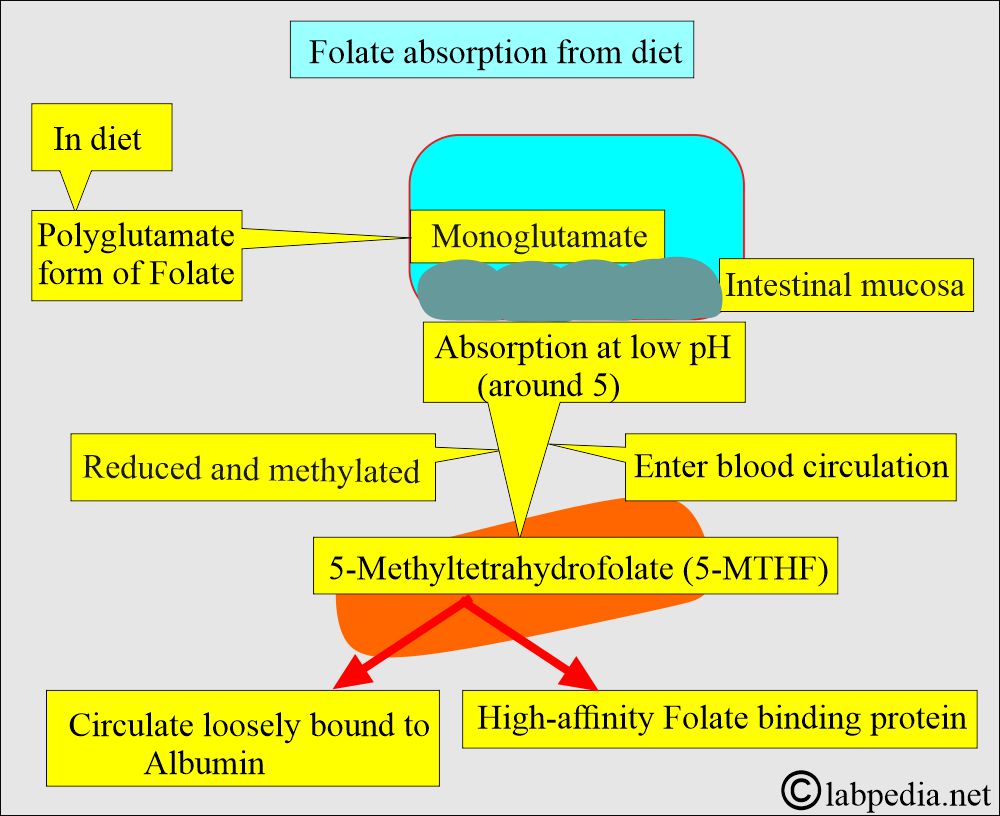
Folate absorption
- This is stable in an acid solution and rapidly absorbs in an empty stomach.
- This is unstable in light.
- Supplemental folate absorption is 100% in comparison to dietary folates.
What are the functions of the Folic Acid and Folate?
- Folic acid produces and maintains new cells.
- It prevents changes in DNA that may lead to cancer.
- Folic acid is needed for the normal function and maturation of RBCs and WBCs.
- Folic acid is a potent growth promoter, and its absorption depends on the normal functioning of the intestinal mucosa.
- Folic acid is also needed to synthesize purine and pyrimidines, which, in turn, are precursors of cell DNA.
- Folic acid is needed for DNA.
- Folate is also needed for methionine synthesis, histidine catabolism, and serine and glycine metabolism.
- It is a hypothesis that folic acid is involved in congenital abnormalities.
- Methylation of homocysteine to methionine.
- Methionine is converted to S-adenosylmethionine, a universal donor of a methyl group to:
- DNA.
- RNA.
- Hormones.
- Neurotransmitter.
- Membrane lipids.
- Proteins.
- The elevation of homocysteine concentration has shown an increased risk for coronary artery disease and cerebrovascular disease.
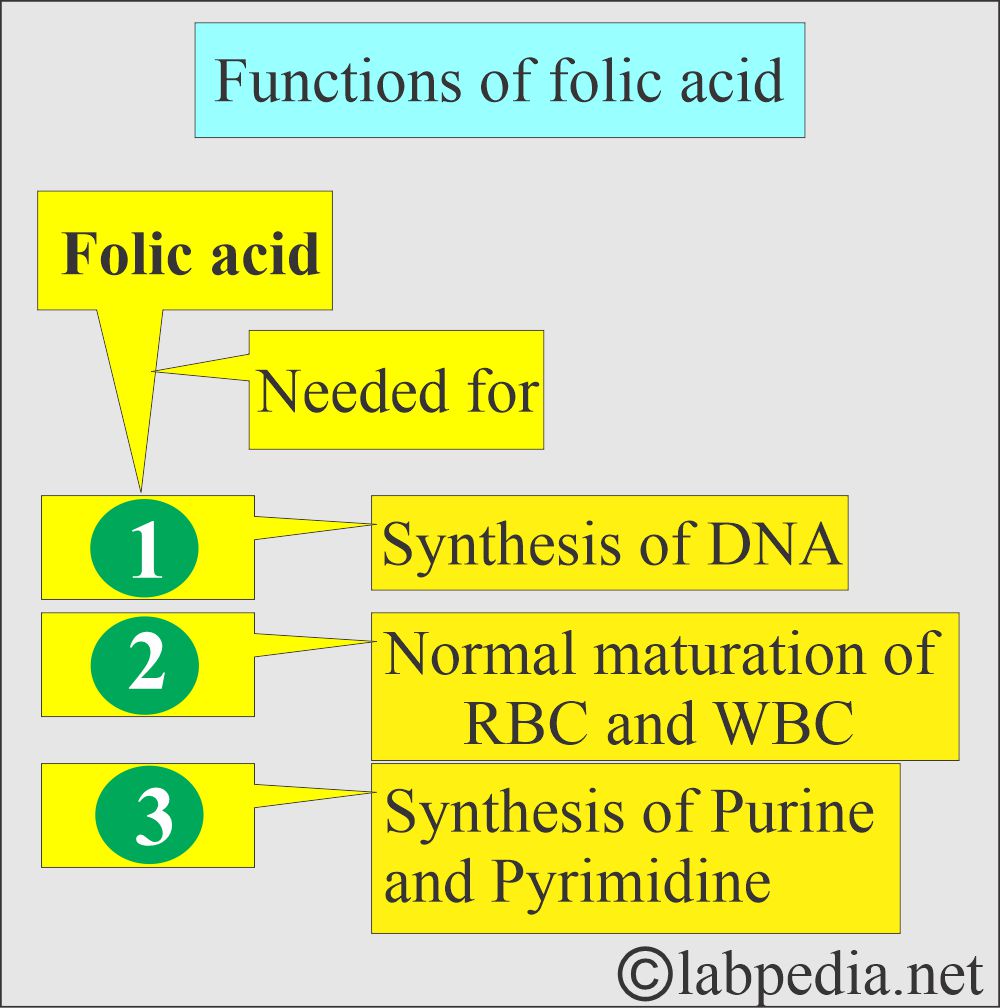
Folic acid functions
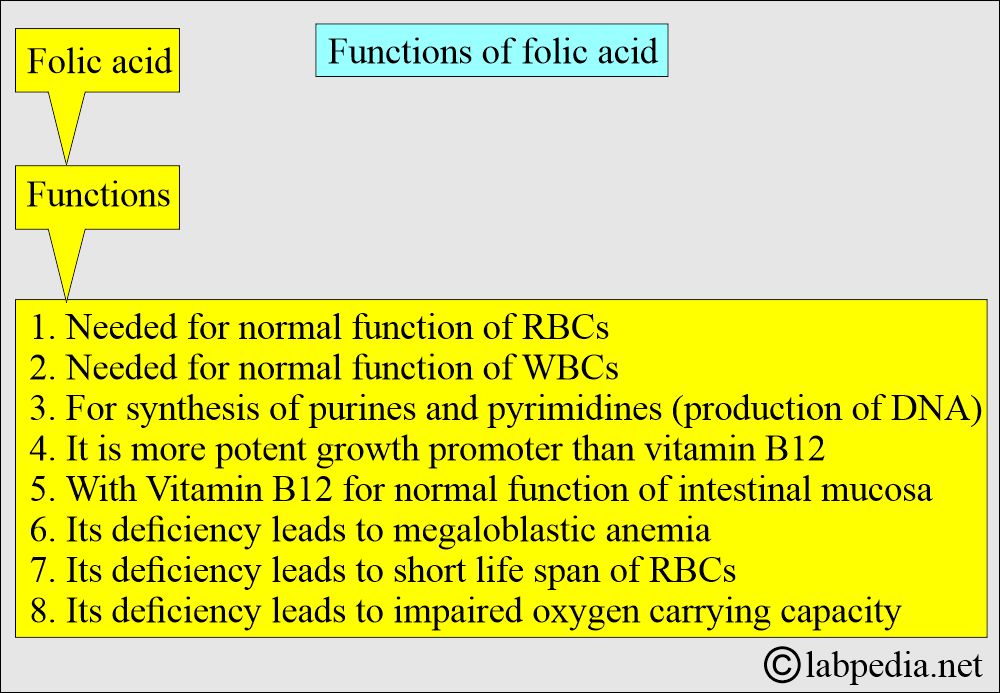
Folic acid functions
What are the sources of Folic Acid and Folate?
- Folates occur naturally in foods, and folic acid is the synthetic form.
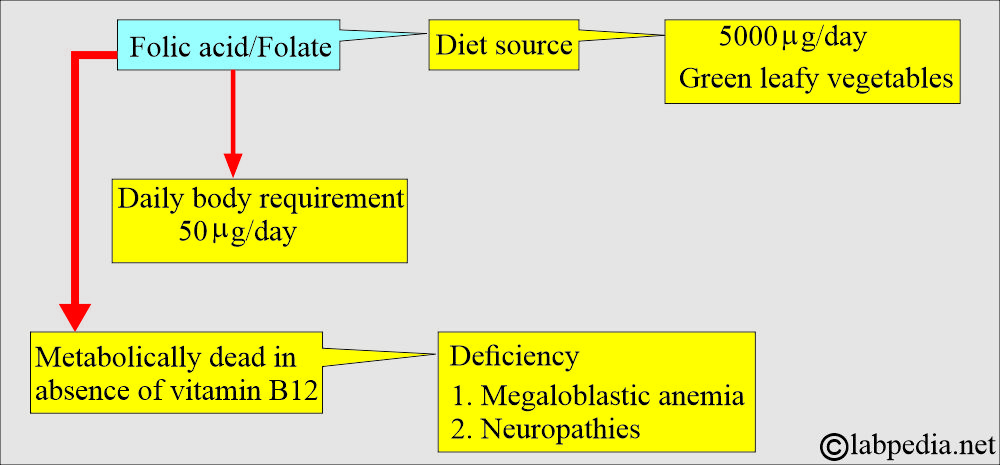
Folic acid is needed in the diet
- Folic acid has been added to cold cereals, flour, bread, pasta, bakery items, cookies, and crackers, as required by federal law since 1998.
- Foods rich in folate include spinach, lettuce, broccoli, okra, and asparagus, as well as fruits such as bananas, watermelon, lemons, orange juice, and tomato juice.
- Folic acid is present in eggs, milk, yeast, liver, fruits, leafy vegetables, and fruits.
- Folate is also present in beef liver and kidneys.
- Folic acid is a more potent growth factor than Vitamin B12.
- Determination of serum folic acid and RBC folic acid is the best measure to rule out folic acid deficiency.
- Vitamin B12 is needed to incorporate folic acid into tissue cells.
What are the causes of Folic Acid and folate deficiency?
- Megaloblastic anemia is the major manifestation of folate deficiency.
- Folic acid deficiency causes megaloblastic anemia and can not be differentiated from pernicious anemia in laboratory tests except the Schilling test without intrinsic factor (IF).
- Neurological symptoms are absent in folic acid deficiency.
- Pernicious anemia is due to a deficiency of vitamin B12 and not a folic acid deficiency.
- It is important to differentiate B12 from folic acid.
- The absence of intestinal bacteria (a sterilized gut).
- Poor intestinal absorption may be seen after surgery or sprue.
- Insufficient dietary intake.
- Excessive demands, as in pregnancy, liver diseases, or malignancies.
- Treatment with antifolate drugs like methotrexate and anticonvulsant therapy.
- In alcoholics.
How will you summarize Folic acid and Vitamin B12 deficiency?
| Parameters | Vitamin B12 deficiency | Folic acid/Folate deficiency |
|
Megaloblastic anemia | Megaloblastic anemia |
|
|
|
|
|
|
|
Slow | Rapid |
|
Present:
|
Absent |
|
|
Same findings |
|
Megaloblastic cells | Megaloblastic cells |
|
Increased | Normal |
|
|
Folic acid |
What are the toxic effects of an overdose of Folic Acid and Folate?
- Toxicity is associated with folate supplements.
- There are toxic neuropathy symptoms along with B12 deficiency.
- Can cause precipitate neuropathy in patients with Vitamin B12 deficiency.
- It masks vitamin B12 deficiency.
- This may delay the treatment of the deficiency and allow progression to the neuropathy.
What are normal folic acid and folates?
Source 4
- Adult (fasting) = 3 to 20 ng/mL, (11 to 57 nmol/L)
- Adult (serum) = 2 to 20 ng/mL, (4.5 to 45.3 nmol/L)
- Children (serum) = 5 to 21 ng/mL (11.3 to 47.6 nmol/L)
- Infants = 14 to 51 ng/mL (31.7 to 115.5 nmol/L)
- RBCs folate:
- Adults = 140 to 628 ng/mL (317 to 1422 nmol/L)
- Children = >160 ng/mL (>362 nmol/L)
Another source
- <60 years adults = 1.8 to 9.0 ng/mL (4.1 to 20.4 nmol/L)
- >60 years adults = 1.2 to 12 ng/mL (1.2 to 12 nmol/L)
What is the equivalent of dietary folate (DEF)?
- It is the dietary daily requirements of the body:
- 0 to 6 months DEF = 65 µg/day.
- 1 to 3 years DEF = 150 µg/day.
- 4 to 8 years DEF = 200 µg/day.
- 9 to 13 years DEF = 200 µg/day.
- 19 years to older DEF = 300 µg/day.
- 14 to 18 years DEF = 300 µg/day.
- Pregnant women DEF = 600 µg/day.
Source 1
Normal Folate
- 2 to 16 years = 5 to 21 ng/mL.
- >16 years = 3 to 20 ng/mL.
- To convert into SI unit x 2.265 = nmol/L
Source 2
Normal folic acid (Folate)
- 5 to 25 ng/mL (11 to 57 nmol/L)
Another source
- Adult fasting serum folate = 3 to 20 ng/mL (7 to 45 nmol/L).
Source From Medscape
- Adult = 2 to 20 ng/mL
- Children = 5 to 21 ng/mL
- Infants = 14 to 51 ng/mL
RBC folate
- Normal range = 5 to 15 ng/mL
- Borderline range = 3 to 5 ng/mL (variable hematologic findings)
- <3 ng/mL range = Positive hematologic findings
What is the purpose of folic acid treatment?
- Memory loss.
- Age-related hearing loss.
- Alzheimer’s disease.
- It reduces the aging effect.
- Sleep problems, nerve pain, depression, and muscle pain.
- In a patient with methotrexate treatment.
- Some people recommend preventing colon cancer and cervical cancer.
How will you do a Lab diagnosis of folic acid/folate deficiency?
- Serum folic acid measurement diagnoses folic acid deficiency.
- The RIA assay is simpler than the bacterial method.
- RBC folate level may be advised.
- Drawbacks of serum folate assay:
- The small laboratory can not perform this test.
- Serum folate levels fall below normal limits 3 to 4 weeks after the dietary or absorption-induced deficiency begins.
- RBC folate levels become abnormal about 3 months later than serum folate.
- Anemia develops 5 months after the onset of folate deficiency.
- A diet full of folate may increase the serum folate level. While RBC folate will be low.
- Serum folate levels may be low in severe liver and kidney diseases.
- A therapeutic trial of the folate may be advised.
When will you see an increased level of folic acid?
- Pernicious anemia.
- Massive blood transfusion in recent times.
- Vegetarian food contains more folic acid.
What are the causes of decreased levels of folic acid/Folate?
- Malnutrition. Dietary deficiency is the most common cause.
- Dietary deficiency is most common in alcoholics.
- It is postulated that alcohol inhibits folate absorption and interferes with folate metabolism.
- Malabsorption syndrome, e.g., Sprue, Celiac disease.
- This is the second most common cause and is due to primary small bowel disease.
- Pregnancy.
- This may be seen in 10% to 25% of pregnant ladies with some degree of folic acid deficiency.
- During pregnancy, folic acid deficiency is due to dietary intake and increased fetal demands.
- More severe deficiency (<5%) may be seen in the third trimester.
- Hemolytic anemia.
- Megaloblastic anemia.
- Liver diseases.
- Malignancies.
- Chronic renal disease.
- Vit.B12 deficiency.
- Malignant tumor-like metastatic carcinoma, acute leukemias.
- Myelofibrosis.
- Crohn’s disease.
- Ulcerative colitis.
- Intestinal resection and jejunal bypass procedure.
- In chronic alcoholics.
- In the case of anorexia nervosa.
- Drugs like:
- Anticonvulsant drugs like phenytoin show in roughly 30% of the cases. It is also seen in primidone.
- Cytotoxic drugs like methotrexate exert an antitumor effect by interfering with folate metabolism.
- Colchicine, para-aminosalicylic acid (PAS), and neomycin interfere with folic acid absorption in some of the patients.
- Diet, pregnancy, and anticonvulsant drugs show a normal Schilling test.
What are the drugs that act as an antagonist to folic acid?
-
- Anticonvulsant.
- Methotrexate and aminopterin.
- Antimalarial.
- Heavy use of antacids.
- Oral contraceptives.
Questions and answers:
Question 1: What is the main function of folic acid?
Question 2: What is the antagonist to the absorption of folic acid?