
Lugol’s Iodine Solution
- Lugol’s iodine is mainly used in the wet preparation of stool.
What are the ingredients of Lugol’s Iodine Solution?
- 5% Lugol’s iodine solution:
- Iodine powder = 5 grams.
- Potassium iodide = 10 grams.
- Distilled water = 100 mL.
How will you prepare Lugol’s Iodine Solution?
- Dissolve the potassium iodide in the distilled water.
- Add iodine crystals slowly and keep shaking the container (test tube) until they are dissolved.
- Filter the resulting solution.
- This is the stock solution.
- For the working solution:
- Dilute the stock solution 1:5 with deionized distilled water.
- You can use this working solution for 2 to 3 weeks and make a new working solution.
What is the principle of Lugol’s iodine solution?
Lugol’s iodine will stain in the stool:
- Cytoplasm of the parasite stains light yellow-brown.
- Nuclei of the parasites stain yellow-brown to brown.
- Glycogen stains golden brown to dark brown.
- It increases the contrast between the parasites and background.
How will you make a smear of stool?
- Make a direct wet smear.
- Mix a small portion of the stool with a drop of saline and Lugol iodine solution.
- Place the cover slip on it.
- The smears should be thin enough to read the newspaper under the slide.
- Check for the amoebae and flagellates. Also, look for cysts.
- Examine immediately because prolonged exposure to Lugol’s iodine will distort the organism.
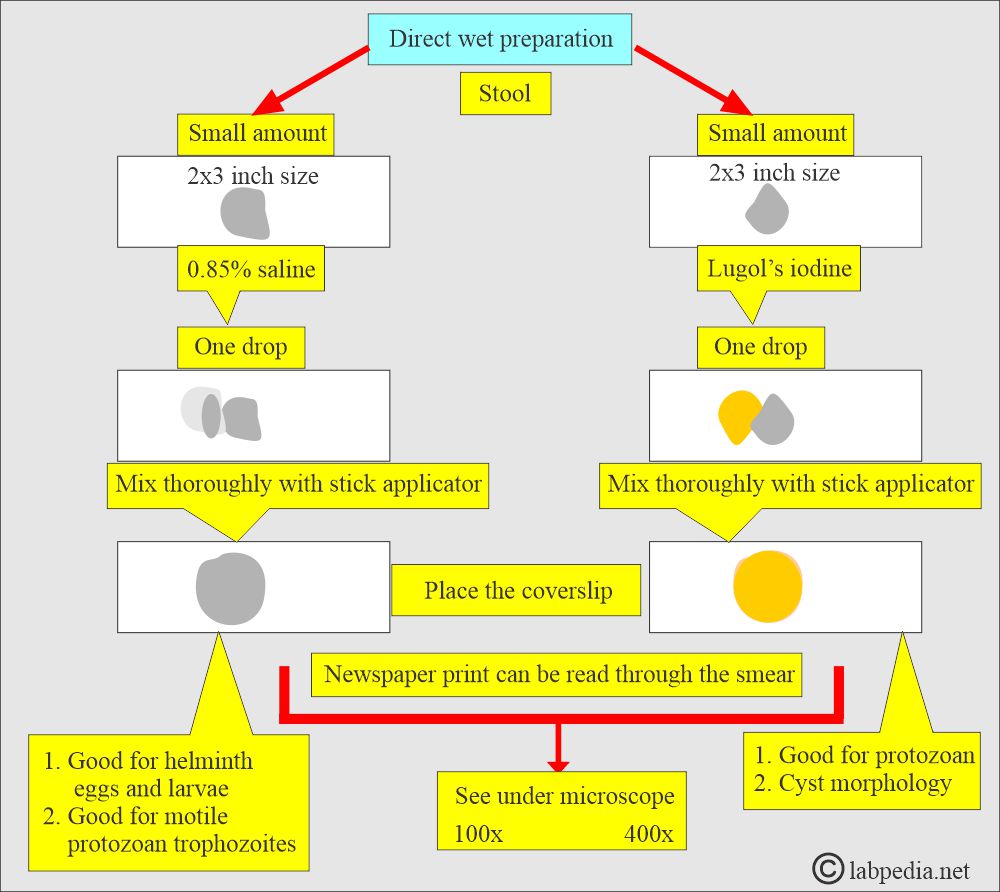
Lugol’s Iodine Solution: Stool wet preparation
What is the storage and shelf-life of Lugol’s iodine solution?
- Lugol’s iodine solution should be kept at room temperature and protected from light.
- If you keep this solution under these conditions, the shelf life is roughly 26 weeks.
- The shelf life of the working solution is approximately 3 to 4 weeks.
How will you interpret Lugol’s iodine-prepared stool slide?
- Lugol’s iodine will stain the cysts of amoebae and other protozoa.
- The iodine stain will show details that saline preparation cannot show.
- Trophozoites are rapidly killed by iodine and may not be identifiable.
- Most parasites get brown coloration when stained with Lugol’s iodine solution.
- When the stain is done correctly, you will see the following:
- Cyst contains yellow-gold cytoplasm.
- Brown glycogen material.
- Paler refractile nuclei.
- Protozoan cyst nuclei = Brown to golden brown, easily visible.
- Glycogen vacuoles = Deep brown.
- Glycogen mass = Brown.
- Yeast cells = Light brown.
- Plant cells = Brown.
- Starch granules = Dark blue, black
What are the advantages of Lugol’s iodine solution?
- It is simple and inexpensive.
- Rapid to read.
- It enhances identification of protozoan cysts.
- It is excellent for demonstrating glycogen.
What are the limitations of Lugol’s iodine solution?
- It will kill trophozoites, so their motility can not be assessed.
- When the stain is too concentrated, it will obliterate the details of the parasites.
- It is not an alternative to concentration methods.
- It is not suitable for permanent staining.
How will you compare the saline and Lugol’s iodine methods?
| Characteristic features | Lugol’s iodine method | Saline method |
|
|
|
|
|
|
|
|
|
|
|
|
|
|
|
|
|
|
Important note:
- When the iodine crystals disappear from the bottom of the bottle, the stock solution will no longer be usable.
- Now, you need to replace the working solution.
Questions and answers:
Question 1: What is the use of Lugol's iodine?
It will differentiate ova and cysts.
Question 2: What will happen to trophozoites by Lugol's iodine?
Trophozoites will be killed by the Lugol's iodine solution.
Please join our group to see updated topics: https://www.facebook.com/share/g/1F6boJmndo/
When the iodine crystals disappear from the bottom of the bottle, the stock solution is no longer to be used. Why ??? How strong is this solution ?
regards Paul Sz.
It looks the concentration of the solution will change.
What is the resulting percentage of the Lugol’s iodine in this protocol?
It is 5% as we add 5 grams into 100 mL.
Why iodine pellet are not completely dissolve despite adding potassium iodide
I think that is why filtration is advised.
Please, how do you preapare Gram’s iodine from the Lugol’s iodine stock solution?
I am on vacation. When reach home, then will try to find the reply to your question.
I am having trouble with the claim that adding 5 grams Iodine to 100ml water creates a 5% solution.
It should be 5 gms Iodine added to 95 mls water creates a 5% solution.
5 grams of Iodine added to 95 mls water creates a 100ml solution by weight, of which only 5% is Iodine.
Let’s suppose we add 100 gms Iodine to 100 mls water. Is that a 100% solution? No, it is 50%
25 gms Iodine added to 100 mls water creates 125 mls of liquid, of which 25 gms is Iodine – a 20% solution.
Therefore, 5 gms Iodine added to 100 mls water is (100/105) * 5, which is 4.762%
My premise is that 5 gms of iodine crystals has some volume. That volume contributes to the volume of the solution and must be taken into account when calculating the strength of the solution.
Thank you…
Thanks for the comments. But when you are preparing Lugol iodine solution, you need 5 grams of iodine powder.