
HealthFlex
×
  • Home
  • Immunology Book
  • Lab Tests
    • Hematology
    • Fluid analysis
    • CSF
    • Urine Analysis
    • Chemical pathology
    • Blood banking
    • Fungi
    • Immune system
    • Microbiology
    • Parasitology
    • Pathology
    • Tumor marker
    • Virology
    • Cytology
  • Lectures
    • Bacteriology
    • Liver
    • Lymph node
    • Mycology
    • Virology
  • Blog
    • Economics and technical
    • Fitness health
    • Mental health
    • Nutrition
    • Travel
    • Preventive health
    • Nature and photos
    • General topic
  • Medical Dictionary
  • About Us
  • Contact

General Health:- Part 1 – General health Check-Up, General fitness evaluation

March 19, 2026Chemical pathologyLab Tests

Table of Contents

Toggle
  • General Health Check-Up
        • What are the indications for a General Health Check-Up?
        • What are the tests needed for the body check-up?
        • What tests are included in a comprehensive metabolic panel?

General Health Check-Up

What are the indications for a General Health Check-Up?

  1. Whenever anyone wants a general body checkup as a preventive measure, the following tests may be advised to help rule out abnormalities in the body’s systems.
  2. This may be advised once a year for everybody.
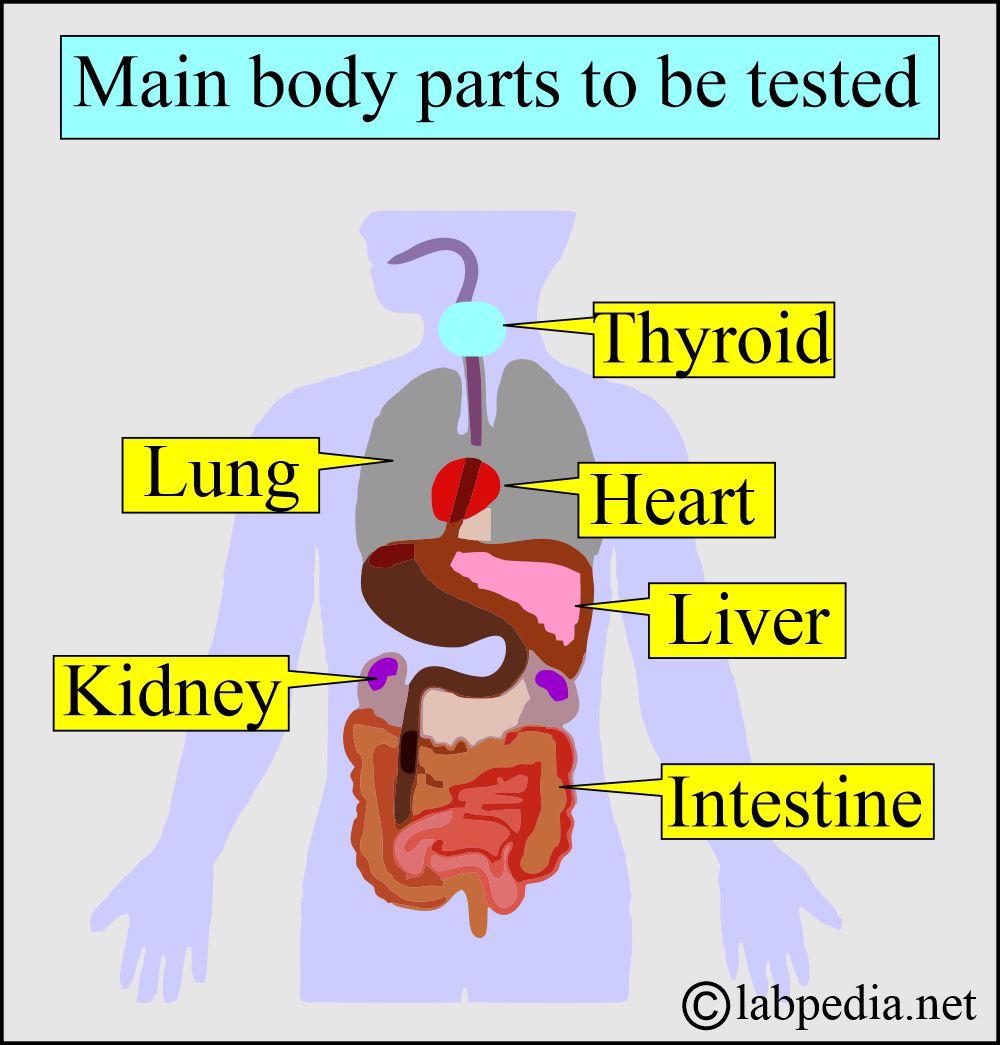
General health Check-Up: Main body parts to be tested

General Health Check-Up: Main body parts to be tested

What are the tests needed for the body check-up?

  1. Complete blood cell count (CBC) includes:
    1. Hemoglobin.
    2. Total leucocyte count.
    3. Differential count.
    4. Platelets count.
    5. Erythrocyte sedimentation rate (ESR).
      1. It will rule out anemias.
      2. Differentiate between acute and chronic infections.
      3. Diagnose leukemias.
  2. Urine complete examination:
    1. It is the most helpful test for detecting many bodily abnormalities.
    2. It is inexpensive, non-invasive, and quick.
    3. It can diagnose any kidney disease.
    4. It can diagnose diabetes mellitus.
  3. Fasting Lipid profile, which will include:
    1. Cholesterol.
    2. Triglyceride.
    3. LDL.
    4. HDL.
    5. VLDL.
    6. The lipid profile is essential for any risk of heart disease.
    7. Lipid profile abnormalities can be treated to prevent early heart problems.
  4. The metabolic panel includes :
    1. Fasting Glucose.
    2. Albumin.
    3. Calcium.
    4. Uric acid.
    5. LDH.
    6. These tests can diagnose diabetes mellitus.
    7. In the case of joint pain, uric acid will be raised.
    8. Albumin levels can help rule out any liver or kidney disease.
    9. An elevated LDH level will require further workup to identify any organ damage.
  5. Kidney functions include:
    1. Urea.
    2. Creatinine.
    3. Sodium.
    4. Potassium.
    5. A kidney function test will assess kidney damage.
    6. Needed in patients with chronic renal failure for follow-up.
  6. Liver functions include:
    1. SGPT.
    2. SGOT.
    3. Gamma- GT.
    4. An LFT can diagnose any liver injury.
    5. It can differentiate obstructive jaundice from jaundice due to liver injury.
  7. Thyroid functions include:
    1. T3.
    2. T4.
    3. TSH.
    4. Thyroid function will diagnose hypo or hyperthyroidism.
    5. Help in the management of goiter.
  8. X-Ray chest:
    1. It will rule out any lung disease like tuberculosis, Emphysema or any tumor infiltrate.
  9. Ultrasound abdomen:
    1. Rule out any organomegaly.
    2. It can find any stones in the kidneys or gallbladder.

What tests are included in a comprehensive metabolic panel?

  1. Glucose.
  2. Total protein.
  3. Albumin.
  4. Bilirubin.
  5. Blood Urea.
  6. Creatinine.
  7. Sodium.
  8. Potassium.
  9. Carbon dioxide.
  10. Chloride.
  11. Calcium.
  12. Alkaline phosphatase.
  13. SGOT.
  14. SGPT.
  15. To complete the health check-up, also add the following test:
    1. LDH.
    2. Uric acid.

How will you summarize the metabolic panel?

Metabolic panel tests What is the importance
  • Blood glucose
  • Diagnose diabetes mellitus
  • Calcium
  1. To evaluate bone
  2. To study nerve conduction
  3. To evaluate muscle function
  • Sodium
  • To evaluate the electrolyte balance
  • Potassium
  1. Given in heart diseases
  2. Help in muscle function
  • Blood urea (Urea nitrogen)
  • To evaluate the kidney function
  • Creatinine
  • To evaluate kidney function
  • Albumin
  1. To evaluate liver function
  2. To evaluate nutritional status
  • Total protein
  • To evaluate protein metabolism
  • Alkaline phosphatase
  1. To evaluate liver function
  2. To evaluate bone disorders


  • SGOT (AST)
  1. To evaluate liver cell injury
  2. To evaluate muscle injury
  • SGPT (ALT)
  • More helpful for liver cell injury
  • Bilirubin
  1. It can find hemolysis
  2. It can evaluate liver function
  • Carbon dioxide (CO2)
  • It is part of the electrolytes
  • Chloride (CL)
  • It is part of the electrolytes
  • Uric acid
  1. It evaluates joint pain
  2. It help in kidney stones
  • Lactate dehydrogenase (LDL )
  1.  It evaluates liver injury
  2. It is advised in tumors

Possible References Used
Go Back to Chemical pathology

Comments

Ricky Damale Reply
March 26, 2023

may acid po ako nahihirapan lng po ako sa pag inom ng tubig ano po dapat kong gawin

Dr. Riaz Reply
March 26, 2023

Please write the question in English.

Ricky Damale Reply
March 26, 2023

may acid po ako nahihirapan lng po ako sa pag inom ng tubig ano po dapat kong gawin

Rohit virmani Reply
August 29, 2023

Urgently Required this test

Dr. Riaz Reply
August 29, 2023

I could not understand your question.

Add Comment Cancel


The reCAPTCHA verification period has expired. Please reload the page.

  • Lab Tests
    • Blood banking
    • Chemical pathology
    • CSF
    • Cytology
    • Fluid analysis
    • Fungi
    • Hematology
    • Immune system
    • Microbiology
    • Parasitology
    • Pathology
    • Tumor marker
    • Urine Analysis
    • Virology

About Us

Labpedia.net is non-profit health information resource. All informations are useful for doctors, lab technicians, nurses, and paramedical staff. All the tests include details about the sampling, normal values, precautions, pathophysiology, and interpretation.

[email protected]

Quick Links

  • Blog
  • About Us
  • Contact
  • Disclaimer

Our Team

Professor Dr. Riaz Ahmad Bhutta

Dr. Naheed Afroz Syed

Dr. Asad Ahmad, M.D.

Dr. Shehpar Khan, M.D.

Copyright © 2014 - 2026. All Rights Reserved.
Web development by Farhan Ahmad.