
Fine needle aspiration Cytology (FNAC), Fine needle aspiration biopsy (FNAB)
Fine needle aspiration cytology (FNAC)
What are the sites from where you can take samples for Fine Needle Aspiration Cytology (FNAC)?
- FNA sample may be obtained from:
- All parts of the body:
- Lymph nodes.
- Breast.
- Liver.
- Respiratory tract.
- Oral cavity.
- Thyroid.
- Genital Tract.
- The most common sites are the breast, thyroid, and palpable lymph nodes.
- You can also classify the site for FNAC:
- Superficial organs:
- Breaast.
- Thyroid.
- Lymphnodes.
- Salivary glands.
- Deep organs:
- Liver mass.
- Lung mass.
- Retroperitoneal nodes.
- Pancreatic mass.
What are the benefits of Fine Needle Aspiration Cytology (FNAC)?
- FNAC is an inexpensive and less traumatic procedure.
- FNA has good results with ultrasound guidance for the Liver and other abdominal masses.
- FNA may be performed with a CT scan, mammogram, or ultrasound-guided biopsy.
What are the indications of Fine Needle Aspiration Cytology (FNAC)?
- FNA material gives a cytological diagnosis of benign or malignant lesions.
- FNA has excellent results in palpable lumps, such as breast or superficial masses.
- FNA material may be subjected to bacterial examination.
- FNA is recommended in areas suspected of cystic fluid, nodules, lumps, and enlarged lymph nodes.
How will you perform Fine needle aspiration cytology (FNAC)?
- This procedure is performed with or without local anesthesia, and 25-g needles are used to obtain a sample from the suspected mass. (Our experience is with 25 G needles, and we get adequate material. But most people use a 22/23 G needle.
- We made the smear and air-dried it before staining.
- In the routine, we use the Field stain.
- Also, we do not give negative pressure unless we see poor yield. Most of the time, enough material comes without any aspiration.
- After the procedure, separate the needle.
- Create negative pressure in the syringe and connect the needle.
- Push the material on the slide.
- Spread the material with another slide or with a cover glass.
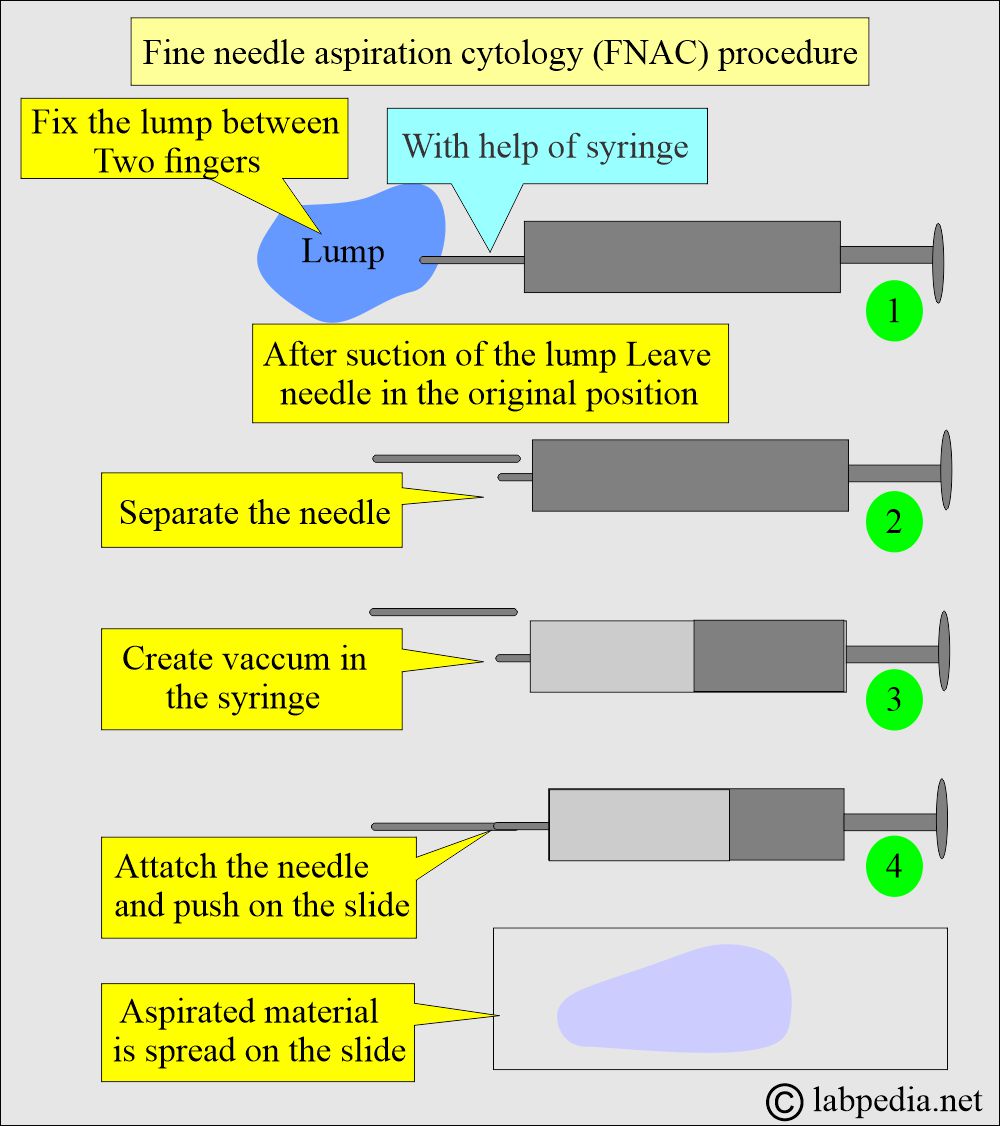
Fine needle aspiration Cytology (FNAC): FNA procedure
How will you do the Fine needle aspiration Cytology (FNAC) without the syringe suction?
- You can perform fine needle aspiration Cytology (FNAC) without a syringe.
- We perform fine-needle aspiration Cytology (FNAC) in most cases without a syringe.
- Our experience shows a very good yield.
- I have tried to show the procedure in the diagram.
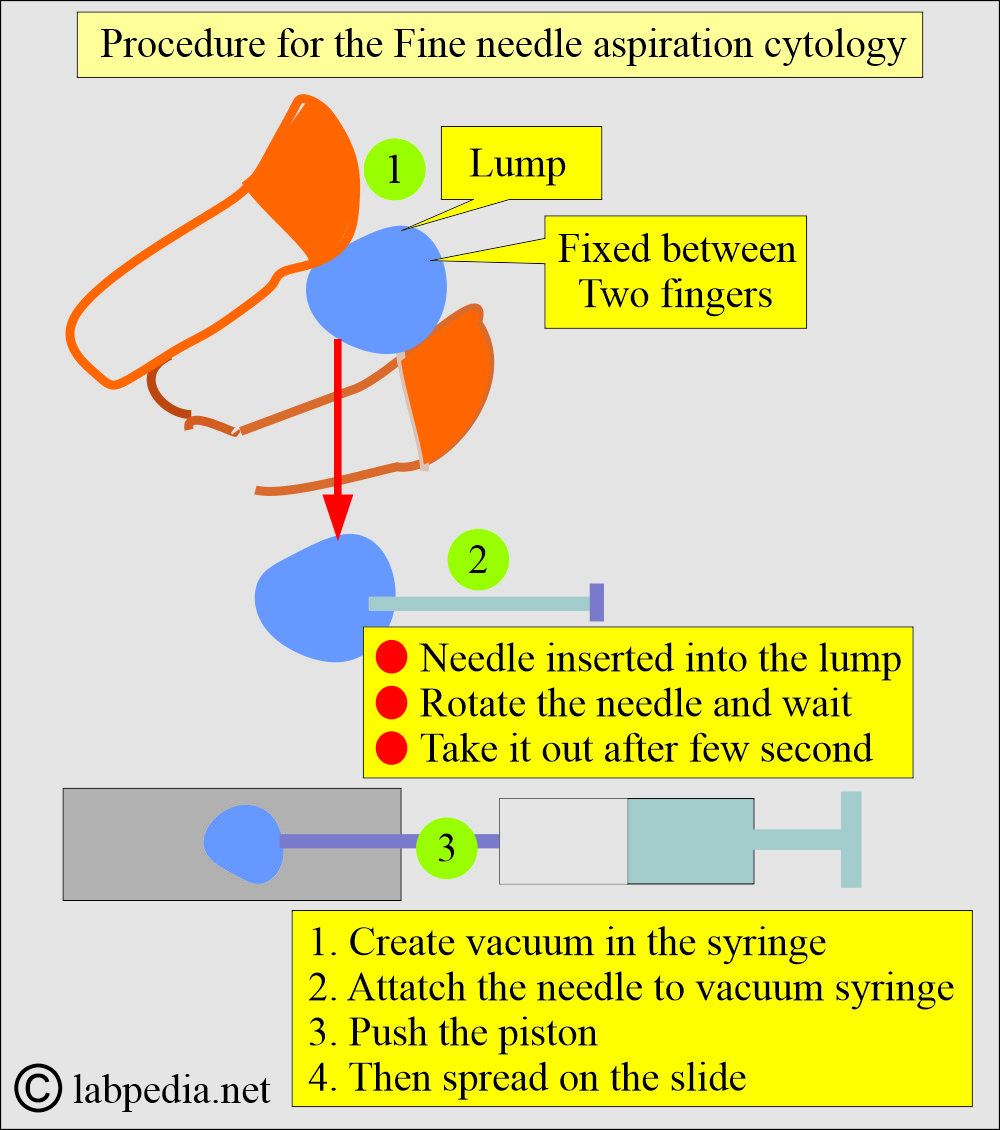
FNA procedure without a syringe
What is the significance of Fine Needle Aspiration Cytology (FNAB)?
- This is one of the best tools for diagnosing tumors in expert hands.
- FNA is a procedure to obtain diagnostic material for cytologic (Cells) study.
- FNA causes minimal trauma to the patient.
What are the advantages of Fine Needle Aspiration Cytology (FNAB)?
- It is economical.
- No anesthesia is required.
- No need for hospitalization.
- It is less painful.
- It is less invasive. No surgery is needed.
- It takes less time compared to a tissue biopsy.
- Results are satisfactory in the expert hands.
What are the medical benefits of Fine needle aspiration cytology (FNAC)?
- Diagnostic value: Cytopathologists can make the diagnosis of a lump as benign or malignant.
- Role of ultrasound: Ultrasound is a very helpful tool for mass in the liver or lungs. With ultrasonographic guidance, it can reach hidden masses.
- Treatment: By diagnosing the lesion, one can determine the line of action.
- Fine needle aspiration cytology (FNAC) can be used to aspirate cystic lesions, abscesses, or villous tissue.
How will you report Fine Needle Aspiration Cytology (FNAB)?
- The results can be reported as follows:
- Atypical.
- Suspicious of malignancy.
- Positive for malignancy.
- There are the following possibilities.:
- Infectious condition. There will be characteristic cellular components, such as poly, lymphocytes, and histiocytes.
- Benign conditions. There are characteristic benign cellular changes, such as uniform nuclei and a normal N/C ratio.
- Malignant conditions. The cellular changes are typical of malignancy, such as bizarre cellular appearance, altered N/C ratio, etc.
How will you report Thyroid FNAC?
- FNAs of the thyroid differentiate between thyroid cysts and tumors.
- It can be done with the help of an ultrasound.
- There is a Bethesda reporting system that classifies the results into 6 categories.
- Nondiagnostic or unsatisfactory.
- Benign lesion.
- Atypical or undetermined significance or follicular lesion of undetermined significance.
- Follicular lesion or suspicious for follicular neoplasm.
- Suspicious of malignancy.
- Malignant.
How will you report Breast FNAC?
- It is the aspiration of the breast mass for cytologic examination of the aspirated material.
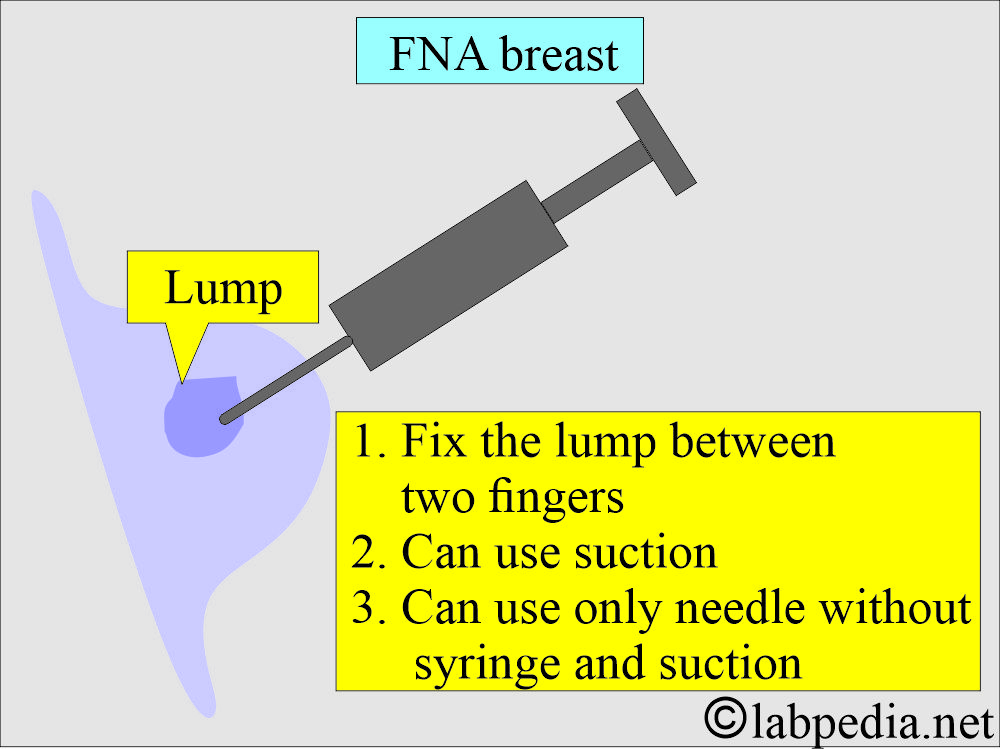
Fine needle aspiration cytology (FNAC) of the breast
How will you interpret the FNA breast result?
- It is about 1% false-positive results.
- There are 5% to 10% false-negative results.
- It gives good results in experienced hands.
- It will give good results to the experienced pathologist.
- If there is a fluid, that will indicate a cystic lesion.
- FNA will differentiate between benign and malignant smears.
- The FNA is reported as follows:
- Insufficient yield.
- There is a benign lesion.
- Atypical, probably a benign lesion.
- Suspicious, probably in situ, or invasive carcinoma.
- Malignant lesion.
Questions and answers:
Question 1: What is the best use of FNAC?
Question 2: What are the cytological features of malignancy?