
Fluid Analysis:- Part 1 – Body Fluids and Their Importance, Transudate and Exudate
Fluid Analysis
How will you define Fluids in various cavities of the body?
The significance of conducting Fluid Analysis is paramount in medical diagnostics, as it helps in understanding various health conditions.
- The fluid is secreted by the serous membranes lining the peritoneum, pleural and pericardial cavities.
- Literally, serous fluid means resembling serum.
What is the importance of fluid in the various cavities?
Fluid Analysis provides insights into disease processes by analyzing the composition of fluids in the body.
What is the role of Fluid Analysis in understanding body fluids?
Fluid Analysis is crucial for detecting abnormalities in bodily fluids that can indicate underlying medical issues.
-
- This serous fluid is found in the pleural, peritoneal, and pericardial cavities, which will lubricate the opposing parietal and visceral membrane surfaces.
- Inflammation or infection affecting the cavities causes fluid to accumulate.
Fluid Analysis allows healthcare providers to assess the health of patients based on the presence of pathogens or inflammatory markers in body fluids.
- Serous fluid is the ultrafiltrate of the plasma.
- The fluid formation depends upon the following factors:
-
- Hydrostatic pressure.
The results of Fluid Analysis can guide treatment decisions and improve patient outcomes significantly.
- Capillary permeability.
- Colloid osmotic pressure.
- Lymphatic drainage.
-
What are the types of body fluids and their normal quantity?
Understanding the results of Fluid Analysis can aid in identifying the types of fluids present and their implications for health.
-
- The pericardial cavity around the heart contains fluid, and the aspiration of the pericardial fluid is called pericardiocentesis.
- Normal pericardial fluid is 15 to 50 mL.
- Peritoneal or ascitic fluid is found in the abdomen. This is the effusion and accumulation of serous fluid in the abdominal cavity. Its aspiration is called paracentesis.
- Normal peritoneal fluid is 50 to 75 mL.
- Pleural cavity fluid was found in the chest. Aspiration is called thoracentesis.
- Normal pleural fluid is 10 to 20 mL.
- Gastric fluid is 1000 to 3000 mL/day.
- Bile is 300 to 1000 mL/day.
- Saliva is 500 to 1500 mL/day.
- Pancreatic fluid is 1000 to 1500 mL/day.
- Small intestinal fluid is 1000 to 2000 mL/day.
- Urine output is 500 to 1500 mL/day.
- Insensible loss through skin and lungs is 600 to 1000 mL/day.
- The pericardial cavity around the heart contains fluid, and the aspiration of the pericardial fluid is called pericardiocentesis.
Fluid Analysis is essential for monitoring patients with chronic conditions that affect bodily fluids.

Fluid Analysis: Fluids’ various sites
What are the normal body fluids and their quantities?
| Fluid site | Quantity Produced |
|
|
Fluid Analysis can differentiate between various types of fluids, assisting in accurate diagnosis. |
|
|
|
After a Fluid Analysis, clinicians can formulate a treatment plan tailored to the patient’s needs. |
|
|
|
A comprehensive Fluid Analysis can reveal critical information about electrolyte balances and organ function. |
|
|
|
Regular Fluid Analysis can help in early detection of diseases, which is key to successful treatment. |
|
|
|
Understanding the results of Fluid Analysis can empower patients by informing them about their health status. |
|
|
|
Fluid Analysis is also used in research settings to investigate fluid dynamics in various health conditions. |
|
|
|
|
|
Serous fluid:
Furthermore, the outcomes of Fluid Analysis can help in predicting patients’ responses to certain therapies.
What are the normal findings of serous fluids?
Effective Fluid Analysis can streamline patient care by providing rapid insights into fluid-related issues.
| Parameters | Characteristic features |
|
|
|
|
|
|
|
|
|
|
|
|
|
|
What are the normal Ascitic fluid findings?
| Parameters | Characteristic features |
|
|
|
|
|
|
|
|
|
|
|
|
|
|
|
|
|
|
|
|
|
|
Transudate:
What are the characteristic features of Transudate?
What is the mechanism of transudate formation?
- It is the fluid that accumulates as ultrafiltrate and is called Transudate.
- The capillary pore can allow the passage of proteins with molecular Weights of 200,000 to 300,000 daltons.
- The larger molecular weight proteins are held back and can not cross the basement membranes.
- Transudate accumulates due to increased hydrostatic pressure in the capillaries.
- The fluid is low in protein as compared to plasma.

Transudate mechanism
What are the features of Transudate?
| Parameters | Values |
|
|
|
|
|
|
|
|
|
|
Exudate:
What are the characteristic features of Exudate?
What is the mechanism of exudate formation?
- Fluid accumulates due to injury to the membranes caused by infection or inflammation.
- The damaged membranes allow larger protein molecules to pass.

Exudate mechanism
What are the features of Exudate?
| Parameters | Values/Findings |
|
|
|
|
|
|
|
|
|
|
What are the types of exudates?
- Serous.
- Fibrinous.
- Serofibrinous.
- Purulent.
- Putrid.
- Chylous.
- Serosanguinopurulent.
How will you differentiate between Transudate and Exudate?
| Parameter | Transudate | Exudate |
|
|
|
|
|
|
|
|
|
|
|
|
|
|
|
|
|
|
|
|
|
|
|
|
|
|
|
|
|
|
|
|
|
|
|
|
|
|
|
|
|
|
|
|
|
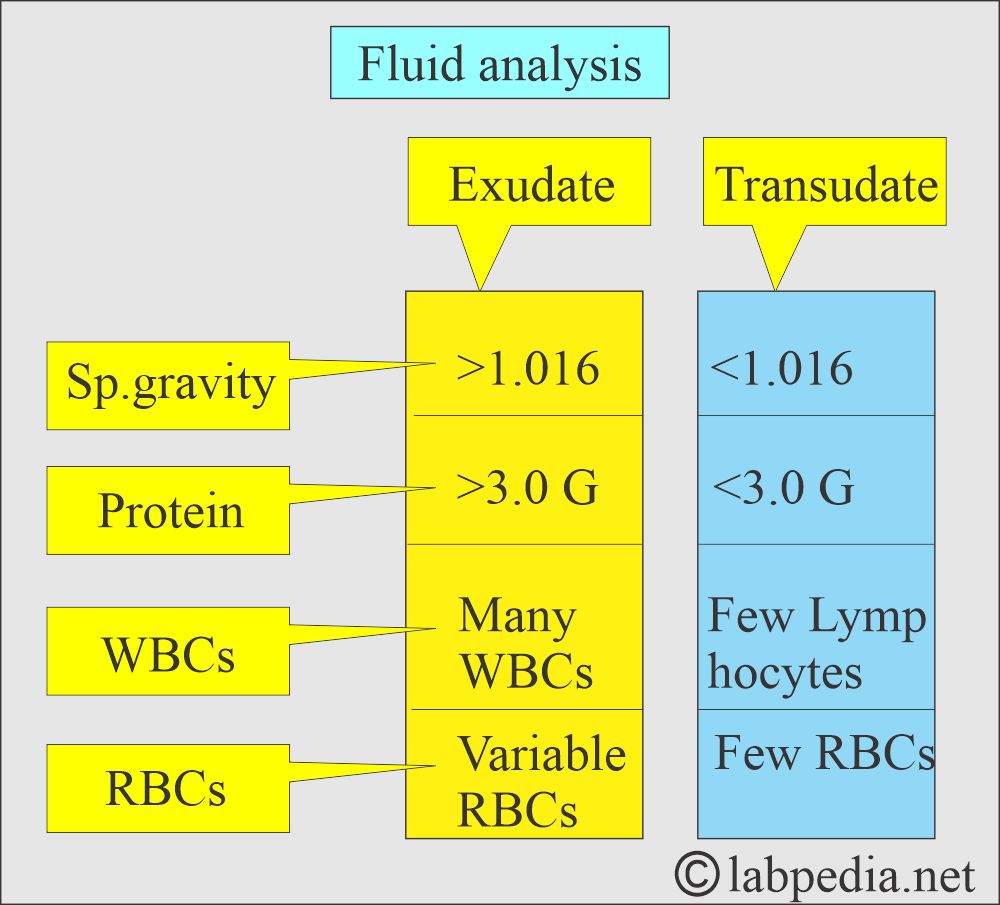
Fluid exudate/transudate difference
we have problem in large in our hospital there is no common job aid for analysis body fluid . would have job aids for routine analysis body fluids
You can follow labpedia.net.