
Estrogen/Progesterone Receptor Assay (ER/PR Receptor Assay)
Estrogen/Progesterone Receptor Assay
What sample is needed for the Estrogen/Progesterone Receptor Assay?
- Breast cancer tissue blocks are needed.
- Fresh tumor cells to get slices of cytoplasm (Cytosol).
What are the Indications for the estrogen/progesterone receptor assay?
- ER is done on the breast cancer tissue to evaluate the hormone response.
- ER also indicates the prognosis.
What are the reasons for False-negative ER receptors?
- Incorrect handling and storage of tissue samples lead to degradation of thermolabile receptor proteins.
- If the protein concentration in the sample being assayed is low.
- If a biopsy is taken from the surrounding normal tissue.
How will you describe the Pathophysiology of the Estrogen/Progesterone Receptor Assay?
- The estrogen receptor is a specific cellular protein with high affinity and specificity for the Estrogen hormone.
- The estrogen receptor protein is found in target tissues such as the breast, uterus, pituitary gland, and hypothalamus.
- Estrogen stimulates the cells through the Estrogen receptor.
- A reduction in the blood estrogen level reduces the biochemical activity of these cells.
- This is the basis for the treatment of breast cancer by anti-hormone therapy.
- ER-positive breast cancer is twice as responsive as ER-negative cases.
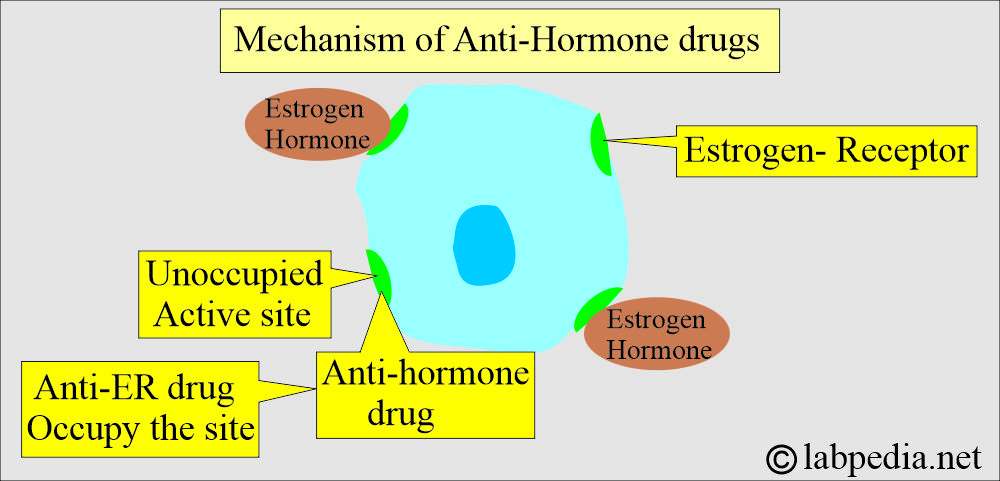
Estrogen Receptor Assay: Estrogen hormone therapy mechanism
- Postmenopausal women’s breast cancers are more ER-positive than those of young women.
- ER-positive tumors have a better prognosis than ER-negative cases.
- More than 50% of ER-positive cases respond to anti-hormone therapy (Tamoxifen).
- In metastatic carcinoma of the breast, 1/3 of the women have various types of endocrine therapy directed at lowering their estrogen level, e.g.
- Oophorectomy.
- Hypophysectomy.
- Adrenalectomy (ablation therapy).
- Anti-estrogen and androgen (additive therapy).
What is the significance of the ER/PR receptor?
- PR receptor is useful for assaying ER receptors.
- Metastatic cancer with ER and PR receptor-positive tumors has a response rate of 75% to endocrine therapy.
- If the ER-positive and PR-negative tumors have a 40% response rate.
- If the ER-negative and PR-positive patients’ only response rate to endocrine therapy is 25%.
- In cases where ER and PR are negative, the response rate is only 5%.
- The percentage of positive cases in postmenopausal women is more significant than in premenopausal women.
| Hormone receptor | ER | PR | Response to the treatment |
|
|
|
|
|
|
|
|
|
|
|
|
|
|
|
|
What are the procedures for Estrogenprogesteron Receptor Assay Detection?
- Mostly, ER testing is performed on cancer tissue (paraffin blocks) using immunohistochemistry.
- Another method can be an enzyme immunoassay.
- Chromatography techniques.
- EIA.
What is the normal estrogen/progesterone receptor assay (tissue)?
- Negative = <3 fmol/mg cystosol protein.
- Borderline = 3 to 9 fmol/mg cytosol protein.
- Positive = >10 fmol/mg cytosol protein.
How will you interpret immunocytochemistry slides for ER/PR?
- Negative = <5 % of the nuclei of the cells for the receptors.
- Positive = >5 % of the nuclei of the cells stain for the receptors.
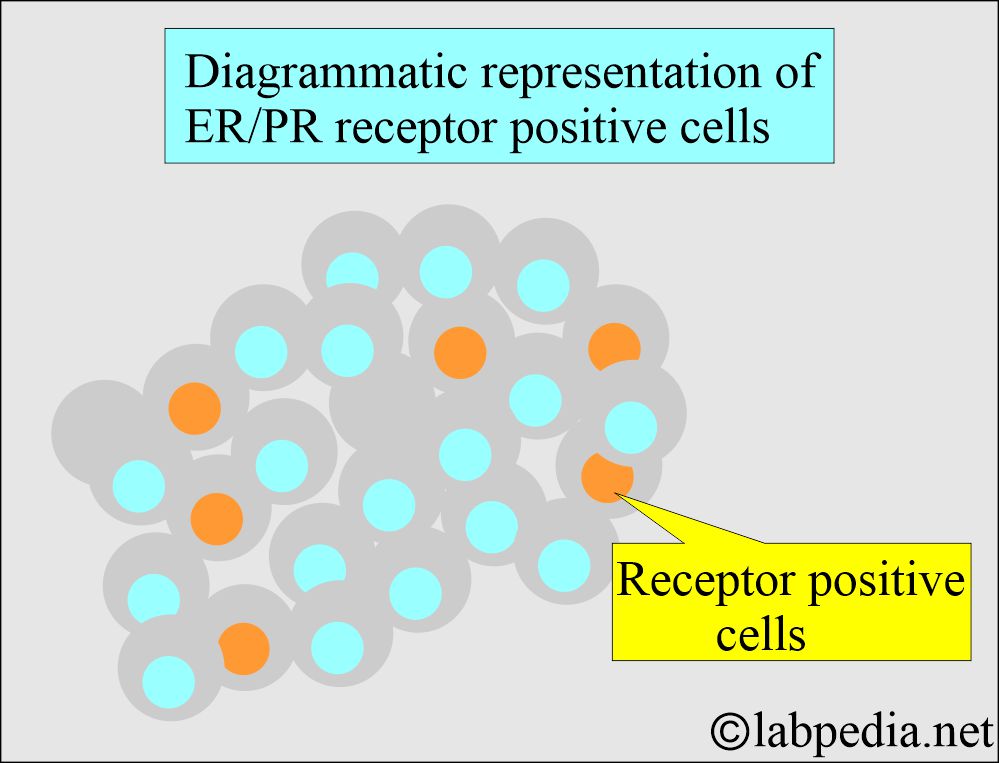
Estrogen Receptor Assay: ER/PR positive cells demonstration
What is ER/PR positivity?
- Carcinoma of the breast (60%) shows positivity.
- Approximately 2/3 of the cases show a response to hormone therapy.
- In ER-negative cases, 90% do not respond to hormone therapy.
- The hormone receptor positivity varies in different patients:
- ER+ = 80% of the cases.
- ER+ PR+ = 65% of the cases.
- ER+ PR– = 13% of the cases.
- ER– PR+ = 2% of the cases.
- ER– PR– = 25% of the cases.
How will you interpret ER/PR positivity?
- Favorable response >20% cell stain.
- The borderline response is 11% – 20% of the cell stain.
- The unfavorable response is <10% cell stain.
- ASCO guidelines are:
- Positive for ER/PR if ≥ 1% of the tumor cell nuclei are immunoreactive.
- Negative ER/PR if <1% of tumor cell nuclei are immunoreactive.
- Allred scoring: This replaced the early scoring system.
- ER-positive tumor cells have >10% positive cells.
- ER-negative tumor cells are 1% – 9% positive.
How will you score the tumor cells?
| Score | Positive cells % | Intensity | Intensity score |
|
|
|
|
|
|
|
|
|
|
|
|
|
|
|
|
|
|
||
|
|
- Progesterone receptors (PRs) should be tested alongside ER. Because PR depends upon estrogen activity.
- PR positivity confirms that all ER steps were performed correctly.
- When ER/PR is positive, the tumor response to treatment is 75%.
Response to anti-hormone therapy
| ER | PR | Response to hormones |
|---|---|---|
|
|
|
|
|
|
|
|
|
|
|
|

Estrogen/Progesterone Receptor Assay: The brown color indicates a positive reaction (ER-positive cells)
Questions and answers:
Question 1: What is the criteria of ASCO guidelines?
Question 2: What is the response of anti-hormone therapy, in case of ER/PR positive cases?