
Gastrin, Zollinger-Ellison Syndrome
Gastrin Level
What sample is needed for Gastrin Level?
- Collect the venous blood to prepare the serum.
- A fasting sample is taken (at least for 12 hours of fasting).
- If the patient is not fasting, then the values will be different.
- The lowest values are between 3.00 a.m. and 7.00 a.m.
- Freeze the sample if the test is not done immediately.
What are the Indications for Gastrin Level?
- Gastrin level is measured in hyperacidity.
- It is done to diagnose Zollinger-Ellison syndrome.
- This test also diagnoses G-cell hyperplasia.
- It is done to diagnose gastrinoma.
What precautions are needed for the Gastrin Level?
- A high-protein diet can increase gastrin levels 2 to 5 times the normal level.
- Diabetic patients on insulin may show a falsely elevated gastrin level.
- Patients with stomach surgery will have an alkaline pH, a strong stimulant to gastrin.
- Drugs like antacids, H2-blockers (cimetidine, ranitidine), and proton pump inhibitors (Omeprazole) will increase gastrin levels.
- Anticholinergic and tricyclic antidepressant drugs decrease the gastrin level.
- Avoid alcohol for at least 24 hours.
How will you define Gastrin?
- Gastrins are a group of peptide hormones secreted by the G-cells of the antrum of the stomach, and these are powerful inducers of the gastric secretion of HCL.
- Food in the stomach produces Gastrin secretion in response to mechanical stress or high pH.
- Gastrin stimulates parietal cells to produce HCL.
How will you describe normal gastrin physiology?
- When food enters the stomach, it changes pH to alkaline.
- This alkaline pH stimulates gastrin secretion, which stimulates acid production by parietal cells.
- Now, low pH stops further production of Gastrin.
- Secretion of gastrin:
- Maximal at an antral pH of 5 to 7.
- Reduced by 80% at a pH of 2 to 5.
- Inhibited at a pH of 1.
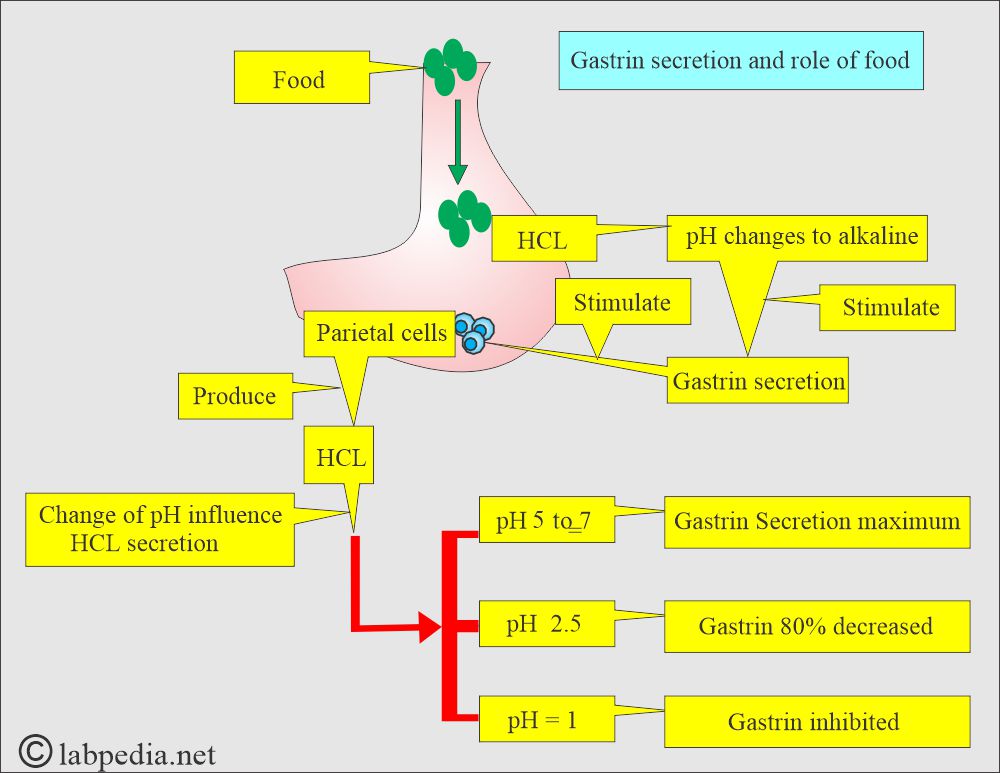
Gastrin control mechanism
- Zollinger-Ellison syndrome is a gastrin-producing tumor of pancreatic origin with a high serum level of gastrin.
- Zollinger-Elison syndrome is due to non-beta-cell tumors of the pancreas, which produce a large amount of gastrin.
- G-cell hyperplasia leads to high serum gastrin levels.
- Both conditions lead to an aggressive peptic ulcer.
- Gastrin level will be normal in routine peptic ulcer evaluation.
- The patient on antacid therapy or with atrophic gastritis has elevated gastrin levels.
- A gastrin stimulation test is done by giving calcium or secretin.
What are the stimuli of the Gastrin secretion?
- Partially digested food.
- Alcohol and caffeine.
- Insulin-induced hypoglycemia.
- The smell of food, swallowing, and chewing.
- Calcium.
- Amino acids like glycine, tryptophan, and phenylalanine.
- Pancreatic islet tumors (non-β cells) produce large amounts of gastrin.
- Gastrin values follow a circadian rhythm and fluctuate physiologically in response to meals.
How will you discuss the pathophysiology of Gastrin?
- Gastrin is a hormone produced by:
- Pancreatic delta cells.
- Duodenal G-cells.
- Stomach mucosa’s antral cells (G-cells).
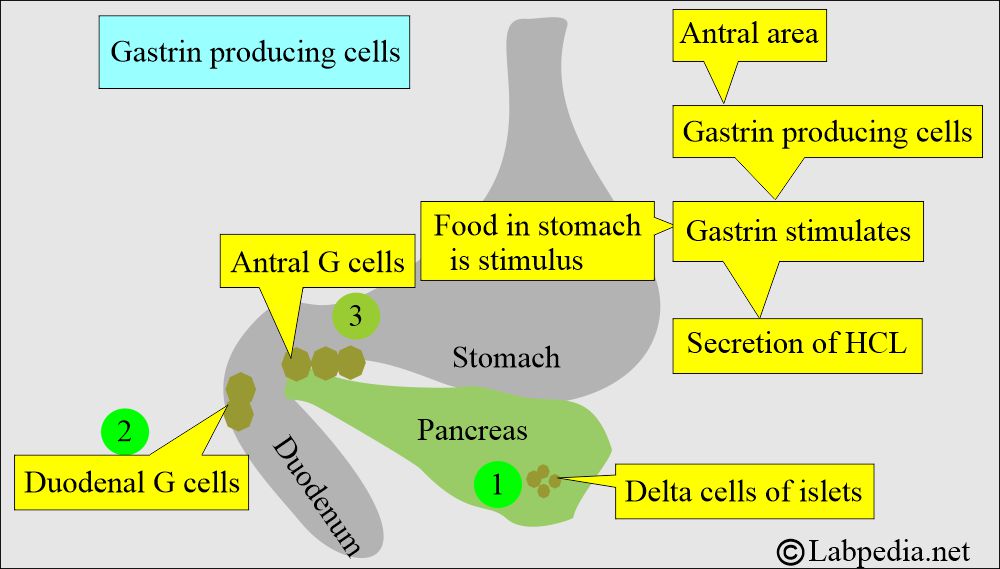
Gastrin-producing cells
What are the types of Gastrin?
- There are different forms of gastrin as biologically active forms that differ only in the length of the chain of the N-terminal end, such as:
- Small gastrin has 17 amino acids polypeptide (little gastrin G17).
- Big gastrin comprises 34 amino acid polypeptides (Big gastrin G34).
- Mini gastrin has 14 amino acids (G14).
- Little and big gastrin are found in the gastric antrum and duodenum.
- Gastrin stimulates gastric acid secretion, pepsinogen, intrinsic factor, and secretin, stimulates intestinal mucosal growth, and increases gastric and intestinal motility.
- Gastrin is produced from pregastrin, which has 101 amino acids and is cleaved into gastrin.
- Gastrin from the three sources enters circulation and then reaches the liver.
- The liver stimulates parietal cells to produce hydrochloric acid (HCl).
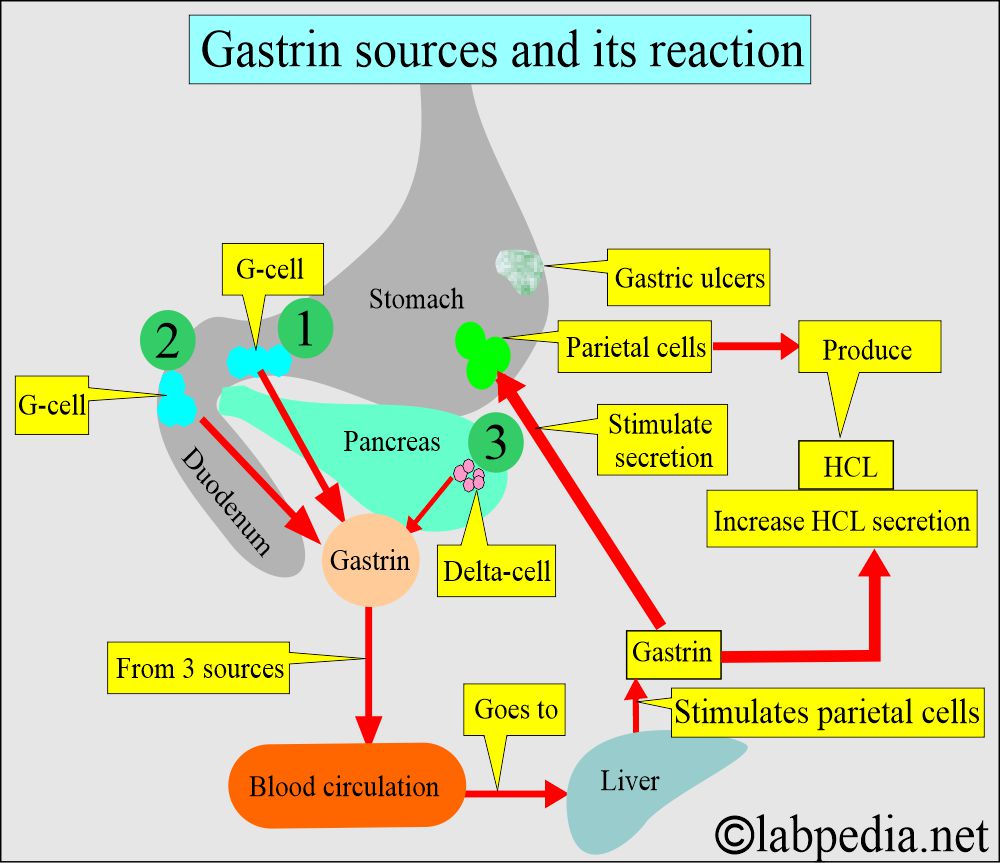
Gastrin sources and action on parietal cells
How will you interpret gastrin action?
- Gastrin is in the normal range for peptic ulcers without Zollinger-Ellison syndrome.
| Clinical presentation | Intragastric administration of 0.1 N HCL | Serum gastrin level |
| Peptic ulcer without Zollinger-Ellison syndrome | Normal | |
| Zollinger- Ellison syndrome | No change | Highly raised |
| Pernicious anemia | Marked decrease | Raised may reach the Zollinger-Ellison syndrome level |
How will you describe the Gastrin functions:
- Stimulates gastric acid production (potent stimulator).
- Gastrin overproduction causes ulcers in the upper gastrointestinal tract.
- Regulate antral motility.
- Control secretion of pepsin.
- Control secretion of intrinsic factors.
- Secretion from the intestinal mucosa.
- Stimulate hepatic bile secretion.
- Secretion of pancreatic HCO3- and enzymes.
- Gastrin increases:
- Gastric Motility.
- Intestinal motility.
- Mucosa growth.
- Blood flow to the stomach.
- Gastrin secretion has diurnal variation.
- Its lowest value is 3 a.m. to 7 a.m.
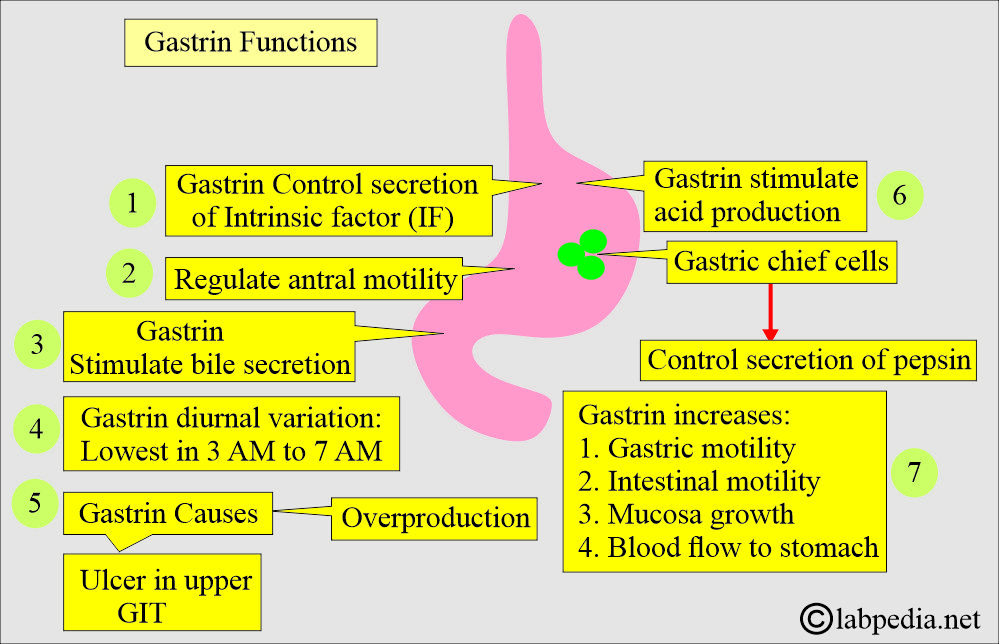
Gastrin functions
What is the normal Gastrin Level?
Source 1
| Age | pg/mL |
|
|
|
|
|
|
|
|
|
|
Source 2
- Adult = 0 to 180 pg/mL or 0 to 180 ng/L.
Source 6
- Adult = 0 to 180 pg/mL (0 to 180 ng/L).
- Child = 0 to 125 pg/mL.
- Levels are higher in elderly patients.
Source 4
- Adult = <25 to 100 pg/mL (<12 to 48 pmol/L)
- Children = 10 to 125 pg/mL (5 to 60 pmol/L)
- Postprandial = 95 to 140 pg/mL (46 to 67 pmol/L)
Another source
- Children = 10 to 125 pg/mL.
- Postprandial = 95 to 140 pg/mL.
- Levels are higher in elderly patients.
Another source
- Child = <10 to 125 pg/mL
- Adult 16 to 60 years = 25 to 90 pg/mL.
- Over 60 years = <100 pg/mL.
What will be the Gastrin Level in various diseases?
| Gastrin level | Causes (Interpretations) |
|
|
|
|
|
|
|
|
What are the conditions where the gastrin level is increased?
- Zollinger-Ellison syndrome.
- G-cell hyperplasia.
- Atrophic gastritis.
- The retained antral portion after gastric surgery.
- Gastric carcinoma.
- Pyloric obstruction (gastric outlet obstruction)
- Gastric and duodenal ulcer.
- Chronic renal failure.
- Pernicious anemia.
- Vagotomy without gastric resection.
- Hyperparathyroidism.
What are the conditions where the gastrin level is decreased?
- Hypothyroidism.
- Anterectomy with a vagotomy.
Zollinger-Ellison syndrome
How will you define Zollinger-Ellison syndrome?
- This is a disorder of autonomous gastric acid hypersecretion caused by the gastrin-secreting tumor.
- This gastrin production may be due to non-β-cell tumors often present in the pancreas.
- Tumors are malignant in 50% of the cases, and 34% have metastatic disease.
- Hyperplasia only occurs in 10% of cases.
How will you discuss the pathophysiology of Zollinger-Ellison syndrome?
- This is a gastrin-producing pancreatic tumor.
- Non-beta cell tumors of the pancreas produce excessive gastrin.
- G-cell hyperplasia of the stomach can also be seen in Zollinger-Ellison syndrome.
- The patient has aggressive peptic ulcer disease.
- These patients have recurrence and complications.
How will you describe the signs and symptoms of Zollinger-Ellison syndrome?
- These patients have multiple ulcers in the antrum, duodenum, and jejunum.
- The ulcers are multiple.
- There is abdominal pain.
- There is burning and discomfort in the upper abdomen.
- There are acid reflux and heartburn.
- The patient may have diarrhea.
- The patient may have nausea and vomiting.
- The patient may have GI tract bleeding.
- The patient may have weight loss and decreased appetite.
- The gastrin level is normal in routine peptic ulcers.
- The gastrin level is normal in routine peptic ulcer disease, while it is high in Zollinger-Ellison syndrome and G-cell hyperplasia.
- Patients on antacid or peptic ulcer disease medications, those with atrophic gastritis, and those who have undergone peptic ulcer surgery have slightly elevated gastrin levels.
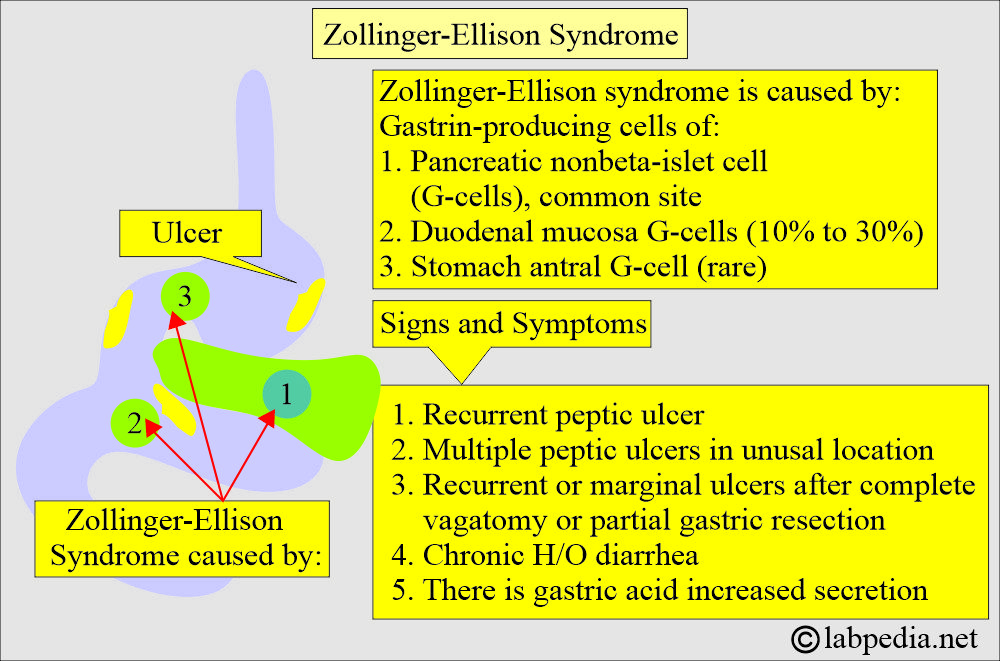
Gastrin level: Zollinger-Ellison syndrome origin and signs/symptoms
How will you diagnose Zollinger-Ellison syndrome?
- Gastrin assay is the method of choice.
- Most patients have fasting gastrin levels >500 pg/mL or >500 ng/L (elevated in>95% of cases).
- The gastrin level may reach 400,000 pg/mL.
- Gastrin level may be >5 times the normal value (1,000 pg/mL or 1,000 ng/L). This value is diagnostic.
- 90% of the Zollinger-Ellison syndrome patients have borderline fasting gastrin levels of 100 to 500 pg/mL.
- Advise Gastrin stimulation test using calcium infusion or secretin.
- It is advised that, when the fasting level is <1,000 pg/mL (1,000 ng/L), this be used to assist in differentiating from other conditions.
- In response to the secretin stimulation test, these patients will increase by 100 pg/mL above the baseline.
- The secretin test has greater sensitivity and simplicity.
- Normal individuals and patients with duodenal ulcers show no increase in serum gastrin levels.
- Patients with Zollinger-Ellison syndrome have elevated serum gastrin levels, and the peak usually occurs at 45 to 60 minutes (>400 pg/mL).
- When a calcium infusion test is performed, patients with gastrinoma have similar results.
- Calcium gluconate 5 mg/Kg body weight is given.
- The pre-infusion level and the post-injection results are compared.
- Blood samples are taken every 30 minutes for up to 4 hours.
- It is advised when the secretin stimulation test is negative in suspected cases of Zollinger-Ellison syndrome.
- Patients with Zollinger-Ellison syndrome show a gastrin level >400 pg/mL in 2 to 3 hours.
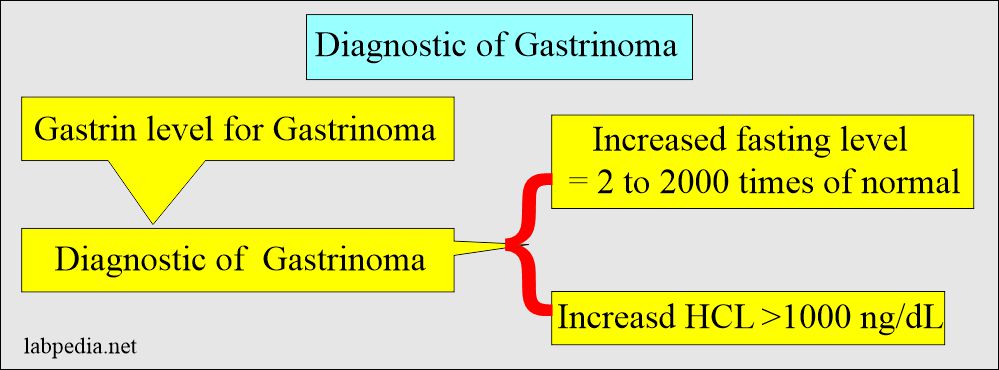
Gastrin level in gastrinoma
- Gastrin stimulation test to diagnose Zollinger-Ellison syndrome:
- Secretin stimulation test:
- Give 2 units/Kg body weight (IV bolus).
- Estimate Gastrin level at baseline, 2, 5, 10, 15 minutes.
- Get >200 pg/mL (200 ng/L)over the baseline.
- Positive results were seen in 87% to 100% of Zollinger-Ellison syndrome.
- Calcium infusion test:
- Give calcium gluconate 10% as 5 mg/Kg/hour for 3 hours.
- Check gastrin as baseline, post-dose 120, 150, and 180 minutes.
- An increase >395 pg/mL (395 ng/L) occurs in 95% of Zollinger-Ellison syndrome.
- An increase of >3 times the baseline is seen in 85% of the cases.
- Response to the Calcium infusion test is less specific than a response to the secretin test.
Gastrinoma
How will you define Gastrinoma?
- Gastrinoma is a tumor that produces excessive gastrin and leads to very high gastric acid secretion.
- This is a neuroendocrine tumor and is most commonly found in the pancreas or duodenum.
What are the common locations of Gastrinoma?
- Duodenum.
- Pancreatic head.
- Peripancreatic lymph nodes.
What are the signs and symptoms of Gastrinoma?
- There is a tumor that leads to increased gastrin.
- Gastrin leads to increased HCL secretion.
- Increased HCL leads to multiple peptic ulcers.
- These ulcers are resistant to treatment.
- Gastrinoma leads to Zollinger-Ellison syndrome.
- There is abdominal pain.
- The patient may have GERD.
- There is chronic diarrhea.
How will you diagnose the Gastrinoma?
- Serum gastrin level is very high (>1000 pg/mL).
- Gastric pH is very low (hyperacidity).
- The secretin secretion test increases the gastrin level.
- Advise imaging to locate the tumor.
How will you treat the Gastrinoma?
- Proton pump inhibitors decrease the acid.
- Surgery is performed when you locate the tumor, and it is single.
- Chemotherapy.
How will you differentiate Gastrinoma and a peptic ulcer?
| Peptic ulcer | Gastrinoma (Zollinger-Ellison syndrome) | |
|
|
|
|
|
|
|
|
|
|
|
|
|
|
|
|
|
Poor with standard treatment |
|
|
|
|
|
|
Questions and answers:
Question 1: What are the functions of gastrin?
Gastrin stimulates acid production. Control secretion of pepsin.
Question 2: What is the source of Gastrin?
It is G-cells of the stomach antral mucosa G-cells, Duodenal G-cells, and Pancreatic delta cells.
Good lecture
Thanks.